<?xml version="1.0" encoding="UTF-8"?><feed
	xmlns="http://www.w3.org/2005/Atom"
	xmlns:thr="http://purl.org/syndication/thread/1.0"
	xml:lang="en"
	>
	<title type="text">Ed Rempel</title>
	<subtitle type="text">Insights From Experience on Building Financially Security</subtitle>

	<updated>2026-09-29T14:44:49Z</updated>

	<link rel="alternate" type="text/html" href="https://edrempel.com/" />
	<id>https://edrempel.com/feed/atom/</id>
	<link rel="self" type="application/atom+xml" href="https://edrempel.com/feed/atom/" />

	<generator uri="https://wordpress.org/" version="7.1.2">WordPress</generator>
<icon>https://edrempel.com/wp-content/uploads/2016/03/cropped-Ed-Rempel-LOGO-512-1-32x32.jpg</icon>
	<entry>
		<author>
			<name>Ed Rempel</name>
							<uri>https://edrempel.com</uri>
						</author>

		<title type="html"><![CDATA[How to Make Financial Decisions When You Don’t Feel Ready]]></title>
		<link rel="alternate" type="text/html" href="https://edrempel.com/how-to-make-financial-decisions-when-you-dont-feel-ready/" />

		<id>https://edrempel.com/?p=7183</id>
		<updated>2026-09-29T14:44:49Z</updated>
		<published>2026-09-29T14:30:21Z</published>
		<category scheme="https://edrempel.com/" term="Podcasts" /><category scheme="https://edrempel.com/" term="Youth Corner" /><category scheme="https://edrempel.com/" term="YouTube" /><category scheme="https://edrempel.com/" term="Career &amp; Money" /><category scheme="https://edrempel.com/" term="FHSA" /><category scheme="https://edrempel.com/" term="Financial Decisions" /><category scheme="https://edrempel.com/" term="Financial Literacy" /><category scheme="https://edrempel.com/" term="financial planning" /><category scheme="https://edrempel.com/" term="Home Buying" /><category scheme="https://edrempel.com/" term="Investing" /><category scheme="https://edrempel.com/" term="Personal Finance" /><category scheme="https://edrempel.com/" term="TFSA" />
		<summary type="html"><![CDATA[<p>A practical guide to making your first big money choices without waiting for perfect confidence. THE CORE IDEA Readiness is not a feeling you have to wait for. A good financial decision is one where you understand the trade-offs, can afford the downside, and have room to adjust if life changes. Some of the biggest&#8230;</p>
<p>The post <a href="https://edrempel.com/how-to-make-financial-decisions-when-you-dont-feel-ready/">How to Make Financial Decisions When You Don’t Feel Ready</a> appeared first on <a href="https://edrempel.com">Ed Rempel</a>.</p>
]]></summary>

					<content type="html" xml:base="https://edrempel.com/how-to-make-financial-decisions-when-you-dont-feel-ready/"><![CDATA[
<figure class="wp-block-embed is-type-video is-provider-youtube wp-block-embed-youtube wp-embed-aspect-16-9 wp-has-aspect-ratio"><div class="wp-block-embed__wrapper">
<iframe title="Investing, Buying a Home or Changing Jobs? Ask These 5 Questions First" width="500" height="281" src="https://www.youtube.com/embed/eErtOhrNI3g?feature=oembed" frameborder="0" allow="accelerometer; autoplay; clipboard-write; encrypted-media; gyroscope; picture-in-picture; web-share" referrerpolicy="strict-origin-when-cross-origin" allowfullscreen></iframe>
</div></figure>


<iframe title="Embed Player" style="border:none" src="https://play.libsyn.com/embed/episode/id/43071898/height/192/theme/modern/size/large/thumbnail/yes/custom-color/008080/time-start/00:00:00/hide-playlist/yes/download/yes/font-color/FFFFFF" height="192" width="100%" scrolling="no" allowfullscreen="" webkitallowfullscreen="true" mozallowfullscreen="true" oallowfullscreen="true" msallowfullscreen="true"></iframe>


<p class="wp-block-paragraph">A practical guide to making your first big money choices without waiting for perfect confidence.</p>


<figure class="wp-block-table"><table class="has-fixed-layout"><tbody><tr><td><strong>THE CORE IDEA</strong> Readiness is not a feeling you have to wait for. A good financial decision is one where you understand the trade-offs, can afford the downside, and have room to adjust if life changes.</td></tr></tbody></table></figure>


<p class="wp-block-paragraph">Some of the biggest money decisions arrive before you feel qualified to make them. Your first investment. A job offer. Moving out. Buying a car. Deciding whether home ownership belongs in your near-term plan.</p>


<p class="wp-block-paragraph">The uncomfortable part is that there is rarely a moment when every variable lines up and someone hands you a certificate that says, “You are officially ready.”</p>


<p class="wp-block-paragraph">That is why the goal is not perfect certainty. The goal is a decision process that keeps one imperfect choice from becoming a financial trap.</p>


<p class="wp-block-paragraph"><strong>A better question than “Am I ready?”</strong></p>


<p class="wp-block-paragraph">Before a big financial decision, run it through five questions. They work whether you are choosing an investment, a home, a job, a car, or another major commitment.</p>


<figure class="wp-block-table"><table class="has-fixed-layout"><tbody><tr><td><strong>1. What problem am I solving?</strong></td><td>Be specific. “I should invest” is vague. “I want money for retirement that I will not need for decades” gives the money a job.</td></tr><tr><td><strong>2. What happens if I am wrong?</strong></td><td>Name the realistic downside: a loss, a monthly payment you regret, less flexibility, a longer commute, or needing to sell sooner than planned.</td></tr><tr><td><strong>3. Can I afford the downside?</strong></td><td>A decision can be reasonable and still be wrong for your cash flow. Protect essentials, high-interest debt repayment, and an emergency buffer first.</td></tr><tr><td><strong>4. How reversible is it?</strong></td><td>Starting a $50 monthly investment is easy to adjust. Signing a large loan or buying a home is much harder and more expensive to unwind.</td></tr><tr><td><strong>5. What does waiting cost?</strong></td><td>Waiting can preserve flexibility, but it can also delay experience, employer benefits, compounding, or progress toward a goal. Compare both sides.</td></tr></tbody></table></figure>


<figure class="wp-block-table"><table class="has-fixed-layout"><tbody><tr><td><strong>SAGE REFRAME</strong> Do not ask, “Can I guarantee this will work?” Ask, “If this does not go exactly as planned, can I still recover without damaging the rest of my financial life?”</td></tr></tbody></table></figure>


<p class="wp-block-paragraph"><strong>Decision #1: “Should I start investing if I don’t feel ready?”</strong></p>


<p class="wp-block-paragraph">A common thought in your late teens and twenties is: “I’ll start when I understand more, earn more, or feel more confident.” The problem is that confidence often comes after you begin learning—not before.</p>


<p class="wp-block-paragraph"><strong>Start with the foundation, not the hype</strong></p>


<p class="wp-block-paragraph">Investing is usually most useful for money that has a long time horizon. Before increasing long-term investing, make sure your short-term foundation is not being ignored.</p>


<figure class="wp-block-table"><table class="has-fixed-layout"><tbody><tr><td><strong>Build the base first</strong> <strong>•</strong> Keep enough cash for near-term needs and a starter emergency fund. <strong>•</strong> Prioritize very high-interest debt before taking extra investment risk. <strong>•</strong> Know when you will need the money; short timelines need more stability.</td><td><strong>Then invest for the long term</strong> <strong>•</strong> Start with an amount you can repeat rather than an amount that impresses you. <strong>•</strong> Use diversified investments that fit your risk tolerance and time horizon. <strong>•</strong> Increase contributions when your income and cash flow improve.</td></tr></tbody></table></figure>


<p class="wp-block-paragraph"><strong>Canadian tool: the TFSA</strong></p>


<p class="wp-block-paragraph">A TFSA is an account type, not an investment. Canadian residents generally begin accumulating contribution room at age 18. The 2026 annual TFSA dollar limit is $7,000, but your personal room depends on residency history, prior contributions, and withdrawals.</p>


<figure class="wp-block-table"><table class="has-fixed-layout"><tbody><tr><td><strong>IMPORTANT</strong> Do not copy a friend’s contribution amount or assume the annual limit equals your personal room. Check your own records and CRA information before contributing.</td></tr></tbody></table></figure>


<p class="wp-block-paragraph"><strong>Example: the value of starting before you feel “expert enough”</strong></p>


<p class="wp-block-paragraph">Suppose someone invests $250 a month and earns an average 6% annual return, compounded monthly. This is only an illustration—real returns are not guaranteed.</p>


<figure class="wp-block-table"><table class="has-fixed-layout"><thead><tr><td><strong>Start</strong></td><td><strong>Invest until age 40</strong></td><td><strong>Total contributed</strong></td><td><strong>Illustrative value at 40</strong></td></tr></thead><tbody><tr><td><strong>Age 25</strong></td><td>15 years</td><td>$45,000</td><td>about $72,700</td></tr><tr><td><strong>Age 30</strong></td><td>10 years</td><td>$30,000</td><td>about $41,000</td></tr></tbody></table></figure>


<p class="wp-block-paragraph"><em>The earlier start does not win because age 25 is magical. It wins because there are five additional years of contributions and more time for compounding. The useful lesson is consistency—not chasing a perfect entry point.</em></p>


<p class="wp-block-paragraph"><strong>Decision #2: “Should I buy a home because renting feels like falling behind?”</strong></p>


<p class="wp-block-paragraph">This is where the original “just start” message needs more nuance. Buying a home can be a good decision, but it is one of the least reversible financial choices most young adults make. Feeling uncertain may be a signal to slow down and check the numbers—not a sign that you are failing.</p>


<figure class="wp-block-table"><table class="has-fixed-layout"><tbody><tr><td><strong>SAGE REFRAME</strong> Renting is not automatically “wasted money,” and buying is not automatically “building wealth.” Renting can buy flexibility. Ownership can build equity, but it also comes with transaction costs, maintenance, taxes, insurance, and market risk.</td></tr></tbody></table></figure>


<p class="wp-block-paragraph"><strong>What “ready to buy” actually includes</strong></p>


<figure class="wp-block-table"><table class="has-fixed-layout"><tbody><tr><td><strong>The upfront question</strong> <strong>•</strong> Down payment and closing costs <strong>•</strong> Emergency savings left after closing <strong>•</strong> Mortgage insurance if the down payment is below 20% <strong>•</strong> Moving, furnishing, and immediate repair costs</td><td><strong>The monthly question</strong> <strong>•</strong> Mortgage payment at a rate you can actually qualify for <strong>•</strong> Property tax, insurance, utilities, condo fees if applicable <strong>•</strong> Maintenance and repair allowance <strong>•</strong> Enough room in the budget for savings and normal life</td></tr></tbody></table></figure>


<p class="wp-block-paragraph"><strong>Current Canadian down-payment rules</strong></p>


<p class="wp-block-paragraph">The minimum down payment depends on the purchase price. For homes priced at $500,000 or less, the minimum is 5%. From $500,000 up to less than $1.5 million, it is 5% of the first $500,000 plus 10% of the amount above $500,000. Homes at $1.5 million or more require at least 20%. A down payment below 20% will typically require mortgage loan insurance.</p>


<p class="wp-block-paragraph">Federally regulated lenders also apply the mortgage stress test. The qualifying rate is generally the higher of 5.25% or your contract rate plus 2%. Some first-time buyers with insured mortgages may be eligible for a 30-year amortization, which can reduce the monthly payment but may increase total interest paid over time.</p>


<p class="wp-block-paragraph"><strong>Example: a $480,000 condo</strong></p>


<p class="wp-block-paragraph">A $480,000 purchase can have a minimum down payment of $24,000. But $24,000 is not the same as being financially ready. A buyer also needs to plan for closing costs, mortgage insurance where applicable, monthly carrying costs, and enough emergency savings to avoid becoming “house rich and cash poor.”</p>


<figure class="wp-block-table"><table class="has-fixed-layout"><tbody><tr><td><strong>BETTER COMPARISON</strong> Do not compare rent with the mortgage payment alone. Compare the full cost of renting with the full cost of owning—and include the value of flexibility, especially if your career or city may change in the next few years.</td></tr></tbody></table></figure>


<p class="wp-block-paragraph"><strong>Canadian tool: the FHSA</strong></p>


<p class="wp-block-paragraph">If you are an eligible first-time home buyer, a First Home Savings Account can be worth learning about even before you are ready to buy. FHSA contributions are generally tax-deductible, qualifying withdrawals can be tax-free, first-year participation room is $8,000, and the lifetime contribution limit is $40,000. Unlike a TFSA, FHSA room begins when you open your first FHSA.</p>


<p class="wp-block-paragraph"><strong>Decision #3: “Should I take the job if I’m not sure I’m qualified—or if the salary isn’t the whole story?”</strong></p>


<p class="wp-block-paragraph">Career decisions are financial decisions because your income, benefits, retirement plan, commute, learning opportunities, and future earning power all affect your financial life.</p>


<p class="wp-block-paragraph"><strong>Compare total compensation, not just salary</strong></p>


<figure class="wp-block-table"><table class="has-fixed-layout"><tbody><tr><td><strong>Factor</strong></td><td><strong>Job A</strong></td><td><strong>Job B</strong></td></tr><tr><td><strong>Salary</strong></td><td>$58,000</td><td>$65,000</td></tr><tr><td><strong>Employer retirement match</strong></td><td>None</td><td>4% dollar-for-dollar match</td></tr><tr><td><strong>Employer match value</strong></td><td>—</td><td>up to about $2,600/year</td></tr><tr><td><strong>Benefits</strong></td><td>Basic</td><td>Stronger health / dental</td></tr><tr><td><strong>Commute</strong></td><td>20 minutes</td><td>55 minutes</td></tr><tr><td><strong>Growth</strong></td><td>Limited promotion path</td><td>Training + clearer advancement</td></tr></tbody></table></figure>


<p class="wp-block-paragraph">Job B looks stronger financially, but the answer is not automatic. A long commute, higher stress, less flexibility, or a poor culture can outweigh part of the compensation difference. The point is to compare the whole package.</p>


<figure class="wp-block-table"><table class="has-fixed-layout"><tbody><tr><td><strong>ONE DETAIL THAT MATTERS</strong> If an employer matches your retirement contributions, understand the plan rules. A match is part of your compensation, but you may need to contribute your own money to receive it, and vesting or withdrawal rules can vary by plan.</td></tr></tbody></table></figure>


<p class="wp-block-paragraph"><strong>Sometimes “I don’t feel ready” is useful information</strong></p>


<p class="wp-block-paragraph">Not every hesitation is fear. Sometimes your numbers are telling you something important. The skill is separating emotional discomfort from a genuine affordability problem.</p>


<figure class="wp-block-table"><table class="has-fixed-layout"><tbody><tr><td><strong>GREEN — probably manageable</strong></td><td><strong>YELLOW — slow down</strong></td><td><strong>RED — the numbers are warning you</strong></td></tr><tr><td><strong>•</strong> You can cover the cost without high-interest debt. <strong>•</strong> Your emergency fund stays intact enough for real surprises. <strong>•</strong> The payment fits your normal income—not just overtime or bonuses. <strong>•</strong> You understand the exit plan if circumstances change.</td><td><strong>•</strong> The decision uses most of your available cash. <strong>•</strong> Your plan depends on a raise, bonus, roommate, or perfect market return. <strong>•</strong> You have not priced taxes, fees, insurance, or maintenance. <strong>•</strong> You are rushing because of pressure or FOMO.</td><td><strong>•</strong> You need credit-card debt to make the monthly budget work. <strong>•</strong> One missed paycheque would cause a crisis. <strong>•</strong> You cannot explain the total cost or repayment terms. <strong>•</strong> You are using long-term savings to patch a recurring cash-flow problem.</td></tr></tbody></table></figure>


<p class="wp-block-paragraph"><strong>A simple process for decisions that are not urgent</strong></p>


<p class="wp-block-paragraph">When the decision is important but not time-sensitive, create a little distance between the emotion and the commitment. A short pause is often enough to reveal whether you want the decision—or just want relief from uncertainty.</p>


<p class="wp-block-paragraph"><strong>The 48-hour decision memo</strong></p>


<p class="wp-block-paragraph"><strong>1. Write the decision in one sentence.</strong> Example: “I am deciding whether to finance a $22,000 used car.”</p>


<p class="wp-block-paragraph"><strong>2. Write the true first-year cost.</strong> Include interest, insurance, taxes, fees, maintenance, or any other predictable cost—not just the sticker price or monthly payment.</p>


<p class="wp-block-paragraph"><strong>3. Write the downside.</strong> What happens if income drops, the investment falls, the commute becomes exhausting, or you need to move?</p>


<p class="wp-block-paragraph"><strong>4. Write the exit route.</strong> Could you pause contributions, sell the asset, change jobs, move, refinance, or cancel without a major penalty?</p>


<p class="wp-block-paragraph"><strong>5. Ask what waiting six months changes.</strong> Would waiting build cash and clarity—or would it simply delay a reasonable next step?</p>


<figure class="wp-block-table"><table class="has-fixed-layout"><tbody><tr><td><strong>TRY THIS NOW</strong> Choose one financial decision you have been avoiding. Do not solve it today. Write down the five answers above. Often the next step becomes much clearer once the decision is specific instead of living as a vague worry.</td></tr></tbody></table></figure>


<p class="wp-block-paragraph"><strong>What “good enough to act” looks like</strong></p>


<p class="wp-block-paragraph"><strong>✓</strong> I can explain what this decision is supposed to do for me.</p>


<p class="wp-block-paragraph"><strong>✓</strong> I know the full cost—not just the headline number or monthly payment.</p>


<p class="wp-block-paragraph"><strong>✓</strong> I know what could realistically go wrong.</p>


<p class="wp-block-paragraph"><strong>✓</strong> I can afford the downside without sacrificing essentials or relying on high-interest debt.</p>


<p class="wp-block-paragraph"><strong>✓</strong> I know whether the choice is easy or expensive to reverse.</p>


<p class="wp-block-paragraph"><strong>✓</strong> I have compared acting now with waiting.</p>


<p class="wp-block-paragraph"><strong>✓</strong> I am not making the decision mainly because someone else seems ahead of me.</p>


<p class="wp-block-paragraph"><strong>✓</strong> I know the next small action, even if I am not ready for the final commitment.</p>


<p class="wp-block-paragraph"><strong>Final thought</strong></p>


<p class="wp-block-paragraph"><strong>You do not need perfect timing, perfect knowledge, or perfect confidence. But you do need enough information to understand the trade-offs—and enough financial margin to survive being imperfect.</strong></p>


<p class="wp-block-paragraph">Start small when the decision is reversible. Slow down when the commitment is expensive to unwind. Build flexibility into your plan whenever you can.</p>


<p class="wp-block-paragraph">Confidence usually does not arrive before action. It grows from making a reasonable choice, watching what happens, learning, and adjusting.</p>


<p class="wp-block-paragraph"><strong>Your future does not require you to get every decision right. It requires a process that helps you keep moving without putting the rest of your life at risk.</strong></p>


<figure class="wp-block-table"><table class="has-fixed-layout"><tbody><tr><td><strong>IMPORTANT NOTE</strong> This article is for general educational purposes and is not personalized financial, investment, tax, legal, mortgage, or credit advice. Examples and return assumptions are illustrative. The right decision depends on your cash flow, obligations, goals, time horizon, risk tolerance, and the terms available to you.</td></tr></tbody></table></figure>


<p class="wp-block-paragraph">— Sabiha</p>


<p class="wp-block-paragraph"></p>
<p>The post <a href="https://edrempel.com/how-to-make-financial-decisions-when-you-dont-feel-ready/">How to Make Financial Decisions When You Don’t Feel Ready</a> appeared first on <a href="https://edrempel.com">Ed Rempel</a>.</p>
]]></content>
		
					<link rel="replies" type="text/html" href="https://edrempel.com/how-to-make-financial-decisions-when-you-dont-feel-ready/#comments" thr:count="0" />
			<link rel="replies" type="application/atom+xml" href="https://edrempel.com/how-to-make-financial-decisions-when-you-dont-feel-ready/feed/atom/" thr:count="0" />
			<thr:total>0</thr:total>
			</entry>
		<entry>
		<author>
			<name>Ed Rempel</name>
							<uri>https://edrempel.com</uri>
						</author>

		<title type="html"><![CDATA[National Post article: Could an RRSP/RRIF meltdown reduce Liam’s GIS clawback without triggering a big tax bill?]]></title>
		<link rel="alternate" type="text/html" href="https://edrempel.com/national-post-article-could-an-rrsp-rrif-meltdown-reduce-liams-gis-clawback-without-triggering-a-big-tax-bill/" />

		<id>https://edrempel.com/?p=7170</id>
		<updated>2026-09-24T16:58:55Z</updated>
		<published>2026-09-24T16:46:27Z</published>
		<category scheme="https://edrempel.com/" term="Retirement Income" /><category scheme="https://edrempel.com/" term="Retirement Planning Wisdom" /><category scheme="https://edrempel.com/" term="faith in investments" /><category scheme="https://edrempel.com/" term="long term perspective" /><category scheme="https://edrempel.com/" term="retirement planning" />
		<summary type="html"><![CDATA[<p>Liam thinks he is in a 19% tax bracket. He isn’t. He is effectively in a 50% tax bracket because he pays 0% income tax, but loses 50% of additional taxable income through the GIS clawback. His situation is interesting because: In my latest article for the National Post, I look at why withdrawing more&#8230;</p>
<p>The post <a href="https://edrempel.com/national-post-article-could-an-rrsp-rrif-meltdown-reduce-liams-gis-clawback-without-triggering-a-big-tax-bill/">National Post article: Could an RRSP/RRIF meltdown reduce Liam’s GIS clawback without triggering a big tax bill?</a> appeared first on <a href="https://edrempel.com">Ed Rempel</a>.</p>
]]></summary>

					<content type="html" xml:base="https://edrempel.com/national-post-article-could-an-rrsp-rrif-meltdown-reduce-liams-gis-clawback-without-triggering-a-big-tax-bill/"><![CDATA[
<figure class="wp-block-image size-large"><a href="https://financialpost.com/personal-finance/family-finance/rrsp-rrif-meltdown-reduce-gis-clawback-big-tax-bill"><img fetchpriority="high" decoding="async" width="1024" height="683" src="https://edrempel.com/wp-content/uploads/2026/09/Liam-Muskoka-1024x683.png" alt="" class="wp-image-7179" srcset="https://edrempel.com/wp-content/uploads/2026/09/Liam-Muskoka-1024x683.png 1024w, https://edrempel.com/wp-content/uploads/2026/09/Liam-Muskoka-300x200.png 300w, https://edrempel.com/wp-content/uploads/2026/09/Liam-Muskoka-768x512.png 768w, https://edrempel.com/wp-content/uploads/2026/09/Liam-Muskoka.png 1536w" sizes="(max-width: 1024px) 100vw, 1024px" /></a></figure>


<p class="wp-block-paragraph">Liam thinks he is in a 19% tax bracket.</p>


<p class="wp-block-paragraph">He isn’t.</p>


<p class="wp-block-paragraph">He is effectively in a 50% tax bracket because he pays 0% income tax, but loses 50% of additional taxable income through the GIS clawback.</p>


<p class="wp-block-paragraph">His situation is interesting because:</p>


<ul class="wp-block-list">
<li>His cash income, taxable income and income for GIS purposes are three very different numbers, which is part of why his situation is so complex.</li>


<li>Most retirees simply take the minimum RRIF withdrawal. For Liam, that could be a poor strategy because he could lose 50% of those withdrawals through reduced GIS over the years.</li>


<li>He is considering an RRSP Meltdown Strategy. The traditional version involves borrowing to invest, which could work exceptionally well for him, but is probably too aggressive and complex.</li>


<li>Liam is thinking about withdrawing $30,000–$35,000/year from his RRSP, but the optimal amount is much higher — about $66,000/year. It means about 2/3 of his RRSP would be taxed about 21%, instead of the 50% clawback.</li>


<li>It’s unconventional, but after about four years of eliminating his RRSP, he could receive roughly $10,000/year in GIS for the rest of his life.</li>


<li>The $66,000/year RRSP meltdown also works beautifully with his plan to buy a new car in four years.</li>


<li>He only has somewhat more money than he needs for his lifestyle for the rest of his life, so he probably should not give much to his nieces and nephews. It is more important to stay financially independent and never have to ask family for money.</li>
</ul>


<p class="wp-block-paragraph">In my latest article for the National Post, I look at why withdrawing more from an RRSP now can sometimes leave you better off later.</p>


<p class="has-text-align-center wp-block-paragraph"><strong>CLICK THE LINK BELOW TO READ THE ARTICLE BY MARY TERESA BITTI:</strong></p>


<p class="has-text-align-center wp-block-paragraph"><a href="https://financialpost.com/personal-finance/family-finance/rrsp-rrif-meltdown-reduce-gis-clawback-big-tax-bill"><strong>Could an RRSP/RRIF meltdown reduce Liam&#8217;s GIS clawbak without triggering a big tax bill?</strong></a></p>


<p class="wp-block-paragraph">Liam*, 67, is retired, single, and focused on managing his finances as effectively and efficiently as possible.</p>


<p class="wp-block-paragraph">He is considering a Registered Retirement Savings Plan/Registered Retirement Income Fund meltdown, a tax strategy that involves drawing down his retirement savings before required to increase his income and smooth out lifetime tax.&nbsp;</p>


<p class="wp-block-paragraph">He is also looking into a reverse mortgage as a living inheritance for his nieces and nephews or to free up funds to expand his modest lifestyle.&nbsp;</p>


<p class="wp-block-paragraph">Liam lives in Ontario where he owns a home valued between $650,000 and $700,000. His monthly income is about $3,000 from part-time work ($500), Canada Pension Plan benefits ($510), Old Age Security 65 ($740), and Guaranteed Income Supplement payments ($1,000), and dividends ($250 automatically deposited to a Tax-Free Savings Account).&nbsp; His monthly expenses are $2,200, including saving $50,000 over the next four years for a new vehicle and $850 in payments on a $78,000 mortgage.&nbsp;</p>


<p class="wp-block-paragraph">“I could pay off the mortgage, but I prefer leaving that money in my TFSA where it can grow,” he said. He may downsize down the road if the house becomes too much or to boost his investments.&nbsp;</p>


<p class="wp-block-paragraph">Liam’s portfolio includes nearly $240,000 in RRSPs and about $120,000 in a TFSA invested in a mix of growth and conservative bank-managed mutual funds. He has $30,000 in contribution room in his TFSA.&nbsp;</p>


<p class="wp-block-paragraph">While Liam thinks withdrawing the RRIF minimum and tapping into his TFSA as needed should be able to cover his expenses, he wonders if there is a strategy that could create more financial flexibility without impacting government benefits and reduce lifetime taxes.&nbsp;</p>


<p class="wp-block-paragraph">For example, in 2030, after he has converted his RRSP, which estimates should be worth about $300,000 at the end of 2029, to a RRIF, does it make sense to start to “meltdown” the account? Specifically, he wonders if, in addition to CPP and OAS, he should apply his marginal tax rate of 19.05 per cent to systematically withdraw between $30,000 to $35,000 a year from his RRIF and contribute any funds he doesn’t immediately need to his TFSA and to pay off any potential tax liability.</p>


<p class="wp-block-paragraph">If so, when?</p>


<p class="wp-block-paragraph">“Should I wait until later in the year (November/December) to calculate and execute this extra ‘meltdown withdrawal’?” he asked.&nbsp;</p>


<p class="wp-block-paragraph">“Is there a better way to manage cash flow and tax-plan in my 70s and 80s?</p>


<p class="wp-block-paragraph"><strong>Financial Plan</strong></p>


<p class="wp-block-paragraph">Liam’s case is typical of many low-income seniors who think their situation is simple and low tax, but it’s actually complicated and high tax. He has a good opportunity, but it is unconventional.</p>


<p class="wp-block-paragraph">Liam needs $220,000 to support his lifestyle of $36,000/year after tax for the rest of his life, which is okay because he has $360,000. He has enough money.</p>


<p class="wp-block-paragraph">The reason he needs this much when he is only withdrawing $3,000/year from his investments (from his TFSA) is because he will stop working at some point, he will be forced to start withdrawing from his RRSP, and he will lose a chunk of his GIS. How much GIS he loses depends on what he does.</p>


<p class="wp-block-paragraph"><strong>Tax Planning</strong></p>


<p class="wp-block-paragraph">he wonders if there is a strategy that could create more financial flexibility without impacting government benefits and reduce lifetime taxes.&nbsp;</p>


<p class="wp-block-paragraph">Liam thinks he is in a low 19% tax bracket, but he is actually in a high 50% tax bracket, which applies to many low-income seniors. He does not actually pay income tax, because his taxable income is less than his basic and age tax credits. However, his GIS is clawed back by 50% of his adjusted taxable income.</p>


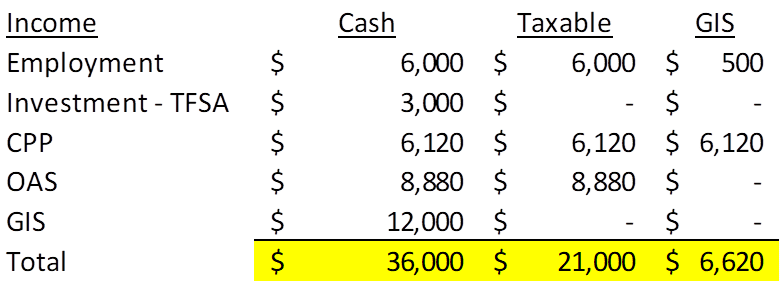
<p class="wp-block-paragraph">Liam gets $36,000/year in cash income, but only $21,000 of it is taxable and $6,620 reduces his GIS. His GIS is reduced by 50% of his income, but there are specific rules for which income is clawed back and which is not. Here are the details:</p>


<figure class="wp-block-image size-full is-resized"><a href="https://edrempel.com/wp-content/uploads/2026/09/image-5.png"><img loading="lazy" decoding="async" width="780" height="282" src="https://edrempel.com/wp-content/uploads/2026/09/image-5.png" alt="" class="wp-image-7171" style="aspect-ratio:2.773049645390071;width:391px;height:auto" srcset="https://edrempel.com/wp-content/uploads/2026/09/image-5.png 780w, https://edrempel.com/wp-content/uploads/2026/09/image-5-300x108.png 300w, https://edrempel.com/wp-content/uploads/2026/09/image-5-766x277.png 766w" sizes="auto, (max-width: 780px) 100vw, 780px" /></a></figure>


<p class="wp-block-paragraph">His employment income is taxable, but the first $5,000 does not count to reduce his GIS and only 50% of the next $10,000 counts. So only $500 of his $6,000 employment income reduces GIS by $250.</p>


<p class="wp-block-paragraph">He thinks he gets a “dividend”, but it is really a combination of interest and some return of his own money from a mortgage fund, but it is not taxable because it is a withdrawal from his TFSA.</p>


<p class="wp-block-paragraph">CPP is taxable and reduces his GIS by $3,060. OAS is taxable, but GIS is not, and neither reduces GIS.</p>


<p class="wp-block-paragraph">The basic tax credit that everyone gets plus the age credit for being over 65 total to about $25,660, which more than offsets all his taxable income, so he pays no income tax. He does not pay 19%. He pays 0% income tax.</p>


<p class="wp-block-paragraph">However, every additional dollar of taxable income he earns will reduce his GIS with the 50% clawback. Whenever he withdraws from his RRSP, he will lose 50% of the withdrawal in GIS. He is essentially in a 50% tax bracket because he loses 50% of any taxable income to the government.</p>


<p class="wp-block-paragraph"><strong>RRSP/RRIF Meltdown Strategy</strong></p>


<p class="wp-block-paragraph">The actual RRIF Meltdown Strategy involves borrowing to invest and using your RRIF to pay the tax-deductible interest. Liam has not mentioned this and he probably does not have the risk tolerance for it, but it would work exceptionally well for him if he took out a reverse mortgage and invested the proceeds.</p>


<p class="wp-block-paragraph">Liam would likely not qualify for any mortgage other than a reverse mortgage. The bank would likely lend him up to $250,000-$300,000. The interest would be about $10,000/year, which is roughly equal to his minimum RRIF. It could mean that he would get close to the maximum GIS all his life and have a simple minimum RRSF withdrawal, but it is a complex strategy to borrow to invest, withdraw a sustainable amount and invest tax-efficiently. This is probably not the right strategy for Liam because he invests conservatively and has no experience borrowing to invest.</p>


<p class="wp-block-paragraph">…does it make sense to start to “meltdown” the account? Specifically, he wonders if, in addition to CPP and OAS, he should apply his marginal tax rate of 19.05 per cent to systematically withdraw between $30,000 to $35,000 a year from his RRIF and contribute any funds he doesn’t immediately need to his TFSA</p>


<p class="wp-block-paragraph">Most retirees do the simple approach and just take the minimum RRIF. This will be somewhat of a disaster for Liam because he will lose 50% of all of his RRIF to reduced GIS over the years. For example, the minimum RRIF for him would be about $13,000/year, which would reduce his GIS by $6,500 with the 50% clawback. His GIS would drop from $12,000/year to $5,500/year.</p>


<p class="wp-block-paragraph">Liam is thinking about a “meltdown” by withdrawing $30,000 or $35,000 per year from his RRSP to melt it down and invest in his TFSA, so that eventually it will be gone and he won’t have his GIS clawed back. Since he gets $12,000/year of GIS, the 50% clawback on the first $24,000/year he withdraws will eliminate his GIS. Withdrawing $30-35,000 would mean only a bit is does not affect his clawback. The $5-11,000 above the clawback would be taxed at 19%.</p>


<p class="wp-block-paragraph">He has the right idea, but the optimal amount is withdrawing $66,000/year from his RRSP, which is much higher. It is unconventional to withdraw that much! This works because it would bring his taxable income up to $94,000 which would be taxed at various tax rates of 33% or less. Any larger withdrawal would be taxed at 44% which is almost as much as the GIS clawback of 50%.</p>


<p class="wp-block-paragraph">This RRSP Meltdown Strategy would eliminate his RRSP in about 3.6 years. He would lose his GIS completely for 4 years and pay about $14,500/year income tax. It means about 2/3 of his RRSP would be taxed about 21%, instead of the 50% clawback. After the 4 years, he should get about $10,000/year GIS for the rest of his life.</p>


<p class="wp-block-paragraph">The bank would withhold about $20,000 of tax and he should get a refund for the $5,500 difference. He should maximize his TFSA every year and invest the rest in a non-registered account that is very tax efficient. Over the 4 years, he should accumulate about $90,000 for his non-registered account and maximize his TFSA every year.</p>


<p class="wp-block-paragraph">He will lose 50% of any taxable income from this non-registered account for the rest of his life. With tax-efficient investing, he should only have $1,000-3,000/year of taxable income. Tax-efficient investing will be very important for Liam, since he will effectively be in a 50% tax bracket – like the very high-income earners!</p>


<p class="wp-block-paragraph">If so, when? “Should I wait until later in the year (November/December) to calculate and execute this extra ‘meltdown withdrawal’?” he asked.&nbsp;</p>


<p class="wp-block-paragraph">He should do this RRSP Meltdown Strategy starting this year. The longer his RRSP grows, the more tax &amp; GIS he will lose when he withdraws it.</p>


<p class="wp-block-paragraph">Ideally, he should wait until near the end of the year and then estimate his taxable income for the year. The optimal RRSP withdrawal is the amount that will bring his taxable income up to $94,000.</p>


<p class="wp-block-paragraph"><strong>Mortgage, Car Purchase and Estate</strong></p>


<p class="wp-block-paragraph">“I could pay off the mortgage, but I prefer leaving that money in my TFSA where it can grow,” he said. He may downsize down the road if the house becomes too much or to boost his investments.&nbsp;</p>


<p class="wp-block-paragraph">This is good thinking. His investments today are about 54% equities and 46% fixed income, so he should expect a long-term average return of about 5.25%. He can renew his mortgage at 3.7%, so it is better for him to keep the investments and the mortgage.</p>


<p class="wp-block-paragraph">…saving $50,000 over the next four years for a new vehicle.</p>


<p class="wp-block-paragraph">Liam is trying to save $50,000 over 4 years, but does not really have the cash flow to do this. The RRSP Meltdown Strategy should give him about $90,000 in addition to maximizing his TFSA, which can allow him to buy his car in 4 years. It’s a nice coincidence that he wants to buy the car in 4 years and the optimal RRSP Meltdown is over 4 years.</p>


<p class="wp-block-paragraph">He is also looking into a reverse mortgage as a living inheritance for his nieces and nephews or to free up funds to expand his modest lifestyle.&nbsp;</p>


<p class="wp-block-paragraph">Liam would likely not qualify for any mortgage other than a reverse mortgage. He has about $140,000 more than he needs to support his lifestyle for the rest of his life, but he should keep a comfortable margin of safety above this.</p>


<p class="wp-block-paragraph">It is probably not advisable for him to give much to his nieces and nephews. He should make sure first that he will be financially independent and have enough for himself, and never need financial help from his family.</p>


<p class="wp-block-paragraph">Ed</p>


<p class="wp-block-paragraph"></p>
<p>The post <a href="https://edrempel.com/national-post-article-could-an-rrsp-rrif-meltdown-reduce-liams-gis-clawback-without-triggering-a-big-tax-bill/">National Post article: Could an RRSP/RRIF meltdown reduce Liam’s GIS clawback without triggering a big tax bill?</a> appeared first on <a href="https://edrempel.com">Ed Rempel</a>.</p>
]]></content>
		
					<link rel="replies" type="text/html" href="https://edrempel.com/national-post-article-could-an-rrsp-rrif-meltdown-reduce-liams-gis-clawback-without-triggering-a-big-tax-bill/#comments" thr:count="0" />
			<link rel="replies" type="application/atom+xml" href="https://edrempel.com/national-post-article-could-an-rrsp-rrif-meltdown-reduce-liams-gis-clawback-without-triggering-a-big-tax-bill/feed/atom/" thr:count="0" />
			<thr:total>0</thr:total>
			</entry>
		<entry>
		<author>
			<name>Ed Rempel</name>
							<uri>https://edrempel.com</uri>
						</author>

		<title type="html"><![CDATA[Protecting What Matters Most: Trust Planning for Children, Dependents, and Vulnerable Beneficiaries in Canada]]></title>
		<link rel="alternate" type="text/html" href="https://edrempel.com/protecting-what-matters-most-trust-planning-for-children-dependents-and-vulnerable-beneficiaries-in-canada/" />

		<id>https://edrempel.com/?p=7158</id>
		<updated>2026-09-22T16:33:45Z</updated>
		<published>2026-09-22T15:56:53Z</published>
		<category scheme="https://edrempel.com/" term="Advice from the Sage owl" /><category scheme="https://edrempel.com/" term="Podcasts" /><category scheme="https://edrempel.com/" term="YouTube" /><category scheme="https://edrempel.com/" term="children’s testamentary trust" /><category scheme="https://edrempel.com/" term="disability planning" /><category scheme="https://edrempel.com/" term="discretionary family trust" /><category scheme="https://edrempel.com/" term="estate planning" /><category scheme="https://edrempel.com/" term="estate planning for children" /><category scheme="https://edrempel.com/" term="family estate planning" /><category scheme="https://edrempel.com/" term="Henson Trust" /><category scheme="https://edrempel.com/" term="inheritance planning" /><category scheme="https://edrempel.com/" term="qualified disability trust" /><category scheme="https://edrempel.com/" term="spendthrift trust" /><category scheme="https://edrempel.com/" term="trust planning" /><category scheme="https://edrempel.com/" term="trusts in Canada" /><category scheme="https://edrempel.com/" term="vulnerable beneficiaries" /><category scheme="https://edrempel.com/" term="wills and trusts" />
		<summary type="html"><![CDATA[<p>A&#160; practical guide to creating structure, continuity, and protection for the people who may need extra care. Estate planning is not only about who receives what. It is about how the people you love are cared for when you are no longer able to guide the decisions yourself. This becomes especially important when you are&#8230;</p>
<p>The post <a href="https://edrempel.com/protecting-what-matters-most-trust-planning-for-children-dependents-and-vulnerable-beneficiaries-in-canada/">Protecting What Matters Most: Trust Planning for Children, Dependents, and Vulnerable Beneficiaries in Canada</a> appeared first on <a href="https://edrempel.com">Ed Rempel</a>.</p>
]]></summary>

					<content type="html" xml:base="https://edrempel.com/protecting-what-matters-most-trust-planning-for-children-dependents-and-vulnerable-beneficiaries-in-canada/"><![CDATA[
<figure class="wp-block-embed is-type-video is-provider-youtube wp-block-embed-youtube wp-embed-aspect-16-9 wp-has-aspect-ratio"><div class="wp-block-embed__wrapper">
<iframe loading="lazy" title="Trust Planning for Children &amp; Vulnerable Beneficiaries in Canada" width="500" height="281" src="https://www.youtube.com/embed/_EchGxYjJ4E?feature=oembed" frameborder="0" allow="accelerometer; autoplay; clipboard-write; encrypted-media; gyroscope; picture-in-picture; web-share" referrerpolicy="strict-origin-when-cross-origin" allowfullscreen></iframe>
</div></figure>


<iframe loading="lazy" title="Embed Player" style="border:none" src="https://play.libsyn.com/embed/episode/id/42994338/height/192/theme/modern/size/large/thumbnail/yes/custom-color/008080/time-start/00:00:00/hide-playlist/yes/download/yes/font-color/FFFFFF" height="192" width="100%" scrolling="no" allowfullscreen="" webkitallowfullscreen="true" mozallowfullscreen="true" oallowfullscreen="true" msallowfullscreen="true"></iframe>


<p class="wp-block-paragraph">A&nbsp; practical guide to creating structure, continuity, and protection for the people who may need extra care.</p>


<p class="wp-block-paragraph">Estate planning is not only about who receives what. It is about how the people you love are cared for when you are no longer able to guide the decisions yourself.</p>


<p class="wp-block-paragraph">This becomes especially important when you are planning for minor children, a loved one living with a disability, or a beneficiary who may need financial guardrails. In those cases, a direct lump-sum inheritance can create unnecessary risk. A trust can turn that inheritance into steady support, thoughtful oversight, and long-term protection.</p>


<figure class="wp-block-table"><table class="has-fixed-layout"><tbody><tr><td><strong>Core idea</strong><strong><br></strong> <strong></strong>A trust is not about controlling people from beyond the grave. At its best, it is a practical way to keep care, stability, and good judgment in place when life is already difficult.</td></tr></tbody></table></figure>


<figure class="wp-block-image size-large is-resized"><a href="https://edrempel.com/wp-content/uploads/2026/09/image-4.jpeg"><img loading="lazy" decoding="async" width="1024" height="672" src="https://edrempel.com/wp-content/uploads/2026/09/image-4-1024x672.jpeg" alt="" class="wp-image-7164" style="aspect-ratio:1.5256723716381417;width:624px;height:auto" srcset="https://edrempel.com/wp-content/uploads/2026/09/image-4-1024x672.jpeg 1024w, https://edrempel.com/wp-content/uploads/2026/09/image-4-300x197.jpeg 300w, https://edrempel.com/wp-content/uploads/2026/09/image-4-768x504.jpeg 768w, https://edrempel.com/wp-content/uploads/2026/09/image-4.jpeg 1363w" sizes="auto, (max-width: 1024px) 100vw, 1024px" /></a></figure>


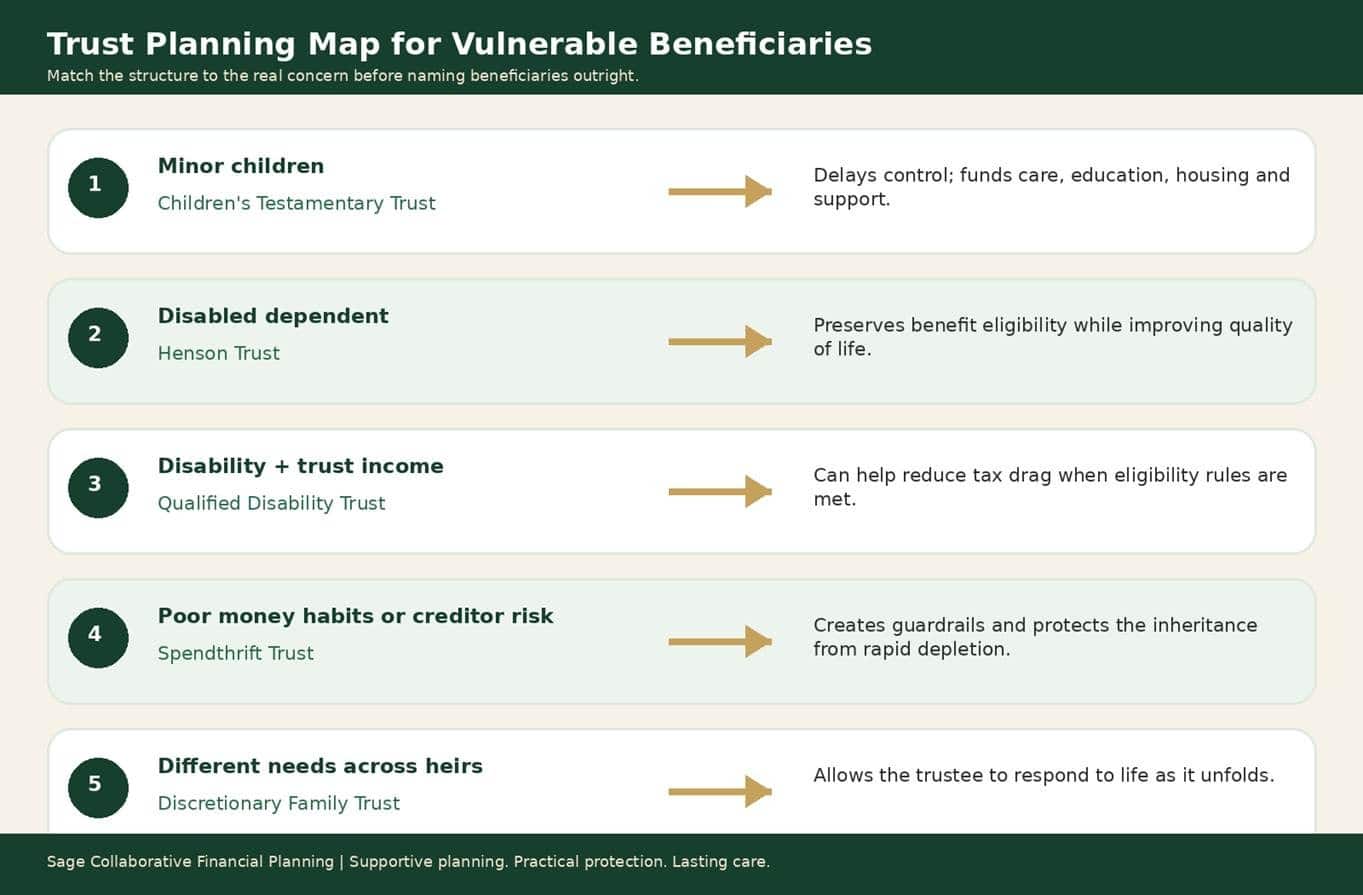
<p class="wp-block-paragraph">Infographic: different vulnerabilities call for different trust tools. The structure should follow the need, not the other way around.</p>


<h1 id="h-at-a-glance-matching-the-right-trust-to-the-real-concern" class="wp-block-heading"><strong>At a glance: matching the right trust to the real concern</strong></h1>


<figure class="wp-block-table"><table class="has-fixed-layout"><tbody><tr><td><strong>Planning concern</strong></td><td><strong>Possible tool</strong></td><td><strong>Primary objective</strong></td></tr><tr><td>Minor children</td><td>Children&#8217;s Testamentary Trust</td><td>Delays control, funds education and daily needs, and avoids unnecessary court involvement.</td></tr><tr><td>Disabled dependent receiving benefits</td><td>Henson Trust</td><td>Protects benefit eligibility while allowing supplemental quality-of-life support.</td></tr><tr><td>Disability-related tax exposure</td><td>Qualified Disability Trust</td><td>May allow graduated tax rates where the legal and tax conditions are met.</td></tr><tr><td>Beneficiary with poor money habits</td><td>Spendthrift Trust</td><td>Creates guardrails, protects capital, and supports basic needs over time.</td></tr><tr><td>Different needs among multiple heirs</td><td>Discretionary Family Trust</td><td>Gives trustees flexibility to respond to changing circumstances.</td></tr></tbody></table></figure>


<h1 id="h-1-when-the-goal-is-structured-support-for-minor-children" class="wp-block-heading"><strong>1. When the goal is structured support for minor children</strong></h1>


<h2 id="h-children-s-testamentary-trust" class="wp-block-heading"><strong>Children&#8217;s Testamentary Trust</strong></h2>


<p class="wp-block-paragraph">A common estate planning risk is assuming that a will is enough when minor children are involved. In Canada, minors generally cannot manage significant property directly. Without a clear trust structure, money may need to be supervised by a court or public guardian, and the child may eventually receive a large amount before they are ready to handle it.</p>


<h3 id="h-how-it-works" class="wp-block-heading"><strong>How it works</strong></h3>


<p class="wp-block-paragraph">A Children&#8217;s Testamentary Trust is created in your will. If both parents pass away, the inheritance flows into the trust instead of directly to the child. The trustee can pay for health, education, housing, activities, and reasonable lifestyle needs while delaying full control until later ages.</p>


<h3 id="h-why-families-consider-it" class="wp-block-heading"><strong>Why families consider it</strong></h3>


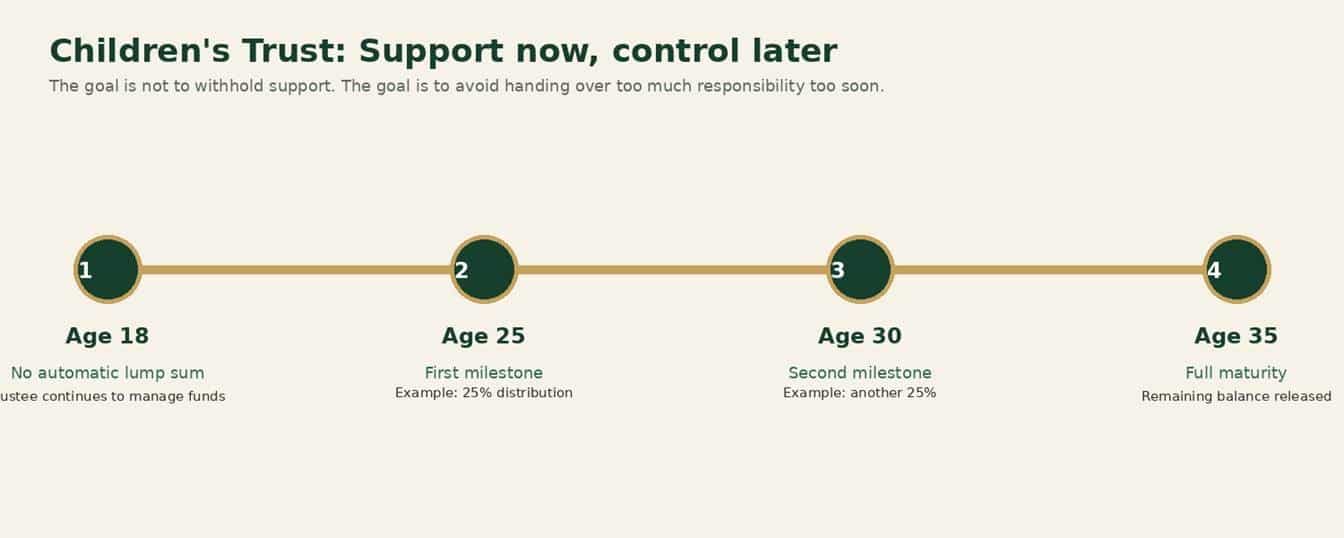
<p class="wp-block-paragraph">· &nbsp; &nbsp; &nbsp; <strong>Control over timing:</strong> you can use staged milestones, such as 25, 30 and 35, instead of one large payout at 18.</p>


<p class="wp-block-paragraph">· &nbsp; &nbsp; &nbsp; <strong>Ongoing care:</strong> the trustee can keep school, housing, healthcare, and day-to-day needs funded.</p>


<p class="wp-block-paragraph">· &nbsp; &nbsp; &nbsp; <strong>Reduced pressure:</strong> children are supported without being asked to manage adult-level financial decisions too early.</p>


<figure class="wp-block-image size-large is-resized"><a href="https://edrempel.com/wp-content/uploads/2026/09/image.jpeg"><img loading="lazy" decoding="async" width="1024" height="410" src="https://edrempel.com/wp-content/uploads/2026/09/image-1024x410.jpeg" alt="" class="wp-image-7160" style="aspect-ratio:2.4860557768924303;width:624px;height:auto" srcset="https://edrempel.com/wp-content/uploads/2026/09/image-1024x410.jpeg 1024w, https://edrempel.com/wp-content/uploads/2026/09/image-300x120.jpeg 300w, https://edrempel.com/wp-content/uploads/2026/09/image-767x307.jpeg 767w, https://edrempel.com/wp-content/uploads/2026/09/image.jpeg 1344w" sizes="auto, (max-width: 1024px) 100vw, 1024px" /></a></figure>


<figure class="wp-block-table"><table class="has-fixed-layout"><tbody><tr><td><strong>Client example: Sara and Imran&#8217;s guardianship plan</strong><strong><br></strong> <strong></strong><strong>Situation:</strong> Sara and Imran have two young children and enough life insurance to create a strong safety net. Their worry is not whether their children will be provided for. Their worry is whether the money would be handed over too quickly.<br><strong>Planning approach:</strong> Their wills direct insurance proceeds and estate assets into a testamentary trust if both parents pass away. The trustee can pay for school, housing, healthcare, summer activities, and university costs.<br><strong>Result:</strong> The children are fully supported as they grow, while the main capital is released gradually at more mature ages. The planning creates care without creating avoidable financial pressure.</td></tr></tbody></table></figure>


<h1 id="h-2-when-the-goal-is-protecting-disability-benefits" class="wp-block-heading"><strong>2. When the goal is protecting disability benefits</strong></h1>


<h2 id="h-henson-trust" class="wp-block-heading"><strong>Henson Trust</strong></h2>


<p class="wp-block-paragraph">Planning for a loved one with a disability requires extra care. A direct inheritance can sometimes affect provincial income supports, drug coverage, housing supports, or other benefits. A Henson Trust is often considered when the goal is to leave meaningful support without accidentally disrupting benefits that are already essential.</p>


<h3 id="h-how-it-works-0" class="wp-block-heading"><strong>How it works</strong></h3>


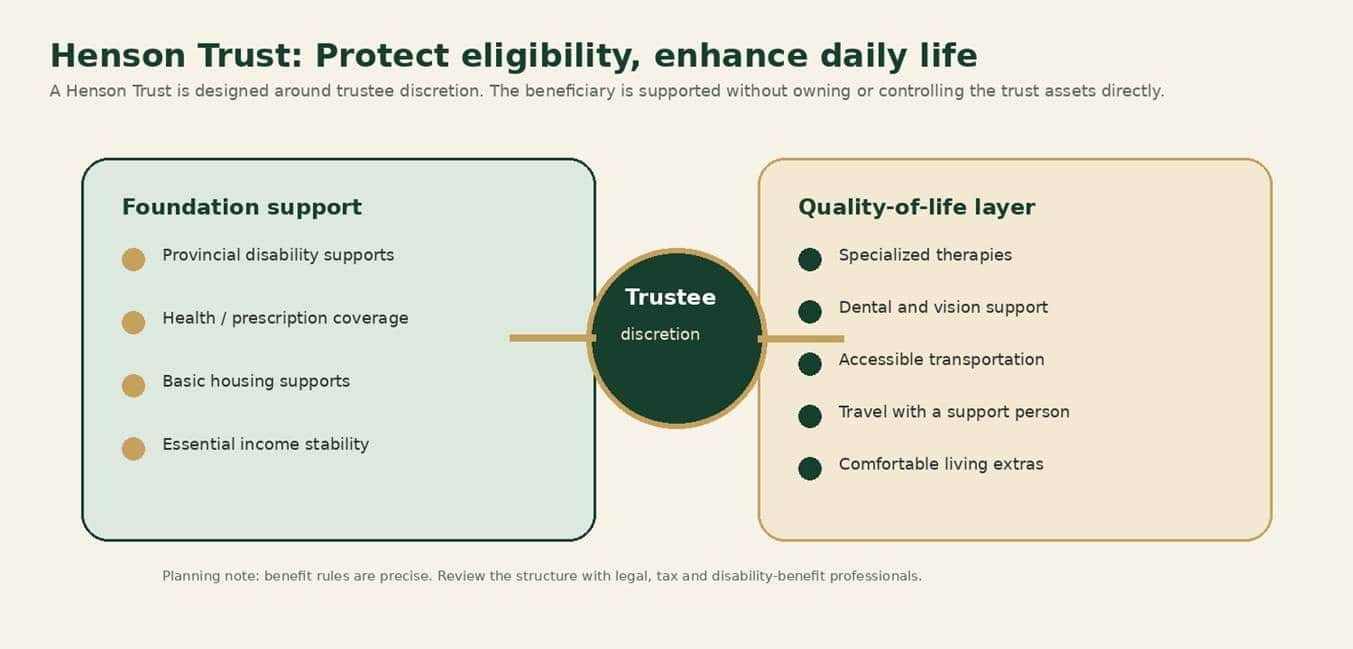
<p class="wp-block-paragraph">A Henson Trust is built around absolute trustee discretion. The beneficiary does not have the legal right to demand payments from the trust. Because the beneficiary does not control the assets directly, those assets may not be treated the same way as a direct inheritance for benefit eligibility purposes.</p>


<figure class="wp-block-table"><table class="has-fixed-layout"><tbody><tr><td><strong>Planning caution</strong><strong><br></strong> <strong></strong>Benefit rules are provincial and precise. Henson Trust planning should always be coordinated with estate counsel, tax advisors, and professionals familiar with the relevant disability support program.</td></tr></tbody></table></figure>


<figure class="wp-block-image size-large is-resized"><a href="https://edrempel.com/wp-content/uploads/2026/09/image-1.jpeg"><img loading="lazy" decoding="async" width="1024" height="491" src="https://edrempel.com/wp-content/uploads/2026/09/image-1-1024x491.jpeg" alt="" class="wp-image-7161" style="aspect-ratio:2.08;width:624px;height:auto" srcset="https://edrempel.com/wp-content/uploads/2026/09/image-1-1024x491.jpeg 1024w, https://edrempel.com/wp-content/uploads/2026/09/image-1-300x144.jpeg 300w, https://edrempel.com/wp-content/uploads/2026/09/image-1-767x368.jpeg 767w, https://edrempel.com/wp-content/uploads/2026/09/image-1.jpeg 1353w" sizes="auto, (max-width: 1024px) 100vw, 1024px" /></a></figure>


<h3 id="h-why-families-consider-it-0" class="wp-block-heading"><strong>Why families consider it</strong></h3>


<p class="wp-block-paragraph">· &nbsp; &nbsp; &nbsp; <strong>Benefit preservation:</strong> the structure is designed to avoid replacing essential public supports with private money.</p>


<p class="wp-block-paragraph">· &nbsp; &nbsp; &nbsp; <strong>Better quality of life:</strong> the trust can fund items that programs may not cover, such as therapies, dental work, transportation, electronics, companion travel, or comfort supports.</p>


<p class="wp-block-paragraph">· &nbsp; &nbsp; &nbsp; <strong>Continuity:</strong> a named trustee can keep support flowing even if the parent or caregiver is no longer alive or able to manage the details.</p>


<figure class="wp-block-table"><table class="has-fixed-layout"><tbody><tr><td><strong>Client example: Nadia&#8217;s quality-of-life strategy</strong><strong><br></strong> <strong></strong><strong>Situation:</strong> Nadia wants to leave assets for her adult son, Liam, who relies on disability supports for housing and medications. She is worried that a direct inheritance could create more harm than help.<br><strong>Planning approach:</strong> Nadia includes a Henson Trust in her will and appoints a trusted family member and backup professional trustee to manage the funds.<br><strong>Result:</strong> Liam continues to have essential support in place, while the trust can improve his daily life with items and services that public programs may not cover.</td></tr></tbody></table></figure>


<h1 id="h-3-when-the-goal-is-reducing-tax-drag-for-a-disabled-beneficiary" class="wp-block-heading"><strong>3. When the goal is reducing tax drag for a disabled beneficiary</strong></h1>


<h2 id="h-qualified-disability-trust" class="wp-block-heading"><strong>Qualified Disability Trust</strong></h2>


<p class="wp-block-paragraph">Many trusts pay tax at high flat rates on income retained inside the trust. For a trust that is meant to support a disabled beneficiary over many years, that tax drag can matter. A Qualified Disability Trust, or QDT, may help when the beneficiary and trust meet the required conditions.</p>


<h3 id="h-what-makes-it-different" class="wp-block-heading"><strong>What makes it different</strong></h3>


<p class="wp-block-paragraph">A QDT is not a separate trust that replaces the underlying planning. It is generally a tax status/election for an eligible testamentary trust. When the rules are met, the trust may access graduated tax rates instead of being taxed at the highest marginal rate on retained income.</p>


<h3 id="h-where-it-may-fit" class="wp-block-heading"><strong>Where it may fit</strong></h3>


<p class="wp-block-paragraph">· &nbsp; &nbsp; &nbsp; <strong>The beneficiary qualifies</strong> for the Disability Tax Credit.</p>


<p class="wp-block-paragraph">· &nbsp; &nbsp; &nbsp; <strong>The trust is created</strong> by a will and meets the required testamentary trust conditions.</p>


<p class="wp-block-paragraph">· &nbsp; &nbsp; &nbsp; <strong>The trustee and beneficiary</strong> make the appropriate annual tax election and coordinate filings properly.</p>


<figure class="wp-block-table"><table class="has-fixed-layout"><tbody><tr><td><strong>Plain-language takeaway</strong><strong><br></strong> <strong></strong>The Henson Trust conversation is often about protecting benefits. The QDT conversation is often about reducing unnecessary tax erosion. In the right case, both conversations may need to happen together.</td></tr></tbody></table></figure>


<figure class="wp-block-table"><table class="has-fixed-layout"><tbody><tr><td><strong>Client example: Protecting Liam&#8217;s trust from tax erosion</strong><strong><br></strong> <strong></strong><strong>Situation:</strong> Nadia’s trust for Liam is invested to support him for decades. If all investment income is taxed at the highest trust rate, less money remains available for his long-term care.<br><strong>Planning approach:</strong> Because Liam qualifies for the Disability Tax Credit, the trustee reviews whether the trust can file as a Qualified Disability Trust.<br><strong>Result:</strong> If eligible and filed properly, more of the trust income can remain available for Liam’s care instead of being lost to avoidable tax drag.</td></tr></tbody></table></figure>


<h1 id="h-4-when-the-goal-is-protection-from-mismanagement-or-outside-risk" class="wp-block-heading"><strong>4. When the goal is protection from mismanagement or outside risk</strong></h1>


<h2 id="h-spendthrift-trust" class="wp-block-heading"><strong>Spendthrift Trust</strong></h2>


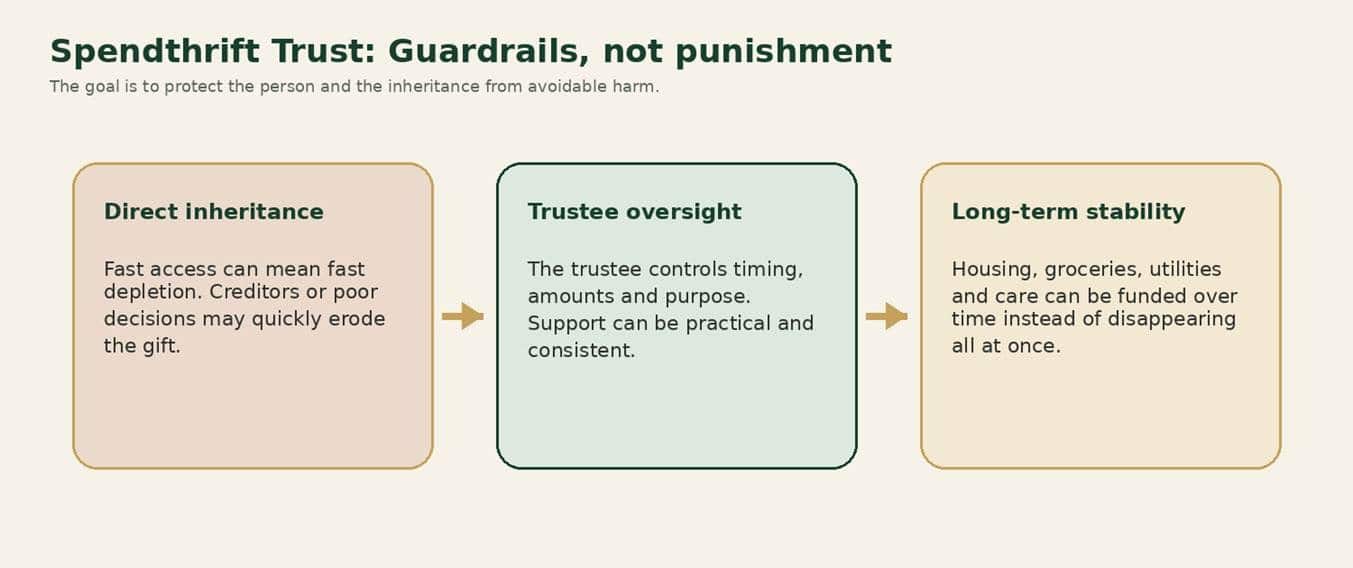
<p class="wp-block-paragraph">Some beneficiaries are deeply loved but not ready to manage a major inheritance. The concern may be addiction, gambling, significant debt, mental health challenges, manipulative relationships, or simply a long pattern of poor financial decisions. In these situations, planning is not about punishment. It is about protection.</p>


<figure class="wp-block-image size-large is-resized"><a href="https://edrempel.com/wp-content/uploads/2026/09/image-3.jpeg"><img loading="lazy" decoding="async" width="1024" height="430" src="https://edrempel.com/wp-content/uploads/2026/09/image-3-1024x430.jpeg" alt="" class="wp-image-7163" style="aspect-ratio:2.3908045977011496;width:624px;height:auto" srcset="https://edrempel.com/wp-content/uploads/2026/09/image-3-1024x430.jpeg 1024w, https://edrempel.com/wp-content/uploads/2026/09/image-3-300x126.jpeg 300w, https://edrempel.com/wp-content/uploads/2026/09/image-3-767x322.jpeg 767w, https://edrempel.com/wp-content/uploads/2026/09/image-3.jpeg 1353w" sizes="auto, (max-width: 1024px) 100vw, 1024px" /></a></figure>


<h3 id="h-how-it-works-1" class="wp-block-heading"><strong>How it works</strong></h3>


<p class="wp-block-paragraph">A Spendthrift Trust limits the beneficiary’s ability to sell, pledge, assign, or quickly spend the inheritance. The trustee controls how and when funds are released and can pay certain expenses directly, such as rent, utilities, groceries, counselling, or treatment supports.</p>


<h3 id="h-why-families-consider-it-1" class="wp-block-heading"><strong>Why families consider it</strong></h3>


<p class="wp-block-paragraph">· &nbsp; &nbsp; &nbsp; <strong>Prevents rapid depletion:</strong> the inheritance is not available to be spent all at once.</p>


<p class="wp-block-paragraph">· &nbsp; &nbsp; &nbsp; <strong>Creates a stable floor:</strong> housing and basic needs can be supported consistently.</p>


<p class="wp-block-paragraph">· &nbsp; &nbsp; &nbsp; <strong>Adds protection from pressure:</strong> the beneficiary is less exposed to creditors, scams, or people trying to access the funds.</p>


<figure class="wp-block-table"><table class="has-fixed-layout"><tbody><tr><td><strong>Client example: David and Claire&#8217;s support plan for Marcus</strong><strong><br></strong> <strong></strong><strong>Situation:</strong> David and Claire have an adult son, Marcus, who struggles with gambling and debt. They want him to be safe and housed, but they know a direct inheritance could disappear quickly.<br><strong>Planning approach:</strong> Their estate plan uses a Spendthrift Trust with clear instructions for the trustee to pay essential expenses directly and provide limited discretionary support.<br><strong>Result:</strong> Marcus does not receive a large lump sum, but he does receive what his parents most wanted for him: housing stability, food security, and a practical layer of protection.</td></tr></tbody></table></figure>


<h1 id="h-5-when-the-goal-is-flexibility-across-different-children-or-heirs" class="wp-block-heading"><strong>5. When the goal is flexibility across different children or heirs</strong></h1>


<h2 id="h-discretionary-family-trust" class="wp-block-heading"><strong>Discretionary Family Trust</strong></h2>


<p class="wp-block-paragraph">Fair does not always mean identical. One child may be independent and established. Another may still be in school. Another may need ongoing financial guardrails or disability-related support. A rigid estate plan can treat everyone the same on paper while creating very different real-life outcomes.</p>


<h3 id="h-how-it-works-2" class="wp-block-heading"><strong>How it works</strong></h3>


<p class="wp-block-paragraph">A Discretionary Family Trust gives the trustee authority to distribute income and capital based on the beneficiaries’ changing needs. The trust terms can provide guidance, but the trustee has room to respond to life as it unfolds.</p>


<h3 id="h-where-it-fits" class="wp-block-heading"><strong>Where it fits</strong></h3>


<p class="wp-block-paragraph">· &nbsp; &nbsp; &nbsp; <strong>Families with children</strong> at very different ages or stages.</p>


<p class="wp-block-paragraph">· &nbsp; &nbsp; &nbsp; <strong>Blended families</strong> where fairness requires careful judgment.</p>


<p class="wp-block-paragraph">· &nbsp; &nbsp; &nbsp; <strong>Families who want</strong> an impartial decision-maker to balance education, housing, care, and long-term protection.</p>


<figure class="wp-block-table"><table class="has-fixed-layout"><tbody><tr><td><strong>Client example: The multi-stage family fund</strong><strong><br></strong> <strong></strong><strong>Situation:</strong> A couple has three children: one established adult, one university student, and one younger adult who has struggled with spending. Equal treatment sounds simple, but their actual needs are very different.<br><strong>Planning approach:</strong> The parents use a discretionary testamentary trust and give the trustee written guidance about education, housing, maturity, and responsible support.<br><strong>Result:</strong> The trustee can fund tuition, provide a home down-payment match where appropriate, and keep guardrails in place for the child who needs more structure. The result is not identical treatment, but thoughtful fairness.</td></tr></tbody></table></figure>


<h1 id="h-how-the-pieces-can-work-together" class="wp-block-heading"><strong>How the pieces can work together</strong></h1>


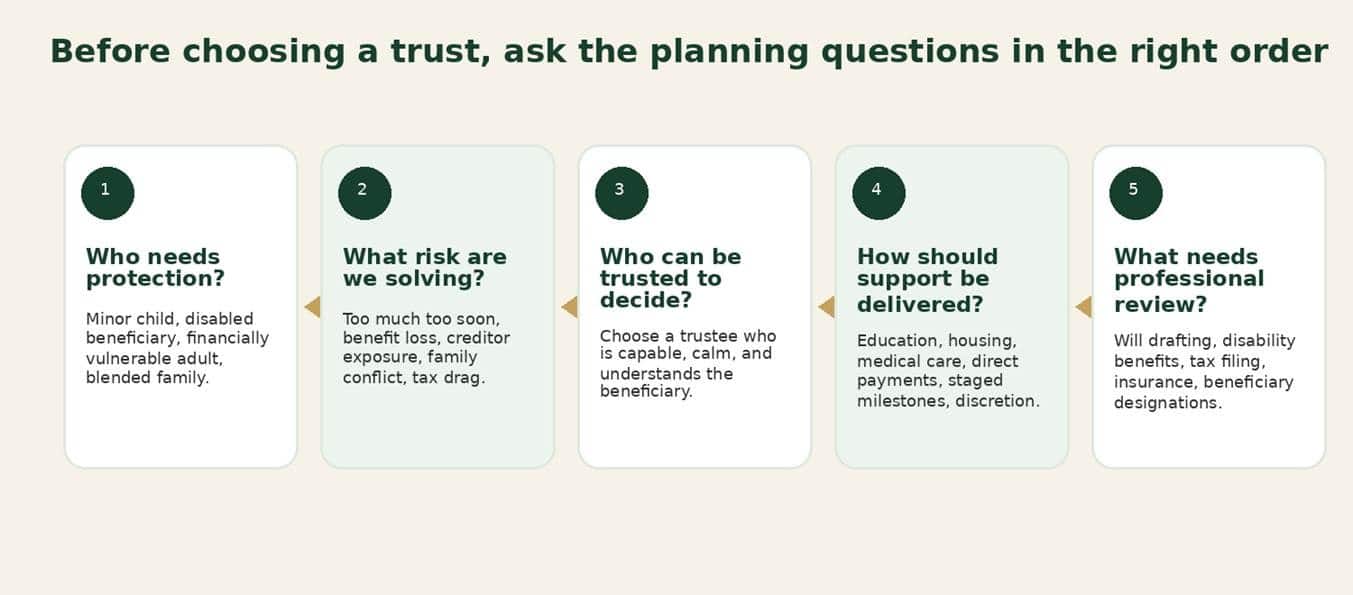
<p class="wp-block-paragraph">In many real families, the answer is not one tool in isolation. The planning may combine a will-based trust, trustee discretion, insurance funding, disability-benefit review, and tax planning. The structure should be simple enough to administer, but strong enough to protect the people it was designed for.</p>


<figure class="wp-block-image size-large is-resized"><a href="https://edrempel.com/wp-content/uploads/2026/09/image-2.jpeg"><img loading="lazy" decoding="async" width="1024" height="450" src="https://edrempel.com/wp-content/uploads/2026/09/image-2-1024x450.jpeg" alt="" class="wp-image-7162" style="aspect-ratio:2.269090909090909;width:624px;height:auto" srcset="https://edrempel.com/wp-content/uploads/2026/09/image-2-1024x450.jpeg 1024w, https://edrempel.com/wp-content/uploads/2026/09/image-2-300x132.jpeg 300w, https://edrempel.com/wp-content/uploads/2026/09/image-2-766x337.jpeg 766w, https://edrempel.com/wp-content/uploads/2026/09/image-2.jpeg 1353w" sizes="auto, (max-width: 1024px) 100vw, 1024px" /></a></figure>


<p class="wp-block-paragraph">Infographic: strong trust planning starts with the beneficiary, the risk, and the trustee before moving into technical drafting.</p>


<h1 id="h-planning-checklist-before-you-finalize-the-structure" class="wp-block-heading"><strong>Planning checklist: before you finalize the structure</strong></h1>


<figure class="wp-block-table"><table class="has-fixed-layout"><tbody><tr><td><strong>✓</strong></td><td>Have you named the specific risk each beneficiary needs protection from?</td></tr><tr><td><strong>✓</strong></td><td>Have you chosen a trustee who is capable, calm, organized, and willing to serve?</td></tr><tr><td><strong>✓</strong></td><td>Have you named backup trustees in case your first choice cannot act?</td></tr><tr><td><strong>✓</strong></td><td>Have you given the trustee clear guidance without making the trust too rigid?</td></tr><tr><td><strong>✓</strong></td><td>Have you coordinated life insurance beneficiary designations with the trust plan?</td></tr><tr><td><strong>✓</strong></td><td>Have you reviewed disability benefits before leaving assets to a disabled beneficiary?</td></tr><tr><td><strong>✓</strong></td><td>Have you reviewed tax filing obligations for testamentary trusts and possible QDT status?</td></tr><tr><td><strong>✓</strong></td><td>Have you considered whether a professional or corporate trustee should be involved?</td></tr><tr><td><strong>✓</strong></td><td>Have you reviewed the plan with qualified legal, tax, and financial professionals?</td></tr></tbody></table></figure>


<h1 id="h-the-ultimate-act-of-protection" class="wp-block-heading"><strong>The ultimate act of protection</strong></h1>


<p class="wp-block-paragraph">At the heart of this planning is a simple idea: some people need more than an inheritance. They need continuity, judgment, and support that does not disappear when life becomes complicated.</p>


<p class="wp-block-paragraph">A trust can make sure that money is not simply transferred, but cared for. It can help a child grow into responsibility, protect a disabled loved one from losing essential supports, or give a financially vulnerable beneficiary a safe and steady foundation.</p>


<p class="wp-block-paragraph">This is not about making estate planning more complicated than it needs to be. It is about making the plan thoughtful enough for the people it is meant to protect.</p>


<figure class="wp-block-table"><table class="has-fixed-layout"><tbody><tr><td><strong>Closing thought</strong><strong><br></strong> <strong></strong>The most meaningful estate plans do not just pass on assets. They pass on stability, care, and the quiet reassurance that the people who matter most will not have to figure everything out alone.</td></tr></tbody></table></figure>


<h1 id="h-important-note" class="wp-block-heading"><strong>Important note</strong></h1>


<p class="wp-block-paragraph">This article is for general educational purposes only and should not be treated as legal, tax, accounting, investment, or disability-benefit advice. Trust planning in Canada is technical, and rules can differ by province and by the beneficiary’s circumstances. Families should work with qualified estate lawyers, tax professionals, financial planners, and disability-benefit specialists before implementing any strategy.</p>


<p class="wp-block-paragraph"><strong>— Sabiha</strong></p>


<p class="wp-block-paragraph"></p>
<p>The post <a href="https://edrempel.com/protecting-what-matters-most-trust-planning-for-children-dependents-and-vulnerable-beneficiaries-in-canada/">Protecting What Matters Most: Trust Planning for Children, Dependents, and Vulnerable Beneficiaries in Canada</a> appeared first on <a href="https://edrempel.com">Ed Rempel</a>.</p>
]]></content>
		
					<link rel="replies" type="text/html" href="https://edrempel.com/protecting-what-matters-most-trust-planning-for-children-dependents-and-vulnerable-beneficiaries-in-canada/#comments" thr:count="0" />
			<link rel="replies" type="application/atom+xml" href="https://edrempel.com/protecting-what-matters-most-trust-planning-for-children-dependents-and-vulnerable-beneficiaries-in-canada/feed/atom/" thr:count="0" />
			<thr:total>0</thr:total>
			</entry>
		<entry>
		<author>
			<name>Ed Rempel</name>
							<uri>https://edrempel.com</uri>
						</author>

		<title type="html"><![CDATA[Should You Pay Off Your Mortgage Early or Invest Instead?]]></title>
		<link rel="alternate" type="text/html" href="https://edrempel.com/should-you-pay-off-your-mortgage-early-or-invest-instead/" />

		<id>https://edrempel.com/?p=7154</id>
		<updated>2026-09-17T16:40:32Z</updated>
		<published>2026-09-17T15:25:09Z</published>
		<category scheme="https://edrempel.com/" term="Financial Planning Wisdom" /><category scheme="https://edrempel.com/" term="Investment Wisdom" /><category scheme="https://edrempel.com/" term="Mortgage Wisdom" /><category scheme="https://edrempel.com/" term="YouTube" /><category scheme="https://edrempel.com/" term="Canadian retirement planning" /><category scheme="https://edrempel.com/" term="faith in investments" /><category scheme="https://edrempel.com/" term="financial independence Canada" /><category scheme="https://edrempel.com/" term="financial planning" /><category scheme="https://edrempel.com/" term="invest or pay off mortgage" /><category scheme="https://edrempel.com/" term="investing for retirement" /><category scheme="https://edrempel.com/" term="investment wisdom" /><category scheme="https://edrempel.com/" term="long term perspective" /><category scheme="https://edrempel.com/" term="mortgage payoff strategy" /><category scheme="https://edrempel.com/" term="mortgage vs investing" /><category scheme="https://edrempel.com/" term="pay off mortgage early" /><category scheme="https://edrempel.com/" term="personal finance Canada" /><category scheme="https://edrempel.com/" term="retirement income planning" /><category scheme="https://edrempel.com/" term="retirement planning Canada" /><category scheme="https://edrempel.com/" term="should I pay off my mortgage" />
		<summary type="html"><![CDATA[<p>For many Canadians, becoming mortgage-free as quickly as possible feels like an obvious financial goal. But I think there’s a more important question to ask first: Once your mortgage is paid off, what percentage of that former mortgage payment will you actually invest? I call this the 95% test. If you pay off your mortgage&#8230;</p>
<p>The post <a href="https://edrempel.com/should-you-pay-off-your-mortgage-early-or-invest-instead/">Should You Pay Off Your Mortgage Early or Invest Instead?</a> appeared first on <a href="https://edrempel.com">Ed Rempel</a>.</p>
]]></summary>

					<content type="html" xml:base="https://edrempel.com/should-you-pay-off-your-mortgage-early-or-invest-instead/"><![CDATA[
<figure class="wp-block-embed is-type-video is-provider-youtube wp-block-embed-youtube wp-embed-aspect-9-16 wp-has-aspect-ratio"><div class="wp-block-embed__wrapper">
<iframe loading="lazy" title="Should You Pay Off Your Mortgage Early or Invest Instead?" width="422" height="750" src="https://www.youtube.com/embed/CqQus1bsNNY?feature=oembed" frameborder="0" allow="accelerometer; autoplay; clipboard-write; encrypted-media; gyroscope; picture-in-picture; web-share" referrerpolicy="strict-origin-when-cross-origin" allowfullscreen></iframe>
</div></figure>


<p class="wp-block-paragraph">For many Canadians, becoming mortgage-free as quickly as possible feels like an obvious financial goal.</p>


<p class="wp-block-paragraph">But I think there’s a more important question to ask first:</p>


<p class="wp-block-paragraph"><strong>Once your mortgage is paid off, what percentage of that former mortgage payment will you actually invest?</strong></p>


<p class="wp-block-paragraph">I call this the <strong>95% test</strong>.</p>


<p class="wp-block-paragraph">If you pay off your mortgage early but then use most of the newly available cash flow for travel, restaurants, renovations or simply a more expensive lifestyle, you haven’t necessarily accelerated your path to financial independence. You may have simply delayed investing.</p>


<h2 id="h-the-mortgage-victory-trap" class="wp-block-heading"><strong>The Mortgage Victory Trap</strong></h2>


<p class="wp-block-paragraph">I’ve seen this happen many times.</p>


<p class="wp-block-paragraph">Someone works hard to eliminate their mortgage 10 years before retirement. Suddenly, they have hundreds or even thousands of additional dollars available every month.</p>


<p class="wp-block-paragraph">It feels fantastic.</p>


<p class="wp-block-paragraph">And because retirement still seems far away, that extra cash gradually gets absorbed into their lifestyle.</p>


<p class="wp-block-paragraph">They travel more. They spend more freely. They become accustomed to living on a higher level of disposable income.</p>


<p class="wp-block-paragraph">Then retirement arrives — and the paycheque disappears.</p>


<p class="wp-block-paragraph">The problem wasn’t paying off the mortgage. The problem was becoming accustomed to a lifestyle that their retirement savings may not be able to support.</p>


<p class="wp-block-paragraph">That’s what I call the <strong>mortgage victory trap</strong>.</p>


<h2 id="h-your-bigger-goal-is-financial-independence" class="wp-block-heading"><strong>Your Bigger Goal Is Financial Independence</strong></h2>


<p class="wp-block-paragraph">For most people, the larger challenge is building a portfolio capable of supporting the lifestyle they want in retirement.</p>


<p class="wp-block-paragraph">Someone hoping to spend roughly $75,000 to $100,000 per year in today’s dollars could require a substantial retirement portfolio, depending on their pensions, taxes, investment returns, retirement age and other circumstances.</p>


<p class="wp-block-paragraph">That is why I generally believe the focus during your working years should be on becoming a confident, disciplined investor — rather than simply eliminating debt as quickly as possible.</p>


<p class="wp-block-paragraph">Historically, diversified long-term investments have had the potential to earn higher returns than typical mortgage borrowing costs, although investment returns are never guaranteed and the right strategy depends on your individual circumstances.</p>


<p class="wp-block-paragraph">For some people, aggressively paying down a mortgage is absolutely appropriate. Debt tolerance, interest rates, retirement timing, cash flow and personal risk tolerance all matter.</p>


<p class="wp-block-paragraph">But paying off your mortgage purely because investing feels uncomfortable can be expensive if it means missing years of potential compound growth.</p>


<h2 id="h-consider-timing-the-mortgage-with-retirement" class="wp-block-heading"><strong>Consider Timing the Mortgage With Retirement</strong></h2>


<p class="wp-block-paragraph">My general preference is to structure your finances so that the mortgage is paid off around the time you retire — perhaps a year beforehand — rather than a decade earlier.</p>


<p class="wp-block-paragraph">During those working years, continue making your regular mortgage payments while directing available savings toward building your investment portfolio.</p>


<p class="wp-block-paragraph">Then, as retirement approaches, two things happen at roughly the same time:</p>


<p class="wp-block-paragraph">Your employment income stops.</p>


<p class="wp-block-paragraph">And your mortgage payment disappears.</p>


<p class="wp-block-paragraph">You haven’t spent a decade getting accustomed to extra disposable income that will suddenly vanish in retirement, and you’ve continued investing throughout your highest-earning years.</p>


<p class="wp-block-paragraph">The goal isn’t simply to own a mortgage-free house.</p>


<p class="wp-block-paragraph">The goal is to reach retirement with <strong>a paid-off home, a strong investment portfolio and the financial freedom to maintain the lifestyle you worked so hard to build.</strong></p>


<p class="wp-block-paragraph">Ed</p>


<p class="wp-block-paragraph"></p>
<p>The post <a href="https://edrempel.com/should-you-pay-off-your-mortgage-early-or-invest-instead/">Should You Pay Off Your Mortgage Early or Invest Instead?</a> appeared first on <a href="https://edrempel.com">Ed Rempel</a>.</p>
]]></content>
		
					<link rel="replies" type="text/html" href="https://edrempel.com/should-you-pay-off-your-mortgage-early-or-invest-instead/#comments" thr:count="0" />
			<link rel="replies" type="application/atom+xml" href="https://edrempel.com/should-you-pay-off-your-mortgage-early-or-invest-instead/feed/atom/" thr:count="0" />
			<thr:total>0</thr:total>
			</entry>
		<entry>
		<author>
			<name>Ed Rempel</name>
							<uri>https://edrempel.com</uri>
						</author>

		<title type="html"><![CDATA[Building an Emergency Fund When Money Is Tight (And How to Stay Protected While You Invest)]]></title>
		<link rel="alternate" type="text/html" href="https://edrempel.com/building-an-emergency-fund-when-money-is-tight-and-how-to-stay-protected-while-you-invest/" />

		<id>https://edrempel.com/?p=7143</id>
		<updated>2026-09-15T14:21:18Z</updated>
		<published>2026-09-15T11:16:37Z</published>
		<category scheme="https://edrempel.com/" term="Podcasts" /><category scheme="https://edrempel.com/" term="Youth Corner" /><category scheme="https://edrempel.com/" term="YouTube" /><category scheme="https://edrempel.com/" term="Budgeting" /><category scheme="https://edrempel.com/" term="Building Wealth" /><category scheme="https://edrempel.com/" term="Emergency Fund" /><category scheme="https://edrempel.com/" term="Emergency Savings" /><category scheme="https://edrempel.com/" term="Financial Literacy" /><category scheme="https://edrempel.com/" term="Investing for Beginners" /><category scheme="https://edrempel.com/" term="Line of Credit" /><category scheme="https://edrempel.com/" term="Money Management" /><category scheme="https://edrempel.com/" term="Personal Finance" /><category scheme="https://edrempel.com/" term="Saving Money" /><category scheme="https://edrempel.com/" term="Saving vs Investing" /><category scheme="https://edrempel.com/" term="TFSA" /><category scheme="https://edrempel.com/" term="TFSA Canada" /><category scheme="https://edrempel.com/" term="Young Adults and Money" />
		<summary type="html"><![CDATA[<p>How to Build a Safety Net Without Putting Your Future on Hold A practical guide for ages 16-25 to building emergency savings, understanding where a TFSA can fit, and balancing saving with investing &#8211; without making money feel all-or-nothing. The goal is not perfection.The goal is enough breathing room that an ordinary surprise does not&#8230;</p>
<p>The post <a href="https://edrempel.com/building-an-emergency-fund-when-money-is-tight-and-how-to-stay-protected-while-you-invest/">Building an Emergency Fund When Money Is Tight (And How to Stay Protected While You Invest)</a> appeared first on <a href="https://edrempel.com">Ed Rempel</a>.</p>
]]></summary>

					<content type="html" xml:base="https://edrempel.com/building-an-emergency-fund-when-money-is-tight-and-how-to-stay-protected-while-you-invest/"><![CDATA[
<figure class="wp-block-embed is-type-video is-provider-youtube wp-block-embed-youtube wp-embed-aspect-16-9 wp-has-aspect-ratio"><div class="wp-block-embed__wrapper">
<iframe loading="lazy" title="Building an Emergency Fund When Money Is Tight" width="500" height="281" src="https://www.youtube.com/embed/Jq9-juSulAE?feature=oembed" frameborder="0" allow="accelerometer; autoplay; clipboard-write; encrypted-media; gyroscope; picture-in-picture; web-share" referrerpolicy="strict-origin-when-cross-origin" allowfullscreen></iframe>
</div></figure>


<iframe loading="lazy" title="Embed Player" style="border:none" src="https://play.libsyn.com/embed/episode/id/42908652/height/192/theme/modern/size/large/thumbnail/yes/custom-color/008080/time-start/00:00:00/hide-playlist/yes/download/yes/font-color/FFFFFF" height="192" width="100%" scrolling="no" allowfullscreen="" webkitallowfullscreen="true" mozallowfullscreen="true" oallowfullscreen="true" msallowfullscreen="true"></iframe>


<p class="wp-block-paragraph"><strong>How to Build a Safety Net Without Putting Your Future on Hold</strong></p>


<p class="wp-block-paragraph">A practical guide for ages 16-25 to building emergency savings, understanding where a TFSA can fit, and balancing saving with investing &#8211; without making money feel all-or-nothing.</p>


<p class="wp-block-paragraph"><strong>The goal is not perfection.</strong><br>The goal is enough breathing room that an ordinary surprise does not force an expensive decision. Start small, protect liquidity, and build from there.</p>


<p class="wp-block-paragraph"><strong>Build in stages: </strong> <strong>$250  ->  $500  ->  $1,000  ->  1 month of essentials</strong>   <strong>TRY THIS NOW </strong> If a $250 surprise happened tomorrow, where would the money come from? That answer tells you where to start.</p>


<h1 id="h-life-does-not-wait-for-the-perfect-budget" class="wp-block-heading">Life does not wait for the perfect budget</h1>


<p class="wp-block-paragraph">A cracked phone you need for work. A laptop that dies during exams. An urgent dental bill. A car repair you need to make it to your shift. A sudden drop in work hours. Life can get expensive before you feel fully “grown up.”</p>


<p class="wp-block-paragraph">The uncomfortable question is simple: if something went wrong tomorrow, could you handle it without creating a second problem?</p>


<p class="wp-block-paragraph">An emergency fund helps turn a crisis into a problem you can solve. It is cash, but it is also time, flexibility, and the ability to make a clear decision without immediately reaching for expensive credit.</p>


<p class="wp-block-paragraph">You do not have to build three to six months of expenses overnight. You do not have to stop every long-term goal until your emergency fund is “finished.” But you do need a sequence that puts stability first.</p>


<h1 id="h-what-actually-counts-as-an-emergency" class="wp-block-heading">What actually counts as an emergency?</h1>


<p class="wp-block-paragraph">A useful rule: an emergency is necessary, urgent, and genuinely unexpected. Irregular expenses that you know are coming belong in your budget or a separate sinking fund.</p>


<figure class="wp-block-table"><table class="has-fixed-layout"><thead><tr><td><strong>Usually an emergency</strong></td><td><strong>Usually a planned expense</strong></td></tr></thead><tbody><tr><td>Laptop suddenly fails and you need it for school or work</td><td>Tuition or school fees you already know are due</td></tr><tr><td>Urgent car or transit-related cost needed to get to work</td><td>Concert, festival, or game tickets</td></tr><tr><td>Unexpected prescription or essential dental cost</td><td>A trip you want to take with friends</td></tr><tr><td>Sudden loss of shifts or income</td><td>Holiday gifts or planned shopping</td></tr></tbody></table></figure>


<h1 id="h-when-money-is-tight-build-your-safety-net-in-layers" class="wp-block-heading">When money is tight, build your safety net in layers</h1>


<p class="wp-block-paragraph">Trying to do everything at once can make saving feel impossible. A layered plan creates progress without pretending that a credit line and cash savings do the same job.</p>


<figure class="wp-block-table"><table class="has-fixed-layout"><tbody><tr><td><strong>1. Starter cash buffer</strong><br>Build the first layer quickly. Even $500-$1,000 can absorb many common surprises.</td><td><strong>2. Full emergency fund</strong><br>Keep adding over time. A common long-term target is roughly 3-6 months of regular expenses.</td><td><strong>3. Optional credit backup</strong><br>An unused line of credit can be a secondary bridge, but it is still debt and interest starts when you borrow.</td></tr></tbody></table></figure>


<p class="wp-block-paragraph"><strong>Sage reframe</strong><br>Your line of credit can be a backup to the plan. It should not be the plan. Cash is what gives you the most control when life is already stressful.</p>


<h1 id="h-saving-and-investing-are-different-jobs" class="wp-block-heading">Saving and investing are different jobs</h1>


<p class="wp-block-paragraph">The question is not “Should I save or invest?” The better question is “What job does this money need to do?”</p>


<figure class="wp-block-table"><table class="has-fixed-layout"><thead><tr><td><strong>Money job</strong></td><td><strong>Priority</strong></td><td><strong>Examples</strong></td></tr></thead><tbody><tr><td>Emergency / next 1-2 years</td><td>Protect principal and access</td><td>Savings account; if eligible, a cash-like TFSA option; short-term or cashable GIC where appropriate</td></tr><tr><td>Medium-term goals</td><td>Balance access and growth</td><td>Depends on timeline, flexibility, and risk capacity</td></tr><tr><td>Long-term goals</td><td>Growth can matter more</td><td>Diversified investments appropriate to your time horizon and risk tolerance</td></tr></tbody></table></figure>


<h1 id="h-a-tfsa-is-an-account-type-not-an-investment-strategy" class="wp-block-heading">A TFSA is an account type &#8211; not an investment strategy</h1>


<p class="wp-block-paragraph">A TFSA can hold cash, GICs, mutual funds, exchange-traded funds, stocks, and other permitted investments. That flexibility is useful, but it also means the label “TFSA” does not tell you how safe or accessible the money is.</p>


<p class="wp-block-paragraph">If part of your TFSA is serving as emergency money, keep that portion aligned with an emergency fund’s job: protected, liquid, and easy to access. Money you will not need for years can be invested according to your longer-term plan.</p>


<p class="wp-block-paragraph"><strong>If you are 16 or 17, start with cash savings first</strong> A TFSA is not available until at least age 18. In some provinces and territories, you must be 19 to enter into the TFSA contract; contribution room from the year you turned 18 can carry forward. If you are not eligible yet, you are not behind &#8211; build the saving habit in a regular savings account and learn how the account works before you need it.</p>


<p class="wp-block-paragraph"><strong>One TFSA detail worth remembering</strong><br>If you withdraw from a TFSA, the amount withdrawn is added back to your contribution room on January 1 of the next calendar year. Re-contributing in the same year can cause an over-contribution if you do not already have enough unused room.</p>


<h1 id="h-where-a-line-of-credit-can-fit" class="wp-block-heading">Where a line of credit can fit</h1>


<p class="wp-block-paragraph">For readers who are legally eligible, approved by a lender, and able to repay what they borrow, a line of credit can sometimes serve as a temporary secondary bridge while a cash reserve is still small. It usually carries a lower interest rate than a credit card, but the rate is often variable and interest starts from the day you borrow. If you are younger or do not qualify, simply skip this layer. Credit is a backup &#8211; not an emergency fund and not free money.</p>


<p class="wp-block-paragraph">A more resilient order of operations is:</p>


<figure class="wp-block-table"><table class="has-fixed-layout"><tbody><tr><td><strong>1</strong></td><td><strong>Use available emergency cash first.</strong><br>That is what the fund is for. Using it is not a failure.</td></tr></tbody></table></figure>


<figure class="wp-block-table"><table class="has-fixed-layout"><tbody><tr><td><strong>2</strong></td><td><strong>Use lower-cost credit only if the emergency is larger than your cash buffer.</strong><br>Know the rate, fees, minimum payment, and how quickly you can repay it.</td></tr></tbody></table></figure>


<figure class="wp-block-table"><table class="has-fixed-layout"><tbody><tr><td><strong>3</strong></td><td><strong>Pause or reduce new investing while expensive debt is outstanding.</strong><br>Redirecting cash flow can prevent a short-term bridge from becoming long-term debt.</td></tr></tbody></table></figure>


<figure class="wp-block-table"><table class="has-fixed-layout"><tbody><tr><td><strong>4</strong></td><td><strong>Consider a TFSA withdrawal carefully.</strong> Selling investments may affect your long-term plan. If you withdraw, remember the contribution-room rules.</td></tr></tbody></table></figure>


<figure class="wp-block-table"><table class="has-fixed-layout"><tbody><tr><td><strong>5</strong></td><td><strong>Rebuild the cash layer.</strong><br>Once the emergency passes, resume automatic savings before increasing lifestyle spending.</td></tr></tbody></table></figure>


<h1 id="h-what-an-emergency-fund-can-look-like-at-your-age" class="wp-block-heading">What an emergency fund can look like at your age</h1>


<p class="wp-block-paragraph">Your responsibilities can change a lot between 16 and 25. These examples are not rules or required balances; they are illustrations of how the next useful milestone can grow with your life.</p>


<figure class="wp-block-table"><table class="has-fixed-layout"><tbody><tr><td><strong>AGE 16-17</strong> <strong>Maya, 17</strong> First target: $250</td><td>Maya earns about $350 a month from weekend grocery shifts and saves $10-$15 from each shift. Her first target is $250. When her phone stops working and she needs it for shifts and a safe ride home, she can pay for the repair without scrambling. <strong>Lesson:</strong> At this age, the habit matters as much as the balance. A small cash cushion can solve a real problem.</td></tr></tbody></table></figure>


<figure class="wp-block-table"><table class="has-fixed-layout"><tbody><tr><td><strong>AGE 19-21</strong> <strong>Noah, 20</strong> First target: $500</td><td>Noah works about 15 hours a week and saves $25 from each paycheque toward $500. When his laptop dies mid-semester, he uses the fund, avoids putting the full cost on a credit card, and starts rebuilding on his next payday. <strong>Lesson:</strong> Protect the life you are living now &#8211; not only some future adult version of it.</td></tr></tbody></table></figure>


<figure class="wp-block-table"><table class="has-fixed-layout"><tbody><tr><td><strong>AGE 22-23</strong> <strong>Priya, 23</strong> Next target: $1,000</td><td>Priya has her first full-time job, pays rent, and takes transit. She builds a $1,000 cash buffer with $75 from every payday, then keeps working toward one month of essentials. When her hours are cut, the fund buys her time to adjust instead of borrowing immediately. <strong>Lesson:</strong> As your fixed responsibilities grow, the breathing room you need usually grows too.</td></tr></tbody></table></figure>


<figure class="wp-block-table"><table class="has-fixed-layout"><tbody><tr><td><strong>AGE 24-25</strong> <strong>Marcus, 25</strong> Build in stages</td><td>Marcus covers rent, a used car, insurance, groceries, and bills. Instead of focusing on a distant multi-month target, he builds in stages: $500, $1,000, one month of essentials, then several months. An $850 car repair is frustrating, but it does not derail everything else. <strong>Lesson:</strong> Treat a large target as a series of milestones, not one giant number.</td></tr></tbody></table></figure>


<h2 id="h-a-simple-age-based-roadmap" class="wp-block-heading">A simple age-based roadmap</h2>


<p class="wp-block-paragraph">Use this as a flexible progression, not a scorecard. Your living situation, family support, income stability, and responsibilities matter more than your birthday.</p>


<figure class="wp-block-table"><table class="has-fixed-layout"><thead><tr><td><strong>Stage</strong></td><td><strong>A practical next milestone</strong></td><td><strong>What to focus on</strong></td></tr></thead><tbody><tr><td><strong>16-17</strong></td><td>$100 -&gt; $250 -&gt; $500</td><td>Cash savings, consistency, and learning the difference between emergencies and wants.</td></tr><tr><td><strong>18-21</strong></td><td>$500 -&gt; $1,000</td><td>Keep building cash; if eligible, learn TFSA basics before investing. Match the fund to school, work, transit, and other real responsibilities.</td></tr><tr><td><strong>22-25</strong></td><td>$1,000 -&gt; 1 month -&gt; 3-6 months over time</td><td>As independence grows, build toward a buffer that can cover several months of regular expenses. Continue long-term investing as cash flow allows.</td></tr></tbody></table></figure>


<h1 id="h-aisha-and-jason-two-paths-one-important-difference" class="wp-block-heading">Aisha and Jason: two paths, one important difference</h1>


<h2 id="h-aisha-builds-liquidity-before-optimization" class="wp-block-heading">Aisha builds liquidity before optimization</h2>


<p class="wp-block-paragraph">Aisha is 21 and can save $150 a month. Instead of investing every dollar immediately, she first directs the full $150 to a starter emergency fund. Because she is eligible and approved, she also keeps a $5,000 line of credit unused as a secondary backup &#8211; not as her primary emergency plan.</p>


<p class="wp-block-paragraph">When her starter fund reaches $1,000, she changes the split: $50 a month continues to emergency savings and $100 a month goes toward long-term TFSA investing. Her safety net and her future goals grow at the same time.</p>


<p class="wp-block-paragraph">Then her laptop dies during exam season. She uses her emergency cash. If the bill is larger than the cash available, she can use a small amount of the line of credit and prioritize repayment. She does not have to automatically sell long-term investments just because an emergency happened.</p>


<h2 id="h-jason-invests-everything-and-keeps-no-cash" class="wp-block-heading">Jason invests everything and keeps no cash</h2>


<p class="wp-block-paragraph">Jason is 24 and feels that cash is “doing nothing,” so he invests every available dollar and keeps no emergency reserve. When his car needs an urgent repair, his only easy options are a high-interest credit card or selling investments at whatever price they happen to be worth.</p>


<p class="wp-block-paragraph">The difference is not that Aisha predicted the emergency. She simply built liquidity into the plan.</p>


<p class="wp-block-paragraph"><strong>The practical lesson</strong><br>The best financial plan is not the one that maximizes every dollar on paper. It is the one you can keep following when real life interrupts it.</p>


<h1 id="h-how-to-build-the-fund-without-feeling-overwhelmed" class="wp-block-heading">How to build the fund without feeling overwhelmed</h1>


<figure class="wp-block-table"><table class="has-fixed-layout"><tbody><tr><td><strong>START</strong></td><td><strong>PROTECT</strong></td><td colspan="2"><strong>REBUILD</strong></td></tr><tr><td><strong>1. Pick a first milestone.</strong> $250, $500, or $1,000 can feel more achievable than starting with a distant multi-month goal. <strong>2. Automate an amount you can repeat.</strong> Set the transfer for payday so saving happens before the month gets busy.</td><td><strong>3. Keep emergency money separate.</strong> Make the fund harder to spend accidentally. <strong>4. Use windfalls strategically.</strong> Direct part of a gift, refund, bonus, or freed-up payment to the fund. <strong>5. Increase contributions when income rises.</strong> Even $10-$20 more can shorten the timeline. <strong>6. Decide the withdrawal rule in advance.</strong> Necessary + urgent + unexpected is a useful test.</td><td colspan="2"><strong>7. Replenish after you use it.</strong> The fund did its job. Restart the automatic transfer and rebuild without guilt.</td></tr><tr><td colspan="3"><strong>TRY THIS NOW&nbsp;</strong> Choose one amount you could move automatically on your next payday. $10 or $20 counts if you can repeat it for the next three months.</td><td>&nbsp;</td></tr><tr><td></td><td></td><td></td><td></td></tr></tbody></table></figure>


<h1 id="h-what-small-contributions-can-become" class="wp-block-heading">What small contributions can become</h1>


<p class="wp-block-paragraph">Consistency matters more than finding a perfect number. Here are simple examples before interest or investment returns:</p>


<figure class="wp-block-table"><table class="has-fixed-layout"><thead><tr><td><strong>Saving rhythm</strong></td><td><strong>Approx. monthly average</strong></td><td><strong>Approx. after 1 year</strong></td></tr></thead><tbody><tr><td>$20 every week</td><td>$87</td><td>$1,040</td></tr><tr><td>$40 every week</td><td>$173</td><td>$2,080</td></tr><tr><td>$50 every biweekly paycheque</td><td>$108</td><td>$1,300</td></tr><tr><td>$100 every biweekly paycheque</td><td>$217</td><td>$2,600</td></tr></tbody></table></figure>


<p class="wp-block-paragraph"><em>The right number is the one you can repeat. Once the habit is stable, increase it when your cash flow allows.</em></p>


<h1 id="h-the-emotional-shift-is-real" class="wp-block-heading">The emotional shift is real</h1>


<p class="wp-block-paragraph">Something changes when you know there is money set aside for the unexpected. You may still dislike the surprise, but you no longer have to solve the expense and the financing at the same time.</p>


<p class="wp-block-paragraph">You move from “What if something goes wrong?” to “If something goes wrong, I have a process.” That confidence usually arrives before the emergency fund is fully built.</p>


<h1 id="h-your-emergency-fund-checklist" class="wp-block-heading">Your emergency-fund checklist</h1>


<ul class="wp-block-list">
<li>I know which expenses in my life would count as a true emergency.</li>


<li>I have a first cash-buffer target that feels achievable.</li>


<li>I have chosen a next milestone that fits my current age, responsibilities, and income.</li>


<li>If I am considering a TFSA, I know whether I am eligible to open one and I understand my available contribution room.</li>


<li>I have an automatic transfer set up.</li>


<li>My emergency money is separate from everyday spending.</li>


<li>If emergency money is inside a TFSA, I know how it is invested and how quickly I can access it.</li>


<li>I understand the interest rate, fees, and repayment terms on any line of credit I may use as backup.</li>


<li>I know that a TFSA withdrawal is added back to contribution room the following calendar year.</li>


<li>I have a plan to pause or reduce investing if I need to repay emergency debt.</li>


<li>I will rebuild the fund after I use it.</li>
</ul>


<p class="wp-block-paragraph"><strong>Closing message</strong><br>You do not need to choose between feeling secure today and building wealth for tomorrow. Start with enough liquidity to protect the present, then invest for the future from a more stable foundation</p>


<h2 id="h-government-of-canada-reference-points" class="wp-block-heading">Government of Canada reference points</h2>


<p class="wp-block-paragraph">Key technical points in this article were checked against current Government of Canada guidance:</p>


<ul class="wp-block-list">
<li><a href="https://www.canada.ca/en/financial-consumer-agency/services/savings-investments/setting-up-emergency-funds.html">Financial Consumer Agency of Canada &#8211; Setting up an emergency fund</a> &#8211; start small, keep emergency money accessible, distinguish unexpected costs from planned expenses, and work toward roughly 3-6 months of regular expenses over time.</li>


<li><a href="https://www.canada.ca/en/revenue-agency/services/tax/individuals/topics/tax-free-savings-account/opening.html">Canada Revenue Agency &#8211; Opening a TFSA</a> &#8211; TFSA eligibility begins at age 18, with contract-age rules in some provinces and territories.</li>


<li><a href="https://www.canada.ca/en/revenue-agency/services/tax/individuals/topics/tax-free-savings-account/withdraw.html">Canada Revenue Agency &#8211; Withdrawing from a TFSA</a> &#8211; withdrawals create new contribution room in the next calendar year.</li>


<li><a href="https://www.canada.ca/en/financial-consumer-agency/services/loans/loans-lines-credit.html">Financial Consumer Agency of Canada &#8211; Lines of credit</a> &#8211; lines of credit are borrowed money; rates are usually variable and interest accrues on amounts borrowed.</li>
</ul>


<h2 id="h-important-note" class="wp-block-heading">Important note</h2>


<p class="wp-block-paragraph">This article is for general educational purposes, not personalized financial, investment, tax, legal, or credit advice. Examples and milestone amounts are illustrative. The right approach depends on your age, eligibility, cash flow, obligations, goals, and risk tolerance. Credit is debt; understand the cost and repayment terms before borrowing. If you are under the age of majority, involve a parent or guardian as appropriate.</p>


<p class="wp-block-paragraph">— Sabiha</p>
<p>The post <a href="https://edrempel.com/building-an-emergency-fund-when-money-is-tight-and-how-to-stay-protected-while-you-invest/">Building an Emergency Fund When Money Is Tight (And How to Stay Protected While You Invest)</a> appeared first on <a href="https://edrempel.com">Ed Rempel</a>.</p>
]]></content>
		
					<link rel="replies" type="text/html" href="https://edrempel.com/building-an-emergency-fund-when-money-is-tight-and-how-to-stay-protected-while-you-invest/#comments" thr:count="0" />
			<link rel="replies" type="application/atom+xml" href="https://edrempel.com/building-an-emergency-fund-when-money-is-tight-and-how-to-stay-protected-while-you-invest/feed/atom/" thr:count="0" />
			<thr:total>0</thr:total>
			</entry>
		<entry>
		<author>
			<name>Ed Rempel</name>
							<uri>https://edrempel.com</uri>
						</author>

		<title type="html"><![CDATA[National Post article: Can Tom afford to retire by 63 with a $1.16 million portfolio?]]></title>
		<link rel="alternate" type="text/html" href="https://edrempel.com/national-post-article-can-tom-afford-to-retire-by-63-with-a-1-16-million-portfolio/" />

		<id>https://edrempel.com/?p=7135</id>
		<updated>2026-09-10T14:23:40Z</updated>
		<published>2026-09-10T14:20:56Z</published>
		<category scheme="https://edrempel.com/" term="Retirement Income" /><category scheme="https://edrempel.com/" term="Retirement Planning Wisdom" /><category scheme="https://edrempel.com/" term="equities" /><category scheme="https://edrempel.com/" term="financial planning" /><category scheme="https://edrempel.com/" term="investment wisdom" /><category scheme="https://edrempel.com/" term="long term perspective" /><category scheme="https://edrempel.com/" term="retirement planning" />
		<summary type="html"><![CDATA[<p>Having enough money to retire is one thing. Knowing how to use it wisely is another. Tom and Judy are in a strong financial position. With a $1.16 million investment portfolio and a valuable defined benefit pension, the bigger question isn’t whether Tom can afford to retire at 63 — it’s how they should make&#8230;</p>
<p>The post <a href="https://edrempel.com/national-post-article-can-tom-afford-to-retire-by-63-with-a-1-16-million-portfolio/">National Post article: Can Tom afford to retire by 63 with a $1.16 million portfolio?</a> appeared first on <a href="https://edrempel.com">Ed Rempel</a>.</p>
]]></summary>

					<content type="html" xml:base="https://edrempel.com/national-post-article-can-tom-afford-to-retire-by-63-with-a-1-16-million-portfolio/"><![CDATA[
<figure class="wp-block-image size-large"><a href="https://financialpost.com/personal-finance/family-finance/can-tom-retire-by-63-over-1-million-portfolio"><img loading="lazy" decoding="async" width="1024" height="655" src="https://edrempel.com/wp-content/uploads/2026/09/Image-for-NP-article-1024x655.png" alt="" class="wp-image-7137" srcset="https://edrempel.com/wp-content/uploads/2026/09/Image-for-NP-article-1024x655.png 1024w, https://edrempel.com/wp-content/uploads/2026/09/Image-for-NP-article-300x192.png 300w, https://edrempel.com/wp-content/uploads/2026/09/Image-for-NP-article-767x490.png 767w, https://edrempel.com/wp-content/uploads/2026/09/Image-for-NP-article-1536x982.png 1536w, https://edrempel.com/wp-content/uploads/2026/09/Image-for-NP-article.png 1569w" sizes="auto, (max-width: 1024px) 100vw, 1024px" /></a></figure>


<p class="wp-block-paragraph">Having enough money to retire is one thing. Knowing how to use it wisely is another.</p>


<p class="wp-block-paragraph">Tom and Judy are in a strong financial position. With a $1.16 million investment portfolio and a valuable defined benefit pension, the bigger question isn’t whether Tom can afford to retire at 63 — it’s how they should make the most of what they’ve built.</p>


<p class="wp-block-paragraph">Their situation raises several interesting retirement planning questions:</p>


<ul class="wp-block-list">
<li>How to think about whether it is worthwhile to delay an employer pension.</li>


<li>When it makes sense to start CPP and OAS.</li>


<li>How income tax rates in British Columbia compare with Nova Scotia.</li>


<li>How large a mortgage their investments should be able to support.</li>


<li>Whether they should consider a future cottage sale when deciding how much to spend on a home now.</li>


<li>Why carrying a mortgage into retirement can sometimes make sense when you invest mainly or entirely in equities.</li>
</ul>


<p class="has-text-align-center wp-block-paragraph"><strong>CLICK THE LINK BELOW TO READ THE ARTICLE BY MARY TERESA BITTI:</strong></p>


<p class="has-text-align-center wp-block-paragraph"><strong><a href="https://financialpost.com/personal-finance/family-finance/can-tom-retire-by-63-over-1-million-portfolio">Can Tom afford to retire by 63 with a $1.16 million portfolio?</a></strong></p>


<p class="wp-block-paragraph">Married couple Tom* (61) and Judy (63) are at an inflection point. Judy retired just over a year ago and loves it. Tom plans to retire in two years. He’s happy to retire sooner, if possible, so long as they can achieve their target after-tax annual retirement income of $120,000 indexed to inflation.&nbsp;</p>


<p class="wp-block-paragraph">Tom and Judy have built an investment portfolio valued at approximately $1.16 million, largely in Registered Retirement Savings Plans ($620,000) and Judy’s Locked-In Retirement Account ($460,000). The asset mix in these accounts is&nbsp;75 per cent&nbsp;equities, 23 per cent fixed income, and 2 per cent cash. They also have approximately $80,000 in Tax-Free Savings Accounts, with an asset mix of 65 per cent equities, 25 per cent fixed income, and 10 per cent cash.</p>


<p class="wp-block-paragraph">If Tom does retire in 2028, he will be eligible to receive an annual defined benefit indexed employer pension income of approximately $100,000 with lifetime survivor benefits for Judy valued at 66 per cent of the pension.&nbsp;</p>


<p class="wp-block-paragraph">They are confident they have enough money to see them through retirement. Their financial focus now is tax efficiency and how to strategically draw down the wealth they have accumulated.&nbsp;</p>


<p class="wp-block-paragraph">Should Tom delay his employer pension until age 65 or later to minimize the couple’s tax costs? At what age should they start receiving Canada Pension Plan and Old Age Security benefits and begin withdrawing from their RRSPs?&nbsp;</p>


<p class="wp-block-paragraph">When Tom does retire, the couple are considering a shift to a bicoastal lifestyle. This could potentially see them divide their time between British Columbia, where their son lives, and their longtime home of Nova Scotia, where they own their principal residence and a cottage.&nbsp;</p>


<p class="wp-block-paragraph">At this point they are exploring their options and looking for advice to determine the most financially responsible approach. For example, should they purchase or rent a home in British Columbia, where house prices are much higher than Nova Scotia, but where tax rates are much lower.&nbsp; Should they sell their principal home, currently valued at approximately $750,000 to help fund a new home on the West Coast and keep their East Coast cottage to use in the summer – at least for the next few years?&nbsp;</p>


<p class="wp-block-paragraph">“If we cleared $750,000 from the sale of our home in Nova Scotia, what is the outer envelope that we could spend on a new home in British Columbia that would effectively mean breaking even in terms of the additional mortgage debt versus the tax benefits of changing our province of residence,” asked Tom.&nbsp;</p>


<p class="wp-block-paragraph">The cottage is conservatively valued at $500,000 and has a mortgage of approximately $190,000 at 3.99 per cent for the next three years. The only other debt Tom and Judy have is a $70,000 home equity line of credit against the cottage. If they do purchase a home in British Columbia and take on a mortgage, when they’re ready to sell their cottage, those proceeds could be used to pay down that additional debt – if that is the best option.&nbsp;</p>


<p class="wp-block-paragraph">The couple don’t want the emotional comfort of being debt-free to create a blind spot in how they move forward. “We know that the choices we make now are really important,” said Judy.&nbsp;</p>


<p class="wp-block-paragraph"><strong><u>Financial Plan</u></strong></p>


<p class="wp-block-paragraph">For him to retire in 2 years with their desired lifestyle of $120,000/year after tax, they will need a before-tax income of $160,000. To achieve this, they would need $510,000. They are expected to have $1.35 million. They are 128% ahead of their goal, which is a comfortable margin of safety.</p>


<p class="wp-block-paragraph">They are confident they have enough money to see them through retirement. Their financial focus now is tax efficiency and how to strategically draw down the wealth they have accumulated.&nbsp;</p>


<p class="wp-block-paragraph">Should Tom delay his employer pension until age 65 or later to minimize the couple’s tax costs? At what age should they start receiving Canada Pension Plan and Old Age Security benefits and begin withdrawing from their RRSPs?&nbsp;</p>


<p class="wp-block-paragraph">Don’t delay pension. Income split when it starts. Pensions typically are based on an actuarial formula that uses a rate of return of about 5%. Their investments are about 75% equities, which should give them a higher rate of return. That means they would likely lose a bit of lifetime income by delaying their pension.</p>


<p class="wp-block-paragraph">It is common to only look at how much the pension would pay without considering how much more they should be able to get with more investments. Those with a high equity allocation are normally better off having more investments and a bit smaller pension.</p>


<p class="wp-block-paragraph">Deferring CPP from age 60 to 65 gives him an implied return of 10.4%/year on investments they would have to withdraw to provide the same income. Deferring to age 70 gives him an implied return of 6.8%/year. Since his investments are about 75% equity investments, they should provide roughly the same as 6.8% while giving him more flexibility with his income, but would be quite unlikely to beat 10.4%. It is probably best for him to start CPP and OAS at age 65.</p>


<p class="wp-block-paragraph">At this point they are exploring their options and looking for advice to determine the most financially responsible approach. For example, should they purchase or rent a home in British Columbia, where house prices are much higher than Nova Scotia, but where tax rates are much lower.&nbsp; Should they sell their principal home, currently valued at approximately $750,000 to help fund a new home on the West Coast and keep their East Coast cottage to use in the summer – at least for the next few years?&nbsp;</p>


<p class="wp-block-paragraph">“If we cleared $750,000 from the sale of our home in Nova Scotia, what is the outer envelope that we could spend on a new home in British Columbia that would effectively mean breaking even in terms of the additional mortgage debt versus the tax benefits of changing our province of residence,” asked Tom.&nbsp;</p>


<p class="wp-block-paragraph">The same income gives them $5,000/year more after tax in BC vs Nova Scotia. That would pay for a mortgage about $125,000 higher. If they sell their home for $750K and clear just over $700K and pay for a mortgage of $125,000, that gets them a home in BC of about $850,000 with the same cash flow.</p>


<p class="wp-block-paragraph">They have about $800,000 more than they need for their desired lifestyle. They should keep $100-200,000 at least as a margin of safety. That means they could use up to $600,000 to make mortgage payments. They could withdraw 4%/year or $24,000/year which would be about $17,000/year after tax. That could make payments on a mortgage about $400,000.</p>


<p class="wp-block-paragraph">That means the maximum home they could afford with a safety margin is about $1.25 million.</p>


<p class="wp-block-paragraph">If they do purchase a home in British Columbia and take on a mortgage, when they’re ready to sell their cottage, those proceeds could be used to pay down that additional debt – if that is the best option.&nbsp;</p>


<p class="wp-block-paragraph">Likely it is not best to consider their cottage in a possible home price now, since they may keep the cottage for many years.</p>


<p class="wp-block-paragraph">The couple don’t want the emotional comfort of being debt-free to create a blind spot in how they move forward. “We know that the choices we make now are really important,” said Judy.&nbsp; This is an insightful comment because most seniors with mostly or all equities in their investments could generally afford a significantly higher lifestyle if they keep a large mortgage with the same amount of additional investments. Their equity investments should have a higher rate of return after tax over time than normal mortgage rates.</p>


<p class="wp-block-paragraph">-Ed</p>
<p>The post <a href="https://edrempel.com/national-post-article-can-tom-afford-to-retire-by-63-with-a-1-16-million-portfolio/">National Post article: Can Tom afford to retire by 63 with a $1.16 million portfolio?</a> appeared first on <a href="https://edrempel.com">Ed Rempel</a>.</p>
]]></content>
		
					<link rel="replies" type="text/html" href="https://edrempel.com/national-post-article-can-tom-afford-to-retire-by-63-with-a-1-16-million-portfolio/#comments" thr:count="0" />
			<link rel="replies" type="application/atom+xml" href="https://edrempel.com/national-post-article-can-tom-afford-to-retire-by-63-with-a-1-16-million-portfolio/feed/atom/" thr:count="0" />
			<thr:total>0</thr:total>
			</entry>
		<entry>
		<author>
			<name>Ed Rempel</name>
							<uri>https://edrempel.com</uri>
						</author>

		<title type="html"><![CDATA[The Right Trust Structure for Business Owners in Canada- How Smart Planning Evolves as Your Business Grows]]></title>
		<link rel="alternate" type="text/html" href="https://edrempel.com/the-right-trust-structure-for-business-owners-in-canada-how-smart-planning-evolves-as-your-business-grows/" />

		<id>https://edrempel.com/?p=7127</id>
		<updated>2026-09-08T16:57:54Z</updated>
		<published>2026-09-08T15:23:03Z</published>
		<category scheme="https://edrempel.com/" term="Advice from the Sage owl" /><category scheme="https://edrempel.com/" term="business owner financial planning" /><category scheme="https://edrempel.com/" term="business owner trust Canada" /><category scheme="https://edrempel.com/" term="business succession planning" /><category scheme="https://edrempel.com/" term="Canadian business owners" /><category scheme="https://edrempel.com/" term="Canadian estate planning" /><category scheme="https://edrempel.com/" term="corporate owned life insurance Canada" /><category scheme="https://edrempel.com/" term="estate freeze Canada" /><category scheme="https://edrempel.com/" term="estate planning Canada" /><category scheme="https://edrempel.com/" term="family trust Canada" /><category scheme="https://edrempel.com/" term="family trust for business owners" /><category scheme="https://edrempel.com/" term="Holdco Canada" /><category scheme="https://edrempel.com/" term="holding company Canada" /><category scheme="https://edrempel.com/" term="Sage Collaborative" /><category scheme="https://edrempel.com/" term="succession planning Canada" /><category scheme="https://edrempel.com/" term="tax planning for business owners" /><category scheme="https://edrempel.com/" term="trust planning Canada" /><category scheme="https://edrempel.com/" term="trust structure Canada" /><category scheme="https://edrempel.com/" term="wealth planning Canada" />
		<summary type="html"><![CDATA[<p>THE RIGHT TRUST STRUCTUREFOR BUSINESS OWNERS IN CANADAA calm, practical guide to using trust planning as your business grows, wealth builds, and family priorities become clearer. For business owners, incorporated professionals, and families who want growth, protection, and transition planning to feel clearer &#8211; not more overwhelming. Core idea Trust planning should not be about&#8230;</p>
<p>The post <a href="https://edrempel.com/the-right-trust-structure-for-business-owners-in-canada-how-smart-planning-evolves-as-your-business-grows/">The Right Trust Structure for Business Owners in Canada- How Smart Planning Evolves as Your Business Grows</a> appeared first on <a href="https://edrempel.com">Ed Rempel</a>.</p>
]]></summary>

					<content type="html" xml:base="https://edrempel.com/the-right-trust-structure-for-business-owners-in-canada-how-smart-planning-evolves-as-your-business-grows/"><![CDATA[
<figure class="wp-block-embed is-type-video is-provider-youtube wp-block-embed-youtube wp-embed-aspect-16-9 wp-has-aspect-ratio"><div class="wp-block-embed__wrapper">
<iframe loading="lazy" title="The Right Trust Structure for Business Owners in Canada" width="500" height="281" src="https://www.youtube.com/embed/i9pzBIbusmc?feature=oembed" frameborder="0" allow="accelerometer; autoplay; clipboard-write; encrypted-media; gyroscope; picture-in-picture; web-share" referrerpolicy="strict-origin-when-cross-origin" allowfullscreen></iframe>
</div></figure>


<iframe loading="lazy" title="Embed Player" style="border:none" src="https://play.libsyn.com/embed/episode/id/42827545/height/192/theme/modern/size/large/thumbnail/yes/custom-color/008080/time-start/00:00:00/hide-playlist/yes/download/yes/font-color/FFFFFF" height="192" width="100%" scrolling="no" allowfullscreen="" webkitallowfullscreen="true" mozallowfullscreen="true" oallowfullscreen="true" msallowfullscreen="true"></iframe>


<figure class="wp-block-table"><table class="has-fixed-layout"><tbody><tr><td><strong>THE RIGHT TRUST STRUCTURE<br>FOR BUSINESS OWNERS IN CANADA<br></strong><strong>A calm, practical guide to using trust planning as your business grows, wealth builds, and family priorities become clearer.</strong> <em>For business owners, incorporated professionals, and families who want growth, protection, and transition planning to feel clearer &#8211; not more overwhelming.</em></td></tr></tbody></table></figure>


<figure class="wp-block-table"><table class="has-fixed-layout"><tbody><tr><td><strong>Core idea</strong> Trust planning should not be about adding complexity for the sake of it. The goal is to use the right structure at the right stage, so your planning keeps pace with the business you are building, the risks you are managing, and the family you are protecting.</td></tr></tbody></table></figure>


<h1 id="h-at-a-glance-match-the-structure-to-the-business-stage" class="wp-block-heading">At a glance: match the structure to the business stage</h1>


<p class="wp-block-paragraph">Most business owners do not need every trust strategy on day one. Needs change as the business grows, profitability improves, succession becomes clearer, or liquidity becomes a priority. The key is to build deliberately instead of reacting late &#8211; and to keep the structure practical enough that it still supports real life.</p>


<figure class="wp-block-image size-large is-resized"><a href="https://edrempel.com/wp-content/uploads/2026/09/image-2.jpg"><img loading="lazy" decoding="async" width="1024" height="665" src="https://edrempel.com/wp-content/uploads/2026/09/image-2-1024x665.png" alt="" class="wp-image-7129" style="aspect-ratio:1.5382830626450117;width:663px;height:auto" srcset="https://edrempel.com/wp-content/uploads/2026/09/image-2-1024x665.png 1024w, https://edrempel.com/wp-content/uploads/2026/09/image-2-300x195.png 300w, https://edrempel.com/wp-content/uploads/2026/09/image-2-768x499.png 768w, https://edrempel.com/wp-content/uploads/2026/09/image-2.jpg 1325w" sizes="auto, (max-width: 1024px) 100vw, 1024px" /></a></figure>


<p class="wp-block-paragraph"><em>Infographic: trust planning can evolve as the business moves from growth to transition.</em></p>


<h1 id="h-1-early-to-growth-stage-building-the-foundation-with-a-family-trust" class="wp-block-heading">1. Early to growth stage: building the foundation with a family trust</h1>


<p class="wp-block-paragraph">As a business starts to grow and build real value, holding shares personally can limit future options. This is often a good time to ask whether a discretionary family trust should be part of the structure.</p>


<h2 id="h-how-it-works" class="wp-block-heading">How it works</h2>


<p class="wp-block-paragraph">Instead of the founder holding all growth shares personally, a family trust may hold some or all of those shares. Beneficiaries often include a spouse, children, or other family members, depending on the family situation and legal advice.</p>


<h2 id="h-why-it-matters" class="wp-block-heading">Why it matters</h2>


<figure class="wp-block-table"><table class="has-fixed-layout"><tbody><tr><td><strong>Future flexibility</strong> Canada&#8217;s Tax on Split Income rules are restrictive, so a trust should not be treated as a simple income-splitting tool. But when it is properly designed, it can still support longer-term equity, dividend, and succession planning.</td></tr></tbody></table></figure>


<figure class="wp-block-table"><table class="has-fixed-layout"><tbody><tr><td><strong>Potential LCGE planning</strong> If shares qualify as qualified small business corporation shares, beneficiaries may be able to access their own Lifetime Capital Gains Exemption on a future sale. The conditions are technical, so this should be planned early with tax advice.</td></tr></tbody></table></figure>


<figure class="wp-block-table"><table class="has-fixed-layout"><tbody><tr><td><strong>Client example: Aman&#8217;s growing tech firm</strong> Aman owns a software consulting business that has grown quickly and may be worth significantly more in a few years. By reorganizing early and using a family trust for future growth shares, the family may preserve more options for a future sale, succession, or transition. The exact outcome depends on share qualification, timing, and tax advice.</td></tr></tbody></table></figure>


<h1 id="h-2-established-and-profitable-stage-protecting-wealth-with-a-holdco-and-family-trust" class="wp-block-heading">2. Established and profitable stage: protecting wealth with a Holdco and family trust</h1>


<p class="wp-block-paragraph">Once the business is profitable and generating more cash than it needs day to day, it may not make sense for every dollar to stay inside the active company. A holding company can help separate the operating business from the wealth being built over time.</p>


<figure class="wp-block-image size-large is-resized"><a href="https://edrempel.com/wp-content/uploads/2026/09/image-4.jpg"><img loading="lazy" decoding="async" width="1024" height="380" src="https://edrempel.com/wp-content/uploads/2026/09/image-4-1024x380.png" alt="" class="wp-image-7131" style="aspect-ratio:2.6857142857142855;width:658px;height:auto" srcset="https://edrempel.com/wp-content/uploads/2026/09/image-4-1024x380.png 1024w, https://edrempel.com/wp-content/uploads/2026/09/image-4-300x111.png 300w, https://edrempel.com/wp-content/uploads/2026/09/image-4-767x285.png 767w, https://edrempel.com/wp-content/uploads/2026/09/image-4.jpg 1316w" sizes="auto, (max-width: 1024px) 100vw, 1024px" /></a></figure>


<p class="wp-block-paragraph"><em>Infographic: a Holdco can help separate business operations from accumulated savings and investment assets.</em></p>


<h2 id="h-how-the-structure-works" class="wp-block-heading">How the structure works</h2>


<ul class="wp-block-list">
<li>The active business continues to operate inside the operating company, often called the Opco.</li>


<li>A separate holding company, or Holdco, may be introduced.</li>


<li>A family trust may sit above the structure, depending on the share design and what the family is trying to accomplish.</li>


<li>Surplus cash may be moved from Opco to Holdco as inter-corporate dividends, but the details need to be reviewed carefully with tax and legal advisors.</li>
</ul>


<h2 id="h-why-it-matters-0" class="wp-block-heading">Why it matters</h2>


<figure class="wp-block-table"><table class="has-fixed-layout"><tbody><tr><td><strong>Asset protection</strong> Surplus cash and investments may be better protected when they are moved out of Opco and into Holdco. This still needs proper legal structuring, insurance review, and attention to creditor-proofing rules.</td></tr></tbody></table></figure>


<figure class="wp-block-table"><table class="has-fixed-layout"><tbody><tr><td><strong>Tax deferral and reinvestment</strong> A Holdco can give the owner more control over when corporate surplus is paid personally and may allow retained funds to be invested corporately. The overall result depends on integration, passive income rules, and the owner&#8217;s broader plan.</td></tr></tbody></table></figure>


<figure class="wp-block-table"><table class="has-fixed-layout"><tbody><tr><td><strong>Client example: Sonia&#8217;s engineering practice</strong> Sonia&#8217;s professional services firm retains significant annual surplus. Rather than letting every dollar sit in the operating company, she uses a Holdco structure to separate daily business operations from accumulated savings. If a dispute ever affects Opco, the funds in Holdco may be better positioned to support her long-term family goals.</td></tr></tbody></table></figure>


<h1 id="h-3-high-growth-or-pre-exit-stage-locking-in-value-with-an-estate-freeze" class="wp-block-heading">3. High growth or pre-exit stage: locking in value with an estate freeze</h1>


<p class="wp-block-paragraph">When a business is growing quickly, future tax exposure can grow quietly in the background. An estate freeze can help lock in the current value for the founder while allowing future growth to accrue elsewhere, often to a family trust.</p>


<figure class="wp-block-image size-large is-resized"><a href="https://edrempel.com/wp-content/uploads/2026/09/image-3.jpg"><img loading="lazy" decoding="async" width="1024" height="380" src="https://edrempel.com/wp-content/uploads/2026/09/image-3-1024x380.png" alt="" class="wp-image-7130" style="aspect-ratio:2.6857142857142855;width:658px;height:auto" srcset="https://edrempel.com/wp-content/uploads/2026/09/image-3-1024x380.png 1024w, https://edrempel.com/wp-content/uploads/2026/09/image-3-767x285.png 767w, https://edrempel.com/wp-content/uploads/2026/09/image-3-300x111.png 300w, https://edrempel.com/wp-content/uploads/2026/09/image-3.jpg 1316w" sizes="auto, (max-width: 1024px) 100vw, 1024px" /></a></figure>


<p class="wp-block-paragraph"><em>Infographic: an estate freeze can separate today&#8217;s value from future growth.</em></p>


<h2 id="h-how-it-works-0" class="wp-block-heading">How it works</h2>


<p class="wp-block-paragraph">The owner may exchange common shares, which capture future growth, for fixed-value preferred shares based on today&#8217;s value. New common shares are then issued to a family trust or successor structure, so future growth can be planned for more intentionally.</p>


<h2 id="h-why-it-works" class="wp-block-heading">Why it works</h2>


<figure class="wp-block-table"><table class="has-fixed-layout"><tbody><tr><td><strong>Caps today&#8217;s value</strong> The founder&#8217;s personal value is generally fixed at the freeze amount. This can make future tax and estate planning more manageable.</td></tr></tbody></table></figure>


<figure class="wp-block-table"><table class="has-fixed-layout"><tbody><tr><td><strong>Moves future growth</strong> Growth after the freeze may accrue to the trust or next generation, giving the family more flexibility for succession, sale planning, and long-term wealth transfer.</td></tr></tbody></table></figure>


<figure class="wp-block-table"><table class="has-fixed-layout"><tbody><tr><td><strong>Client example: Imran&#8217;s e-commerce business</strong> Imran owns a fast-growing manufacturing and e-commerce company. Rather than waiting until the company is worth much more, he freezes his current value and has future growth accrue to a family trust. This helps keep his own estate exposure more manageable while giving his children more flexibility if the business continues to do well.</td></tr></tbody></table></figure>


<h1 id="h-4-transition-and-retirement-stage-simplifying-continuity-with-a-joint-partner-or-alter-ego-trust" class="wp-block-heading">4. Transition and retirement stage: simplifying continuity with a Joint Partner or Alter Ego Trust</h1>


<p class="wp-block-paragraph">After an exit, or once the owner has fully stepped back, the planning conversation changes. The focus often shifts from growing the business to protecting income, maintaining privacy, planning for capacity, and making estate administration easier for the family.</p>


<h2 id="h-how-it-works-1" class="wp-block-heading">How it works</h2>


<p class="wp-block-paragraph">For individuals age 65 or older, certain assets may be transferred into a Joint Partner Trust, or an Alter Ego Trust for a single individual, on a tax-deferred basis. These trusts are often used to help manage assets during life and support a smoother transition later.</p>


<h2 id="h-why-it-matters-1" class="wp-block-heading">Why it matters</h2>


<figure class="wp-block-table"><table class="has-fixed-layout"><tbody><tr><td><strong>Continuity</strong> If one spouse passes away or loses capacity, the trust can continue to manage assets and make distributions with less disruption for the surviving spouse and family.</td></tr></tbody></table></figure>


<figure class="wp-block-table"><table class="has-fixed-layout"><tbody><tr><td><strong>Privacy and probate planning</strong> Assets in the trust may pass outside the will, which can reduce probate exposure and keep more details private. Provincial rules and personal circumstances matter, so this should be reviewed carefully.</td></tr></tbody></table></figure>


<figure class="wp-block-table"><table class="has-fixed-layout"><tbody><tr><td><strong>Client example: Farid and Lila&#8217;s post-exit life</strong> After selling their manufacturing company, Farid and Lila want their investment portfolio to support both of them with as little disruption as possible. A Joint Partner Trust may help ensure income continues, administration is clearer, and the surviving spouse is not left managing unnecessary complexity during a difficult time.</td></tr></tbody></table></figure>


<h1 id="h-5-liquidity-layer-funding-tax-liabilities-with-corporate-owned-insurance" class="wp-block-heading">5. Liquidity layer: funding tax liabilities with corporate-owned insurance</h1>


<p class="wp-block-paragraph">Even with thoughtful corporate and estate planning, there may still be a future tax bill. The key question is often not whether tax will be payable, but whether the estate will have enough cash available when it is needed.</p>


<figure class="wp-block-table"><table class="has-fixed-layout"><tbody><tr><td><strong>Why liquidity matters</strong> Without liquidity, executors may have to sell real estate, borrow money, or liquidate investments at an inconvenient time to pay tax. Corporate-owned life insurance can be one way to create cash when the estate needs it most.</td></tr></tbody></table></figure>


<p class="wp-block-paragraph">In many corporate structures, life insurance proceeds can create a Capital Dividend Account credit, which may allow tax-free capital dividends to be paid to shareholders. The mechanics are technical and should be coordinated with tax and insurance professionals, but the planning purpose is simple: create liquidity so the family is not forced to sell important assets at the wrong time.</p>


<figure class="wp-block-table"><table class="has-fixed-layout"><tbody><tr><td><strong>Client example: Hassan and Noor&#8217;s real estate legacy</strong> Hassan and Noor own a holding company with commercial real estate. Their children want to keep the properties, but the estate may need cash for tax. A joint-last-to-die corporate insurance policy could provide liquidity so the tax can be paid without forcing a rushed sale of the real estate portfolio.</td></tr></tbody></table></figure>


<h1 id="h-key-planning-questions-for-business-owners" class="wp-block-heading">Key planning questions for business owners</h1>


<figure class="wp-block-table"><table class="has-fixed-layout"><tbody><tr><td><strong>Question</strong></td><td><strong>Why it matters</strong></td></tr><tr><td><strong>Where is the business today?</strong></td><td>Early growth, profitable and established, high growth, pre-exit, or post-exit?</td></tr><tr><td><strong>Where is the value building?</strong></td><td>Inside Opco, inside Holdco, personally, or across multiple corporations?</td></tr><tr><td><strong>Who should benefit from future growth?</strong></td><td>Founder, spouse, children, key family members, or a future buyer?</td></tr><tr><td><strong>What risks need protection?</strong></td><td>Operating liability, creditor risk, tax exposure, incapacity, probate, or forced asset sales?</td></tr><tr><td><strong>What needs to stay simple?</strong></td><td>Complexity should serve the plan. If a structure creates more friction than value, it may not be the right fit yet.</td></tr></tbody></table></figure>


<h1 id="h-the-ultimate-act-of-protection" class="wp-block-heading">The ultimate act of protection</h1>


<p class="wp-block-paragraph">The best trust planning is not about making life more complicated. It is about creating stability, protecting what has been built, and making sure the structure supports the family &#8211; not the other way around.</p>


<p class="wp-block-paragraph">When you strip away the legal terminology, this planning is really about continuity. It protects a lifetime of early mornings, late nights, shared sacrifice, risk-taking, and the quiet promises made to the people who helped build the business alongside you.</p>


<p class="wp-block-paragraph">The right structure can help a spouse avoid financial chaos during grief, give children a clearer path forward, and preserve a business or investment legacy without forcing rushed decisions at an already difficult time.</p>


<figure class="wp-block-table"><table class="has-fixed-layout"><tbody><tr><td><strong>Closing message</strong> True wealth is not only what you build. It is the security, flexibility, and calm you create around the people who matter most. A thoughtful structure can help the business you built continue to support the life and legacy you intended.</td></tr></tbody></table></figure>


<h1 id="h-business-owner-checklist" class="wp-block-heading">Business owner checklist</h1>


<ul class="wp-block-list">
<li>Confirm whether shares are held personally, by a corporation, or through an existing trust.</li>


<li>Review whether Opco is holding more cash or investments than it needs for operations.</li>


<li>Confirm whether shares could qualify for LCGE planning before a future sale.</li>


<li>Discuss whether an estate freeze is appropriate before the next major growth stage.</li>


<li>Review liquidity for future tax, buyout, estate, or succession needs.</li>


<li>Coordinate the plan with your accountant, corporate lawyer, estate lawyer, insurance advisor, and financial planner.</li>
</ul>


<h1 id="h-important-note" class="wp-block-heading">Important note</h1>


<p class="wp-block-paragraph"><em>This article is for general educational purposes only and should not be treated as legal, tax, accounting, insurance, lending, or investment advice. Canadian trust planning, TOSI rules, LCGE planning, estate freezes, probate planning, and corporate-owned insurance are technical areas. Always review your situation with qualified Canadian tax and legal professionals before making changes.</em></p>


<p class="wp-block-paragraph"><strong>— Sabiha</strong></p>


<p class="wp-block-paragraph"></p>
<p>The post <a href="https://edrempel.com/the-right-trust-structure-for-business-owners-in-canada-how-smart-planning-evolves-as-your-business-grows/">The Right Trust Structure for Business Owners in Canada- How Smart Planning Evolves as Your Business Grows</a> appeared first on <a href="https://edrempel.com">Ed Rempel</a>.</p>
]]></content>
		
					<link rel="replies" type="text/html" href="https://edrempel.com/the-right-trust-structure-for-business-owners-in-canada-how-smart-planning-evolves-as-your-business-grows/#comments" thr:count="0" />
			<link rel="replies" type="application/atom+xml" href="https://edrempel.com/the-right-trust-structure-for-business-owners-in-canada-how-smart-planning-evolves-as-your-business-grows/feed/atom/" thr:count="0" />
			<thr:total>0</thr:total>
			</entry>
		<entry>
		<author>
			<name>Ed Rempel</name>
							<uri>https://edrempel.com</uri>
						</author>

		<title type="html"><![CDATA[Retiring at an All-Time High: What History Actually Shows]]></title>
		<link rel="alternate" type="text/html" href="https://edrempel.com/retiring-at-an-all-time-high-what-history-actually-shows/" />

		<id>https://edrempel.com/?p=7112</id>
		<updated>2026-09-03T11:29:53Z</updated>
		<published>2026-09-03T11:29:51Z</published>
		<category scheme="https://edrempel.com/" term="Financial Planning Wisdom" /><category scheme="https://edrempel.com/" term="Navigating Market Crashes" /><category scheme="https://edrempel.com/" term="Podcasts" /><category scheme="https://edrempel.com/" term="Retirement Income" /><category scheme="https://edrempel.com/" term="Retirement Planning Wisdom" /><category scheme="https://edrempel.com/" term="YouTube" /><category scheme="https://edrempel.com/" term="4% Rule" /><category scheme="https://edrempel.com/" term="All-Time Highs" /><category scheme="https://edrempel.com/" term="Equity Investing" /><category scheme="https://edrempel.com/" term="Fixed Income" /><category scheme="https://edrempel.com/" term="retirement income" /><category scheme="https://edrempel.com/" term="Retirement Investing" /><category scheme="https://edrempel.com/" term="retirement planning" /><category scheme="https://edrempel.com/" term="Sequence of Returns Risk" /><category scheme="https://edrempel.com/" term="stock market" />
		<summary type="html"><![CDATA[<p>I get this question a lot. Is a retirement plan safe if you retire when the markets are at an all-time high? Can you reasonably still expect good performance in the future? The Conventional Wisdom About Retirement Risk The conventional wisdom here is 3 things: All the questions I get about sequence of returns risk&#8230;</p>
<p>The post <a href="https://edrempel.com/retiring-at-an-all-time-high-what-history-actually-shows/">Retiring at an All-Time High: What History Actually Shows</a> appeared first on <a href="https://edrempel.com">Ed Rempel</a>.</p>
]]></summary>

					<content type="html" xml:base="https://edrempel.com/retiring-at-an-all-time-high-what-history-actually-shows/"><![CDATA[
<figure class="wp-block-embed is-type-video is-provider-youtube wp-block-embed-youtube wp-embed-aspect-16-9 wp-has-aspect-ratio"><div class="wp-block-embed__wrapper">
<iframe loading="lazy" title="Retiring at an All-Time High: What History Actually Shows" width="500" height="281" src="https://www.youtube.com/embed/ijF62lemofQ?feature=oembed" frameborder="0" allow="accelerometer; autoplay; clipboard-write; encrypted-media; gyroscope; picture-in-picture; web-share" referrerpolicy="strict-origin-when-cross-origin" allowfullscreen></iframe>
</div></figure>


<iframe loading="lazy" title="Embed Player" style="border:none" src="https://play.libsyn.com/embed/episode/id/42726890/height/192/theme/modern/size/large/thumbnail/yes/custom-color/008080/time-start/00:00:00/hide-playlist/yes/download/yes/font-color/FFFFFF" height="192" width="100%" scrolling="no" allowfullscreen="" webkitallowfullscreen="true" mozallowfullscreen="true" oallowfullscreen="true" msallowfullscreen="true"></iframe>


<p class="wp-block-paragraph">I get this question a lot. Is a retirement plan safe if you retire when the markets are at an all-time high? Can you reasonably still expect good performance in the future?</p>


<h2 id="h-the-conventional-wisdom-about-retirement-risk" class="wp-block-heading">The Conventional Wisdom About Retirement Risk</h2>


<p class="wp-block-paragraph">The conventional wisdom here is 3 things:</p>


<ol start="1" class="wp-block-list">
<li>The risk to your retirement is “sequence of returns risk” (SOR), meaning the risk of what happens if the first years are bad.</li>


<li>The main risk is the first 5 years.</li>


<li>You should protect your portfolio somehow by putting part of it into either cash or a fixed income investment like bonds.</li>
</ol>


<p class="wp-block-paragraph">All the questions I get about sequence of returns risk focus on 5 years. Why 5 years and not 3 or 10? Everyone is reading the same sources and studies. I can guess the logic is that markets give you a normal 10%/year return for 5 years and you only withdrew 4%/year, then you should be ahead of your goal. However, if you are worried about the first 5 years, there is an obvious question: “After 5 years, is the main risk done or is the next 5 years the main risk now?” If the next 5 years is always the main risk, then the risk is your entire retirement!</p>


<p class="wp-block-paragraph">I have heard hundreds of variations of how much and which income investment should protect you, but the questions essentially always include fixed income as the answer to the risk of temporary market declines.</p>


<h2 id="h-my-unconventional-wisdom" class="wp-block-heading">My Unconventional Wisdom</h2>


<p class="wp-block-paragraph">Here is my unconventional wisdom based on studies and actual experience:</p>


<ol start="1" class="wp-block-list">
<li>Markets are not necessarily riskier when they are at an all-time high. All-time highs happen all the time.</li>


<li><a href="https://edrempel.com/debunking-sequence-of-returns-risk/">Sequence of returns risk is not a thing for a 30-year retirement.</a></li>


<li>You do not need any fixed income investments, unless that will help you stay invested.</li>


<li>If you have any fixed income investments, you should assume that you will have less growth and less cash flow during your retirement.</li>


<li>People who don’t think about sequence of returns risk usually have significantly more comfortable retirements.</li>
</ol>


<p class="wp-block-paragraph">Note that if you need fixed income to stay invested, then it is probably better for you to have some. Markets have reliably provided strong long-term returns, but only if you stay fully invested for the long term. Many people cannot stay fully invested after a large market decline.</p>


<p class="wp-block-paragraph">My unconventional wisdom applies to people who want to optimize and maximize their retirement and have the risk tolerance to stay invested right through any market declines. Not nearly everyone can do this, but it is a highly valuable skill and is the way to reliably maximize your retirement. Remember, high risk tolerance is the ability to do nothing after a major market decline.</p>


<h2 id="h-are-markets-riskier-at-an-all-time-high" class="wp-block-heading">Are Markets Riskier at an All-Time High?</h2>


<p class="wp-block-paragraph">Why are markets not riskier at an all-time high? The markets typically rise in 3 of 4 years, so most years include an all-time high. They happen all the time – in about 60% of years. After a large market gain, the most likely next year based on history is another gain. If you become more defensive when the market is at an all-time high, you will be defensive most of the time!</p>


<h2 id="h-sequence-of-returns-risk-over-a-30-year-retirement" class="wp-block-heading">Sequence of Returns Risk Over a 30-Year Retirement</h2>


<p class="wp-block-paragraph">How can I say sequence of returns risk is not a thing for a 30-year retirement? Looking at the stock markets for the last 95 years (the modern stock market), the worst 25-year period had a gain of 8%/year. That is the worst period. The worst 25-year period in the last 150 years had a gain of 5%/year.</p>


<figure class="wp-block-image size-full"><a href="https://edrempel.com/wp-content/uploads/2026/09/image-2.png"><img loading="lazy" decoding="async" width="903" height="625" src="https://edrempel.com/wp-content/uploads/2026/09/image-2.png" alt="" class="wp-image-7117" srcset="https://edrempel.com/wp-content/uploads/2026/09/image-2.png 903w, https://edrempel.com/wp-content/uploads/2026/09/image-2-300x208.png 300w, https://edrempel.com/wp-content/uploads/2026/09/image-2-767x531.png 767w" sizes="auto, (max-width: 903px) 100vw, 903px" /></a></figure>


<p class="wp-block-paragraph">My point is that the stock market has reliably provided strong returns over the long term – even when the first years are bad. In fact, my study showed adding fixed income consistently increased your risk of running out of money during retirement. <a href="https://edrempel.com/debunking-sequence-of-returns-risk/">Fixed income makes a 30-year retirement MORE risky, not less risky.</a> There is no guarantee that this will always be true, but it has been true in the last 150 years.</p>


<figure class="wp-block-image size-full"><a href="https://edrempel.com/wp-content/uploads/2026/09/image-3.png"><img loading="lazy" decoding="async" width="846" height="615" src="https://edrempel.com/wp-content/uploads/2026/09/image-3.png" alt="" class="wp-image-7118" srcset="https://edrempel.com/wp-content/uploads/2026/09/image-3.png 846w, https://edrempel.com/wp-content/uploads/2026/09/image-3-300x218.png 300w, https://edrempel.com/wp-content/uploads/2026/09/image-3-768x558.png 768w" sizes="auto, (max-width: 846px) 100vw, 846px" /></a></figure>


<h2 id="h-the-4-rule-and-fixed-income" class="wp-block-heading">The 4% Rule and Fixed Income</h2>


<p class="wp-block-paragraph">The general recommended withdrawal guideline for your retirement is the “4% Rule”, which says you should withdraw 4% of your retirement investments the first year and then increase that by inflation every year &#8211; regardless of what the markets do. <a href="https://edrempel.com/reliably-maximize-retirement-income-4-rule-safe/">I studied this 4% Rule in detail for the last 150 years and found that a 100% equity portfolio with no fixed income has provided a reliable retirement 96% of the time with no management.</a> If you manage your withdrawals effectively by taking less if you find yourself withdrawing more then 5% or 6% of your portfolio, then it has worked 100% of the time the last 150 years.</p>


<p class="wp-block-paragraph">Fixed income successfully provided a 30-year retirement with the 4% Rule less than half the time. Fixed income usually fails over 30 years. This is because you need an income that rises with inflation – not a fixed income. Don’t assume that adding fixed income is safer over a 30-year retirement.</p>


<p class="wp-block-paragraph">Bottom line: You do not need any fixed income investments, unless that will help you stay invested.</p>


<h2 id="h-the-cost-of-holding-cash-or-fixed-income" class="wp-block-heading">The Cost of Holding Cash or Fixed Income</h2>


<p class="wp-block-paragraph">What is wrong with holding a bit of cash or fixed income to use after a market crash? The problem is that you hold that low-return investment for your entire retirement. That means you almost definitely will have lower returns, and therefore less cash flow during your retirement.</p>


<p class="wp-block-paragraph">For example, you put just 10% of your investments into fixed income. If that 10% averages 6%/year lower return than the stock market, then your long-term return of your portfolio is .6% lower – such as 7.4%/year instead of 8%/year. With compounding over 30 years, that is 15% less growth! You may or may not be able to use the cash after a market decline and then replenish it when the markets are higher (because market timing is hard), but you do lose the 15% of your return for 30 years. The lower returns you get for 30 years is why studies show holding cash or fixed income of any amount does not help you provide more for your retirement.</p>


<p class="wp-block-paragraph">I studied holding cash holdings of a wide variety of sizes over the last 150 years and could not find even one example where it was helpful over a 30-year retirement. <a href="https://edrempel.com/reliably-maximize-retirement-income-4-rule-safe/">There was not a single time in the last 150 years when you would have run out of money with 100% in equities when you would not have if you had any amount of fixed income.</a> Of course, the 100% equity portfolio always provided much more growth and cash flow during retirement.</p>


<figure class="wp-block-image size-full"><a href="https://edrempel.com/wp-content/uploads/2026/09/image-4.png"><img loading="lazy" decoding="async" width="872" height="525" src="https://edrempel.com/wp-content/uploads/2026/09/image-4.png" alt="" class="wp-image-7119" srcset="https://edrempel.com/wp-content/uploads/2026/09/image-4.png 872w, https://edrempel.com/wp-content/uploads/2026/09/image-4-300x181.png 300w, https://edrempel.com/wp-content/uploads/2026/09/image-4-767x462.png 767w" sizes="auto, (max-width: 872px) 100vw, 872px" /></a></figure>


<p class="wp-block-paragraph">Bottom line: If you hold any cash or fixed income through your retirement, you should assume you will have less cash flow during your retirement.</p>


<h2 id="h-retiring-at-an-all-time-high-the-bottom-line" class="wp-block-heading">Retiring at an All-Time High: The Bottom Line</h2>


<p class="wp-block-paragraph">The bottom line to questions about “Retiring when Markets are at an All-Time High” is that they are usually at an all-time high, so it does not necessarily mean anything. You can have the highest, reliable retirement if you ignore sequence of returns risk. Stay invested for long-term growth right through your retirement. Use your Financial Plan or a guideline like the 4% Rule to withdraw about 4% of your portfolio the first year and then just increase that by inflation every year to maintain the purchasing power of your retirement income. Monitor how much you withdraw each year and consider taking less if you find yourself withdrawing more than 5% or 6% of your portfolio in any year.</p>


<p class="wp-block-paragraph">Note that when you have a professional retirement plan, your actual income each year is based on your desired lifestyle. The amount you withdraw is calculated more precisely and may vary quite a bit from the 4% Rule. Following your Financial Plan is usually the most effective and reliable advice. The 4% Rule is just a guideline.</p>


<p class="wp-block-paragraph">We have extensive experience with this working with many retired clients for years, including some that retired just before 2008 (the worst crash since 1930s). Staying fully invested in equities (especially global and US growth equities) right through your retirement, following your Financial Plan, and monitoring your withdrawals has worked for us and our clients reliably. It is amazing how comfortable your retirement can be when your portfolio continues to give you strong growth all the way through your retirement!</p>


<p class="wp-block-paragraph">Check out the Reviews page on my blog for stories like the story of P.H. from Brampton who said, <a href="https://edrempel.com/reviews/">“With Ed’s knowledge and vision, he has shown how his plan can generate $15-20,000 of additional income per year throughout our retirement years. And THAT, in short, is the difference between penny pinching “golden years” or the freedom to finance all the plans we had already made, but for which we didn’t really know if the money would be there or not. “</a></p>


<p class="wp-block-paragraph">In short, our extensive experience is that you can have the most comfortable, reliable retirement by ignoring all the conventional wisdom. Just relax, stay focused on long-term growth, and enjoy your comfortable retirement.</p>


<p class="wp-block-paragraph">Ed</p>


<p class="wp-block-paragraph"></p>
<p>The post <a href="https://edrempel.com/retiring-at-an-all-time-high-what-history-actually-shows/">Retiring at an All-Time High: What History Actually Shows</a> appeared first on <a href="https://edrempel.com">Ed Rempel</a>.</p>
]]></content>
		
					<link rel="replies" type="text/html" href="https://edrempel.com/retiring-at-an-all-time-high-what-history-actually-shows/#comments" thr:count="0" />
			<link rel="replies" type="application/atom+xml" href="https://edrempel.com/retiring-at-an-all-time-high-what-history-actually-shows/feed/atom/" thr:count="0" />
			<thr:total>0</thr:total>
			</entry>
		<entry>
		<author>
			<name>Sabiha Mukadam</name>
					</author>

		<title type="html"><![CDATA[Budgeting With a Full-Time Income Without Feeling Restricted]]></title>
		<link rel="alternate" type="text/html" href="https://edrempel.com/budgeting-with-a-full-time-income-without-feeling-restricted/" />

		<id>https://edrempel.com/?p=7099</id>
		<updated>2026-09-01T10:08:55Z</updated>
		<published>2026-09-01T04:43:00Z</published>
		<category scheme="https://edrempel.com/" term="Podcasts" /><category scheme="https://edrempel.com/" term="Youth Corner" /><category scheme="https://edrempel.com/" term="YouTube" /><category scheme="https://edrempel.com/" term="financial planning" /><category scheme="https://edrempel.com/" term="long term perspective" /><category scheme="https://edrempel.com/" term="youth corner" />
		<summary type="html"><![CDATA[<p>A practical guide to managing your first full-time income with clarity, consistency, and room to enjoy your life. The Moment Your Income Starts Feeling Real There is a moment that happens a few months after you start earning a full-time income. First, everything feels new &#8211; your paycheques, your routines, your sense of independence. But&#8230;</p>
<p>The post <a href="https://edrempel.com/budgeting-with-a-full-time-income-without-feeling-restricted/">Budgeting With a Full-Time Income Without Feeling Restricted</a> appeared first on <a href="https://edrempel.com">Ed Rempel</a>.</p>
]]></summary>

					<content type="html" xml:base="https://edrempel.com/budgeting-with-a-full-time-income-without-feeling-restricted/"><![CDATA[
<figure class="wp-block-embed is-type-video is-provider-youtube wp-block-embed-youtube wp-embed-aspect-16-9 wp-has-aspect-ratio"><div class="wp-block-embed__wrapper">
<iframe loading="lazy" title="How to Budget Your First Full-Time Income Without Feeling Restricted" width="500" height="281" src="https://www.youtube.com/embed/TR0FQuIclKM?feature=oembed" frameborder="0" allow="accelerometer; autoplay; clipboard-write; encrypted-media; gyroscope; picture-in-picture; web-share" referrerpolicy="strict-origin-when-cross-origin" allowfullscreen></iframe>
</div></figure>


<iframe loading="lazy" title="Embed Player" style="border:none" src="https://play.libsyn.com/embed/episode/id/42637285/height/192/theme/modern/size/large/thumbnail/yes/custom-color/008080/time-start/00:00:00/hide-playlist/yes/download/yes/font-color/FFFFFF" height="192" width="100%" scrolling="no" allowfullscreen="" webkitallowfullscreen="true" mozallowfullscreen="true" oallowfullscreen="true" msallowfullscreen="true"></iframe>


<p class="wp-block-paragraph">A practical guide to managing your first full-time income with clarity, consistency, and room to enjoy your life.</p>


<h1 id="h-the-moment-your-income-starts-feeling-real" class="wp-block-heading"><strong>The Moment Your Income Starts Feeling Real</strong></h1>


<p class="wp-block-paragraph">There is a moment that happens a few months after you start earning a full-time income.</p>


<p class="wp-block-paragraph">First, everything feels new &#8211; your paycheques, your routines, your sense of independence. But then something shifts. You are paying your bills, buying groceries, going out, and still asking yourself: where did all my money go?</p>


<p class="wp-block-paragraph">It is usually not because you are irresponsible. It is because no one ever taught you how to manage a full-time income in a way that feels supportive instead of suffocating.</p>


<p class="wp-block-paragraph">So, this is not about a restrictive, colour-coded, track-every-coffee budget. It is about a system that helps you breathe easier, enjoy your life, and still move forward.</p>


<figure class="wp-block-table"><table class="has-fixed-layout"><tbody><tr><td><strong>Reframe</strong><strong>Budgeting is not about controlling every dollar. It is about creating clarity, so money does not control you.</strong></td></tr></tbody></table></figure>


<h1 id="h-why-most-budgets-fail" class="wp-block-heading"><strong>Why Most Budgets Fail</strong></h1>


<figure class="wp-block-image size-large is-resized"><a href="https://edrempel.com/wp-content/uploads/2026/08/image-3.jpeg"><img loading="lazy" decoding="async" width="1024" height="494" src="https://edrempel.com/wp-content/uploads/2026/08/image-3-1024x494.jpeg" alt="" class="wp-image-7100" style="aspect-ratio:2.0618556701030926;width:600px;height:auto" srcset="https://edrempel.com/wp-content/uploads/2026/08/image-3-1024x494.jpeg 1024w, https://edrempel.com/wp-content/uploads/2026/08/image-3-300x145.jpeg 300w, https://edrempel.com/wp-content/uploads/2026/08/image-3-767x370.jpeg 767w, https://edrempel.com/wp-content/uploads/2026/08/image-3.jpeg 1200w" sizes="auto, (max-width: 1024px) 100vw, 1024px" /></a></figure>


<p class="wp-block-paragraph"><strong><em>A supportive budget gives permission and clarity. A restrictive budget usually collapses.</em></strong></p>


<p class="wp-block-paragraph">Most people hear the word budget and immediately think about cutting everything fun, tracking every dollar, and feeling guilty about spending. No wonder people avoid it.</p>


<p class="wp-block-paragraph">But a good budget is not about restriction. It is about clarity. It tells you what is safe to spend, what needs to be protected, and what can be enjoyed without anxiety.</p>


<figure class="wp-block-table"><table class="has-fixed-layout"><tbody><tr><td><strong>Core idea</strong><strong>A budget is not a cage. It is a map. It shows you what is safe to spend so you can enjoy your money without anxiety.</strong></td></tr></tbody></table></figure>


<h1 id="h-the-three-bucket-budget" class="wp-block-heading"><strong>The Three-Bucket Budget</strong></h1>


<p class="wp-block-paragraph">Instead of a complicated spreadsheet, think of your money in three buckets.</p>


<figure class="wp-block-image size-full is-resized"><a href="https://edrempel.com/wp-content/uploads/2026/08/image-4.jpeg"><img loading="lazy" decoding="async" width="852" height="426" src="https://edrempel.com/wp-content/uploads/2026/08/image-4.jpeg" alt="" class="wp-image-7101" style="aspect-ratio:2.004694835680751;width:427px;height:auto" srcset="https://edrempel.com/wp-content/uploads/2026/08/image-4.jpeg 852w, https://edrempel.com/wp-content/uploads/2026/08/image-4-300x150.jpeg 300w, https://edrempel.com/wp-content/uploads/2026/08/image-4-768x384.jpeg 768w" sizes="auto, (max-width: 852px) 100vw, 852px" /></a></figure>


<p class="wp-block-paragraph"><strong><em>The target ranges are flexible. The goal is consistency, not perfection.</em></strong></p>


<figure class="wp-block-table"><table class="has-fixed-layout"><tbody><tr><td><strong>Bucket</strong></td><td><strong>Target Range</strong></td><td><strong>Purpose</strong></td></tr><tr><td><strong>Your Future</strong></td><td><strong>10-20%</strong></td><td><strong>Savings, investing, emergency fund, future goals, and long-term freedom.</strong></td></tr><tr><td><strong>Your Responsibilities</strong></td><td><strong>50-60%</strong></td><td><strong>Rent, groceries, phone, bills, transportation, insurance, debt payments, and must-pay expenses.</strong></td></tr><tr><td><strong>Your Life</strong></td><td><strong>20-30%</strong></td><td><strong>Fun money, hobbies, dinners out, weekend trips, gifts, clothes, and small joys.</strong></td></tr></tbody></table></figure>


<figure class="wp-block-table"><table class="has-fixed-layout"><tbody><tr><td><strong>Planning note</strong><strong>If your rent or cost of living is high, these ranges may not fit perfectly at first. Start with the structure, then adjust the percentages to reflect real life.</strong></td></tr></tbody></table></figure>


<h1 id="h-two-people-two-budgets-two-very-different-experiences" class="wp-block-heading"><strong>Two People, Two Budgets, Two Very Different Experiences</strong></h1>


<p class="wp-block-paragraph">Let us revisit Aisha and Jason from the first-paycheque conversation.</p>


<figure class="wp-block-image size-large is-resized"><a href="https://edrempel.com/wp-content/uploads/2026/08/image-7.jpeg"><img loading="lazy" decoding="async" width="1024" height="517" src="https://edrempel.com/wp-content/uploads/2026/08/image-7-1024x517.jpeg" alt="" class="wp-image-7104" style="aspect-ratio:1.977346278317152;width:611px;height:auto" srcset="https://edrempel.com/wp-content/uploads/2026/08/image-7-1024x517.jpeg 1024w, https://edrempel.com/wp-content/uploads/2026/08/image-7-300x151.jpeg 300w, https://edrempel.com/wp-content/uploads/2026/08/image-7-768x388.jpeg 768w, https://edrempel.com/wp-content/uploads/2026/08/image-7.jpeg 1221w" sizes="auto, (max-width: 1024px) 100vw, 1024px" /></a></figure>


<p class="wp-block-paragraph"><strong><em>Aisha and Jason earn similar incomes. The difference is the system around their money.</em></strong></p>


<h2 id="h-aisha-the-calm-budgeter" class="wp-block-heading"><strong>Aisha &#8211; The Calm Budgeter</strong></h2>


<p class="wp-block-paragraph">Aisha did not create a perfect spreadsheet. She did not track every purchase. She simply divided her money into three buckets and automated the first two.</p>


<p class="wp-block-paragraph">· &nbsp; &nbsp; &nbsp; 10% to savings</p>


<p class="wp-block-paragraph">· &nbsp; &nbsp; &nbsp; 55% to essentials</p>


<p class="wp-block-paragraph">· &nbsp; &nbsp; &nbsp; 35% to living her life</p>


<p class="wp-block-paragraph">She knew her bills were covered. She knew her savings were growing. She knew exactly how much she could spend guilt-free. She was not magically good with money &#8211; she was consistent.</p>


<h2 id="h-jason-the-figure-it-out-later-budget" class="wp-block-heading"><strong>Jason &#8211; The Figure-It-Out-Later Budget</strong></h2>


<p class="wp-block-paragraph">Jason avoided budgeting because he did not want to feel restricted. He wanted freedom. But without a plan, his money slipped through the cracks.</p>


<p class="wp-block-paragraph">· &nbsp; &nbsp; &nbsp; A few extra dinners out</p>


<p class="wp-block-paragraph">· &nbsp; &nbsp; &nbsp; A subscription he forgot about</p>


<p class="wp-block-paragraph">· &nbsp; &nbsp; &nbsp; A weekend trip he did not plan for</p>


<p class="wp-block-paragraph">· &nbsp; &nbsp; &nbsp; A new gadget he convinced himself he deserved</p>


<p class="wp-block-paragraph">By the end of the month, Jason was not sure where his money went &#8211; only that it went fast. He did not feel free. He felt stressed because he did not know what was safe to spend.</p>


<figure class="wp-block-table"><table class="has-fixed-layout"><tbody><tr><td><strong>The lesson</strong><strong>Freedom does not come from ignoring your money. It comes from knowing what is safe to spend.</strong></td></tr></tbody></table></figure>


<h1 id="h-a-real-full-time-income-budget-example" class="wp-block-heading"><strong>A Real Full-Time Income Budget Example</strong></h1>


<p class="wp-block-paragraph">Let us say your monthly take-home pay is $3,800. Here is one simple, healthy budget framework.</p>


<figure class="wp-block-table"><table class="has-fixed-layout"><tbody><tr><td><strong>Category</strong></td><td><strong>Monthly Amount</strong></td><td><strong>What it covers</strong></td></tr><tr><td><strong>Your Future</strong></td><td><strong>$380</strong></td><td><strong>Savings or investing moved automatically on payday.</strong></td></tr><tr><td><strong>Rent / Housing</strong></td><td><strong>$1,700</strong></td><td><strong>The biggest fixed cost. Roommates, location, or family support can change the math.</strong></td></tr><tr><td><strong>Utilities + Internet</strong></td><td><strong>$200</strong></td><td><strong>Keeping the lights on and the internet working.</strong></td></tr><tr><td><strong>Phone</strong></td><td><strong>$100</strong></td><td><strong>A realistic Canadian phone-line estimate.</strong></td></tr><tr><td><strong>Groceries</strong></td><td><strong>$450</strong></td><td><strong>Food basics and meal-prep baseline.</strong></td></tr><tr><td><strong>Transportation</strong></td><td><strong>$250</strong></td><td><strong>Transit, gas, parking, or commuting costs.</strong></td></tr><tr><td><strong>Insurance / Misc.</strong></td><td><strong>$170</strong></td><td><strong>Insurance, subscriptions, gym, cloud storage, or other recurring costs.</strong></td></tr><tr><td><strong>Your Life</strong></td><td><strong>~$550</strong></td><td><strong>Fun, hobbies, gifts, entertainment, travel savings, and small joys.</strong></td></tr></tbody></table></figure>


<figure class="wp-block-table"><table class="has-fixed-layout"><tbody><tr><td><strong>Key idea</strong><strong>This is not restrictive. You are saving, paying your bills, and giving yourself permission to enjoy the rest.</strong></td></tr></tbody></table></figure>


<h1 id="h-the-secret-to-budgeting-without-feeling-restricted" class="wp-block-heading"><strong>The Secret to Budgeting Without Feeling Restricted</strong></h1>


<figure class="wp-block-image size-large is-resized"><a href="https://edrempel.com/wp-content/uploads/2026/08/image-5.jpeg"><img loading="lazy" decoding="async" width="1024" height="458" src="https://edrempel.com/wp-content/uploads/2026/08/image-5-1024x458.jpeg" alt="" class="wp-image-7102" style="aspect-ratio:2.225941422594142;width:532px;height:auto" srcset="https://edrempel.com/wp-content/uploads/2026/08/image-5-1024x458.jpeg 1024w, https://edrempel.com/wp-content/uploads/2026/08/image-5-300x134.jpeg 300w, https://edrempel.com/wp-content/uploads/2026/08/image-5-767x343.jpeg 767w, https://edrempel.com/wp-content/uploads/2026/08/image-5.jpeg 1064w" sizes="auto, (max-width: 1024px) 100vw, 1024px" /></a></figure>


<p class="wp-block-paragraph"><strong><em>The system works because the important money moves before you have to make another decision.</em></strong></p>


<p class="wp-block-paragraph">Here is the part that changes everything: you do not need to track every dollar. You just need to automate the important ones.</p>


<p class="wp-block-paragraph">When your paycheque lands:</p>


<p class="wp-block-paragraph">· &nbsp; &nbsp; &nbsp; Your savings move automatically.</p>


<p class="wp-block-paragraph">· &nbsp; &nbsp; &nbsp; Your bills get paid.</p>


<p class="wp-block-paragraph">· &nbsp; &nbsp; &nbsp; Whatever remains is yours to enjoy.</p>


<p class="wp-block-paragraph">That means no guilt, no spreadsheet anxiety, and no constant second-guessing. Just clarity.</p>


<figure class="wp-block-table"><table class="has-fixed-layout"><tbody><tr><td><strong>Simple operating rule</strong><strong>Automate the money that protects you. Then give yourself permission to enjoy the money that remains.</strong></td></tr></tbody></table></figure>


<h1 id="h-add-sinking-funds-so-life-does-not-surprise-you" class="wp-block-heading"><strong>Add Sinking Funds So Life Does Not Surprise You</strong></h1>


<p class="wp-block-paragraph">One enhancement that makes this system much stronger is adding small sinking funds inside your Life or Future bucket. A sinking fund is money set aside for an expense you know is coming, even if it is not monthly.</p>


<figure class="wp-block-table"><table class="has-fixed-layout"><tbody><tr><td><strong>Sinking Fund</strong></td><td><strong>Example Amount</strong></td><td><strong>Why it helps</strong></td></tr><tr><td><strong>Gifts</strong></td><td><strong>$25-$50/month</strong></td><td><strong>Birthdays, holidays, weddings, and special occasions.</strong></td></tr><tr><td><strong>Travel</strong></td><td><strong>$50-$150/month</strong></td><td><strong>Weekend trips, flights, hotels, or vacation spending.</strong></td></tr><tr><td><strong>Annual costs</strong></td><td><strong>$25-$100/month</strong></td><td><strong>Subscriptions, license renewals, memberships, or insurance surprises.</strong></td></tr></tbody></table></figure>


<h1 id="h-when-the-numbers-do-not-fit" class="wp-block-heading"><strong>When the Numbers Do Not Fit</strong></h1>


<figure class="wp-block-image size-large is-resized"><a href="https://edrempel.com/wp-content/uploads/2026/08/image-6.jpeg"><img loading="lazy" decoding="async" width="1024" height="494" src="https://edrempel.com/wp-content/uploads/2026/08/image-6-1024x494.jpeg" alt="" class="wp-image-7103" style="aspect-ratio:2.076923076923077;width:567px;height:auto" srcset="https://edrempel.com/wp-content/uploads/2026/08/image-6-1024x494.jpeg 1024w, https://edrempel.com/wp-content/uploads/2026/08/image-6-300x145.jpeg 300w, https://edrempel.com/wp-content/uploads/2026/08/image-6-767x370.jpeg 767w, https://edrempel.com/wp-content/uploads/2026/08/image-6.jpeg 1132w" sizes="auto, (max-width: 1024px) 100vw, 1024px" /></a></figure>


<p class="wp-block-paragraph"><strong><em>A budget is a guide. When life is expensive, adjust the plan instead of abandoning it.</em></strong></p>


<p class="wp-block-paragraph">Some months, the three-bucket budget will not fit perfectly. Rent may be too high. Groceries may jump. A car repair may hit. That does not mean you failed. It means the system needs a reset.</p>


<h2 id="h-use-this-order-of-operations" class="wp-block-heading"><strong>Use this order of operations</strong></h2>


<p class="wp-block-paragraph">· &nbsp; &nbsp; &nbsp; Start with a smaller savings rate if 10% is not realistic yet &#8211; even 3% to 5% builds the habit.</p>


<p class="wp-block-paragraph">· &nbsp; &nbsp; &nbsp; Review recurring expenses before cutting the things that genuinely bring you joy.</p>


<p class="wp-block-paragraph">· &nbsp; &nbsp; &nbsp; Separate true essentials from lifestyle upgrades that became automatic.</p>


<p class="wp-block-paragraph">· &nbsp; &nbsp; &nbsp; Keep a Life bucket, even if it is small, so the budget does not feel like punishment.</p>


<p class="wp-block-paragraph">· &nbsp; &nbsp; &nbsp; Revisit the numbers monthly instead of judging yourself daily.</p>


<figure class="wp-block-table"><table class="has-fixed-layout"><tbody><tr><td><strong>Reality check</strong><strong>The goal is not a perfect budget. The goal is to have a repeatable system that can survive real life.</strong></td></tr></tbody></table></figure>


<h1 id="h-why-this-works-emotionally-not-just-financially" class="wp-block-heading"><strong>Why This Works Emotionally, Not Just Financially</strong></h1>


<p class="wp-block-paragraph">Budgeting is not really about controlling your money. It is about creating a life where money does not control you.</p>


<p class="wp-block-paragraph">· &nbsp; &nbsp; &nbsp; Permission to enjoy your life.</p>


<p class="wp-block-paragraph">· &nbsp; &nbsp; &nbsp; Confidence that you are moving forward.</p>


<p class="wp-block-paragraph">· &nbsp; &nbsp; &nbsp; Protection from unexpected expenses.</p>


<p class="wp-block-paragraph">· &nbsp; &nbsp; &nbsp; You can feel a sense of stability.</p>


<p class="wp-block-paragraph"><strong>Your Monthly Money Check-In</strong></p>


<p class="wp-block-paragraph">You do not need a complicated tracking system. A 15-minute monthly check-in is enough to keep the system alive.</p>


<figure class="wp-block-table"><table class="has-fixed-layout"><tbody><tr><td><strong>Step</strong></td><td><strong>Action</strong></td><td><strong>What to do</strong></td></tr><tr><td><strong>1</strong></td><td><strong>Look at what came in.</strong></td><td><strong>Confirm your total take-home income for the month.</strong></td></tr><tr><td><strong>2</strong></td><td><strong>Check your three buckets.</strong></td><td><strong>Did Future, Responsibilities, and Life stay roughly on track?</strong></td></tr><tr><td><strong>3</strong></td><td><strong>Spot one leak.</strong></td><td><strong>Find one subscription, fee, or habit that no longer fits.</strong></td></tr><tr><td><strong>4</strong></td><td><strong>Plan one joy item.</strong></td><td><strong>Choose one thing you can enjoy on purpose this month.</strong></td></tr><tr><td><strong>5</strong></td><td><strong>Adjust next month.</strong></td><td><strong>Make one small improvement, not a full lifestyle overhaul.</strong></td></tr></tbody></table></figure>


<h1 id="h-final-thought" class="wp-block-heading"><strong>Final Thought</strong></h1>


<p class="wp-block-paragraph">Here is the thing no one tells you when you start earning a full-time income: you are not just learning how to manage money. You are learning how to manage your life.</p>


<p class="wp-block-paragraph">You are learning how to take care of yourself, build stability, create a future that feels safe, and still enjoy the life you are working so hard to build.</p>


<p class="wp-block-paragraph">Budgeting is not about restriction. It is about giving yourself room to breathe. It is about knowing that you can enjoy today and still protect tomorrow.</p>


<p class="wp-block-paragraph">You do not need perfection. You need consistency. Keep saving your first percentage, keep honouring your responsibilities, and keep giving yourself permission to enjoy the life you are building.</p>


<p class="wp-block-paragraph"><strong>Your Payday Checklist</strong></p>


<figure class="wp-block-table"><table class="has-fixed-layout"><tbody><tr><td><strong>Step</strong></td><td><strong>Action</strong></td></tr><tr><td><strong>1</strong></td><td><strong>Move 10-20% to your Future bucket automatically.</strong></td></tr><tr><td><strong>2</strong></td><td><strong>Confirm rent, bills, and essentials are covered.</strong></td></tr><tr><td><strong>3</strong></td><td><strong>Send small amounts to sinking funds for future expenses.</strong></td></tr><tr><td><strong>4</strong></td><td><strong>Give yourself a clear Life bucket for guilt-free spending.</strong></td></tr><tr><td><strong>5</strong></td><td><strong>Do one 15-minute monthly check-in.</strong></td></tr><tr><td><strong>6</strong></td><td><strong>Adjust the system when life changes &#8211; do not abandon it.</strong></td></tr></tbody></table></figure>


<h1 id="h-disclaimer" class="wp-block-heading"><strong>Disclaimer</strong></h1>


<figure class="wp-block-table"><table class="has-fixed-layout"><tbody><tr><td><strong>Educational content only</strong><strong>This article is for general educational purposes only and should not be considered personalized financial, investment, tax, legal, credit, or debt advice. Budget percentages and strategies should be reviewed based on your income, goals, province, debt obligations, risk tolerance, and personal circumstances.</strong></td></tr></tbody></table></figure>


<p class="wp-block-paragraph"><strong>&nbsp;</strong><strong>— Sabiha</strong></p>


<p class="wp-block-paragraph"></p>
<p>The post <a href="https://edrempel.com/budgeting-with-a-full-time-income-without-feeling-restricted/">Budgeting With a Full-Time Income Without Feeling Restricted</a> appeared first on <a href="https://edrempel.com">Ed Rempel</a>.</p>
]]></content>
		
					<link rel="replies" type="text/html" href="https://edrempel.com/budgeting-with-a-full-time-income-without-feeling-restricted/#comments" thr:count="1" />
			<link rel="replies" type="application/atom+xml" href="https://edrempel.com/budgeting-with-a-full-time-income-without-feeling-restricted/feed/atom/" thr:count="1" />
			<thr:total>1</thr:total>
			</entry>
		<entry>
		<author>
			<name>Ed Rempel</name>
							<uri>https://edrempel.com</uri>
						</author>

		<title type="html"><![CDATA[iWatchMarkets article: Ed Rempel, CFP, Explains Why Self-Made Dividends Are Better Than Ordinary Dividends, In Every Way]]></title>
		<link rel="alternate" type="text/html" href="https://edrempel.com/iwatchmarkets-article-ed-rempel-cfp-explains-why-self-made-dividends-are-better-than-ordinary-dividends-in-every-way/" />

		<id>https://edrempel.com/?p=7032</id>
		<updated>2026-08-27T16:42:57Z</updated>
		<published>2026-08-27T00:44:25Z</published>
		<category scheme="https://edrempel.com/" term="Dividends" /><category scheme="https://edrempel.com/" term="Financial Planning Wisdom" /><category scheme="https://edrempel.com/" term="Investment Wisdom" /><category scheme="https://edrempel.com/" term="faith in investments" /><category scheme="https://edrempel.com/" term="financial planning" /><category scheme="https://edrempel.com/" term="investment wisdom" />
		<summary type="html"><![CDATA[<p>Most investors think dividends are one of the safest and smartest ways to create retirement income. But are they really? Ordinary dividends have some significant drawbacks that are often overlooked: There’s another option: self-made dividends. Instead of relying on companies to decide when and how much income you receive, you create your own cash flow&#8230;</p>
<p>The post <a href="https://edrempel.com/iwatchmarkets-article-ed-rempel-cfp-explains-why-self-made-dividends-are-better-than-ordinary-dividends-in-every-way/">iWatchMarkets article: Ed Rempel, CFP, Explains Why Self-Made Dividends Are Better Than Ordinary Dividends, In Every Way</a> appeared first on <a href="https://edrempel.com">Ed Rempel</a>.</p>
]]></summary>

					<content type="html" xml:base="https://edrempel.com/iwatchmarkets-article-ed-rempel-cfp-explains-why-self-made-dividends-are-better-than-ordinary-dividends-in-every-way/"><![CDATA[
<figure class="wp-block-image size-full"><a href="https://iwatchmarkets.com/09/ed-rempel-cfp-explains-why-self-made-dividends-are-better-than-ordinary-dividends-in-every-way/"><img loading="lazy" decoding="async" width="950" height="570" src="https://edrempel.com/wp-content/uploads/2026/08/IMG_4048-1-950x570-1.png" alt="" class="wp-image-7033" srcset="https://edrempel.com/wp-content/uploads/2026/08/IMG_4048-1-950x570-1.png 950w, https://edrempel.com/wp-content/uploads/2026/08/IMG_4048-1-950x570-1-300x180.png 300w, https://edrempel.com/wp-content/uploads/2026/08/IMG_4048-1-950x570-1-768x461.png 768w" sizes="auto, (max-width: 950px) 100vw, 950px" /></a></figure>


<p class="wp-block-paragraph">Most investors think dividends are one of the safest and smartest ways to create retirement income.</p>


<p class="wp-block-paragraph">But are they really?</p>


<p class="wp-block-paragraph">Ordinary dividends have some significant drawbacks that are often overlooked:</p>


<ul class="wp-block-list">
<li>They’re a forced withdrawal you don’t control</li>


<li>They can create unnecessary taxable income</li>


<li>They can increase OAS and GIS clawbacks</li>


<li>Dividend portfolios are often concentrated in slower-growth sectors</li>


<li>They can cause you to miss many of the world’s best growth companies</li>
</ul>


<p class="wp-block-paragraph">There’s another option: self-made dividends.</p>


<p class="wp-block-paragraph">Instead of relying on companies to decide when and how much income you receive, you create your own cash flow by selling small portions of a broadly diversified, total-return portfolio.</p>


<p class="wp-block-paragraph">In my latest article, I explain why self-made dividends are better than ordinary dividends <strong>in</strong> <strong>every way</strong> — from taxes and diversification to flexibility and control.</p>


<p class="has-text-align-center wp-block-paragraph"><strong>CLICK THE LINK BELOW TO READ THE ARTICLE BY JOANNA LEWIS</strong><strong>&nbsp;</strong></p>


<p class="has-text-align-center wp-block-paragraph"><strong><a href="https://iwatchmarkets.com/09/ed-rempel-cfp-explains-why-self-made-dividends-are-better-than-ordinary-dividends-in-every-way/">Ed Rempel, CFP, Explains Why Self-Made Dividends Are Better Than Ordinary Dividends, In Every Way</a></strong></p>


<p class="wp-block-paragraph">For decades, income-focused investors and retirees have treated ordinary dividends as the holy grail of financial security. The narrative seems simple and comforting: buy shares in established blue-chip companies that pay reliable dividends, collect the quarterly payouts, and live off the yield without ever touching the capital. However, <a href="https://www.youtube.com/EdRempel">Ed Rempel CFP, Toronto</a>, argues that relying strictly on traditional dividend-paying stocks is an old and heavily flawed income strategy for modern investors. Instead, a comprehensive analysis of portfolio mechanics reveals that <a href="https://edrempel.com/dividend-investing-perfected-with-self-made-dividends/">self-made dividends</a> (generating predictable cash flow by selling small portions of a broadly diversified, total-return growth portfolio) are superior to ordinary dividends in every measurable way.</p>


<p class="wp-block-paragraph">To evaluate both investment methods, financial analysts point to how share prices behave on distribution dates. When a corporation issues a cash dividend, the company’s stock price decreases by the exact amount of the payout on the ex-dividend date. In practical terms, an ordinary dividend functions as an automatic, mandatory withdrawal of capital, determined by corporate executives rather than the individual investor.</p>


<p class="wp-block-paragraph">“Dividends are not ‘free money,” says Rempel. “When a company pays a dividend, the stock price drops by the exact amount of the dividend on the ex-dividend date. Dividends are just a forced cash withdrawal.”</p>


<p class="wp-block-paragraph">Conversely, self-made dividends operate by holding a portfolio optimized for global market expansion and selling off precise dollar amounts on a monthly or quarterly basis using a Systematic Withdrawal Plan (SWP). This shifts the primary investment goal from immediate yield generation to total portfolio return, providing investors with complete authority over the timing and size of their distributions.</p>


<p class="wp-block-paragraph">A primary drawback of traditional dividend strategies involves taxation. When corporations distribute dividends, investors incur taxable income in that calendar year, regardless of whether they require the liquidity. For high-earning individuals or retirees, eligible and non-eligible dividends can inflate taxable income due to Canadian gross-up formulas, potentially triggering higher marginal tax rates and benefit clawbacks, such as the Old Age Security (OAS) or Guaranteed Income Supplement (GIS).</p>


<p class="wp-block-paragraph">By contrast, self-made dividends help investors control their taxable event. Because liquidating a portion of an investment yields a return of original capital with capital growth, only the capital gain portion is subject to taxation. In Canada, where capital gains receive favourable tax treatment compared to ordinary income or grossed up dividends, this structure minimizes overall tax liability.</p>


<p class="wp-block-paragraph">“In your retirement plan, it is actually cash flow that you need, not income,” says <a href="https://exeleonmagazine.com/interview-with-ed-rempel/">Rempel</a>. “Income is taxable. Cash flow is sometimes taxable and sometimes not. Self-made dividends give you the cash flow you want in your retirement, while having only a small portion of it be considered taxable income.”</p>


<p class="wp-block-paragraph">For instance, if an investor holds a portfolio that has doubled in value from $500,000 to $1,000,000 and requires $40,000 in annual retirement income, selling $40,000 worth of shares results in $20,000 of returned capital (tax-free) and $20,000 of capital gains. Under standard tax rules where 50% of capital gains are taxable, only $10,000 enters the investor’s taxable income calculation for the year.</p>


<p class="wp-block-paragraph">Beyond tax considerations, financial advisors highlight severe sector concentration as a major risk associated with dividend-focused portfolios. In Canada, high-dividend mutual funds and exchange-traded funds (ETFs) remain heavily weighted in Canadian stocks, as well as cyclical, lower-growth industries like telecommunications, utilities, energy, and financial institutions. Consequently, investors who filter strictly for dividend yield routinely exclude major international growth sectors, particularly global technology, healthcare, and broad-market innovations.</p>


<p class="wp-block-paragraph">Focusing strictly on yield can also lead investors into “dividend traps”, holding mature or financially strained companies that maintain high dividend yields to attract capital despite stagnant earnings. Should market conditions deteriorate, corporations can reduce or eliminate payouts, disrupting an investor’s income stream.</p>


<p class="wp-block-paragraph">Rempel notes that a total-return approach avoids these constraints by enabling broad geographic and sector exposure without requiring individual companies to pay dividends.</p>


<p class="wp-block-paragraph">“Smart investors never pay extra for dividends on their investments,” <a href="https://www.linkedin.com/in/edrempel-fee-for-service-financialplanner-unconventionalwisdom-taxaccountant-smithmanoeuvreexpert/">Rempel</a> emphasizes, citing legendary investor Warren Buffet’s view that investors should remain agnostic about dividends. “Invest based on fundamentals like risk, return, and growth potential, and invest for the highest, reliable long-term total return after tax.”</p>


<p class="wp-block-paragraph">This is the key point. The long-term success of your investing and retirement plan is based on the highest, reliable long-term total return after tax. Whether or not there is a dividend payout is a minor technical heavier tax factor.</p>


<p class="wp-block-paragraph">From an operational standpoint, financial planners emphasize that self-made dividends offer a level of flexibility that corporate dividends cannot match. Retirees can set exact monthly distributions to match their budget, increase withdrawals for major expenses, or pause cash flows entirely during years when secondary income streams are sufficient.</p>


<p class="wp-block-paragraph">By prioritizing total return over dividend yield, investors retain full ownership over their financial plan, insulating their cash flow from corporate board decisions while maximizing long-term portfolio growth.</p>


<p class="wp-block-paragraph">Ed</p>


<p class="wp-block-paragraph"></p>
<p>The post <a href="https://edrempel.com/iwatchmarkets-article-ed-rempel-cfp-explains-why-self-made-dividends-are-better-than-ordinary-dividends-in-every-way/">iWatchMarkets article: Ed Rempel, CFP, Explains Why Self-Made Dividends Are Better Than Ordinary Dividends, In Every Way</a> appeared first on <a href="https://edrempel.com">Ed Rempel</a>.</p>
]]></content>
		
					<link rel="replies" type="text/html" href="https://edrempel.com/iwatchmarkets-article-ed-rempel-cfp-explains-why-self-made-dividends-are-better-than-ordinary-dividends-in-every-way/#comments" thr:count="1" />
			<link rel="replies" type="application/atom+xml" href="https://edrempel.com/iwatchmarkets-article-ed-rempel-cfp-explains-why-self-made-dividends-are-better-than-ordinary-dividends-in-every-way/feed/atom/" thr:count="1" />
			<thr:total>1</thr:total>
			</entry>
	</feed>

<!--
Performance optimized by W3 Total Cache. Learn more: https://www.boldgrid.com/w3-total-cache/?utm_source=w3tc&utm_medium=footer_comment&utm_campaign=free_plugin

Object Caching 58/239 objects using Disk
Page Caching using Disk: Enhanced 
Minified using Disk

Served from: edrempel.com @ 2026-10-01 08:06:14 by W3 Total Cache
-->