

Protecting What Matters Most: Trust Planning for Children, Dependents, and Vulnerable Beneficiaries in Canada
A practical guide to creating structure, continuity, and protection for the people who may need extra care.
Estate planning is not only about who receives what. It is about how the people you love are cared for when you are no longer able to guide the decisions yourself.
This becomes especially important when you are planning for minor children, a loved one living with a disability, or a beneficiary who may need financial guardrails. In those cases, a direct lump-sum inheritance can create unnecessary risk. A trust can turn that inheritance into steady support, thoughtful oversight, and long-term protection.
| Core idea A trust is not about controlling people from beyond the grave. At its best, it is a practical way to keep care, stability, and good judgment in place when life is already difficult. |
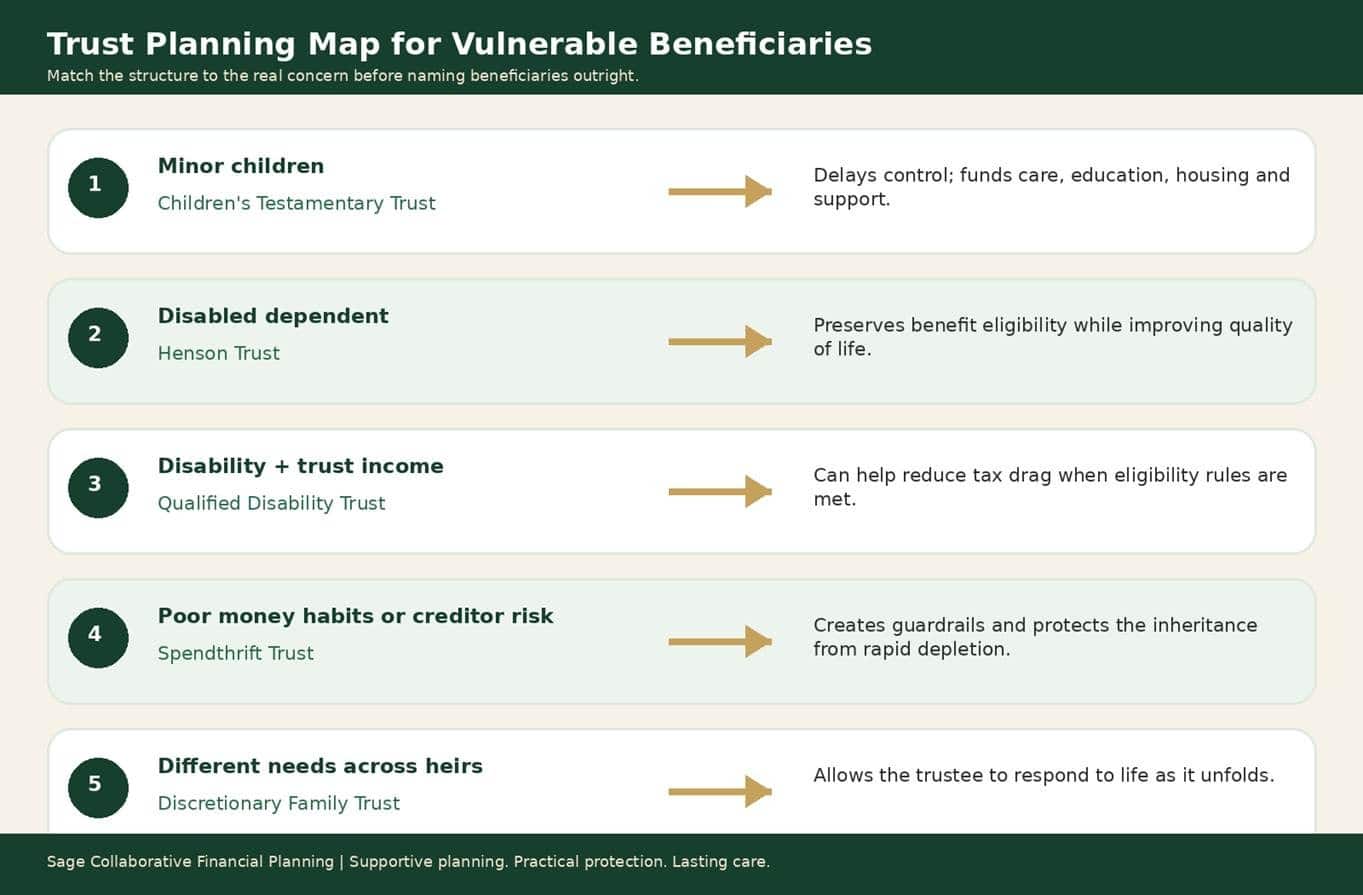
Infographic: different vulnerabilities call for different trust tools. The structure should follow the need, not the other way around.
At a glance: matching the right trust to the real concern
| Planning concern | Possible tool | Primary objective |
| Minor children | Children’s Testamentary Trust | Delays control, funds education and daily needs, and avoids unnecessary court involvement. |
| Disabled dependent receiving benefits | Henson Trust | Protects benefit eligibility while allowing supplemental quality-of-life support. |
| Disability-related tax exposure | Qualified Disability Trust | May allow graduated tax rates where the legal and tax conditions are met. |
| Beneficiary with poor money habits | Spendthrift Trust | Creates guardrails, protects capital, and supports basic needs over time. |
| Different needs among multiple heirs | Discretionary Family Trust | Gives trustees flexibility to respond to changing circumstances. |
1. When the goal is structured support for minor children
Children’s Testamentary Trust
A common estate planning risk is assuming that a will is enough when minor children are involved. In Canada, minors generally cannot manage significant property directly. Without a clear trust structure, money may need to be supervised by a court or public guardian, and the child may eventually receive a large amount before they are ready to handle it.
How it works
A Children’s Testamentary Trust is created in your will. If both parents pass away, the inheritance flows into the trust instead of directly to the child. The trustee can pay for health, education, housing, activities, and reasonable lifestyle needs while delaying full control until later ages.
Why families consider it
· Control over timing: you can use staged milestones, such as 25, 30 and 35, instead of one large payout at 18.
· Ongoing care: the trustee can keep school, housing, healthcare, and day-to-day needs funded.
· Reduced pressure: children are supported without being asked to manage adult-level financial decisions too early.
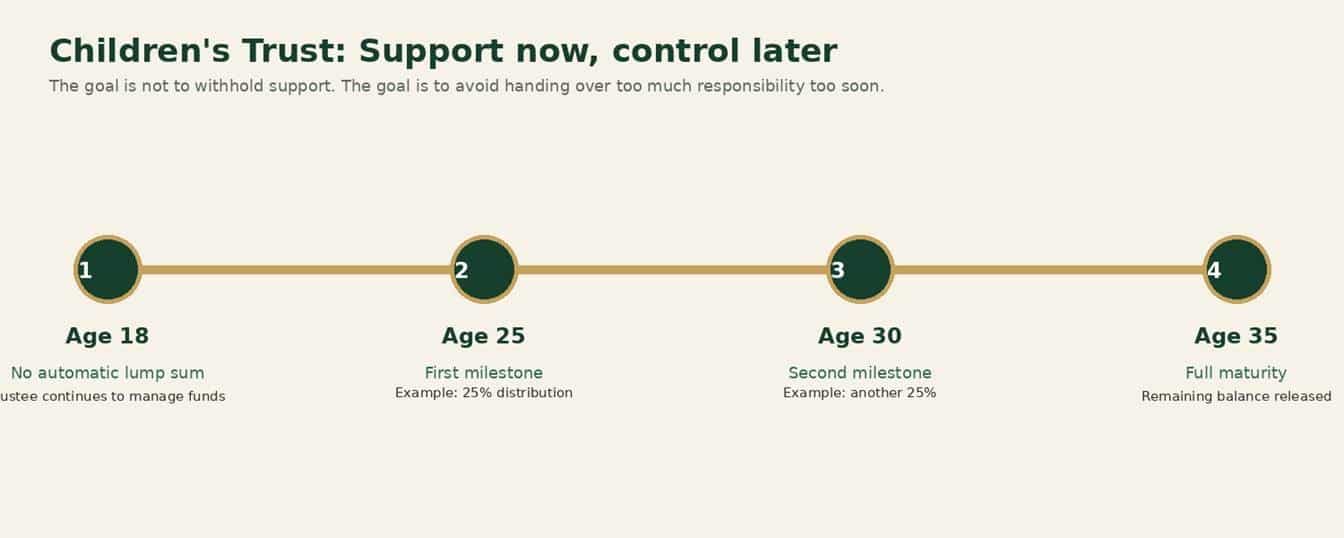
| Client example: Sara and Imran’s guardianship plan Situation: Sara and Imran have two young children and enough life insurance to create a strong safety net. Their worry is not whether their children will be provided for. Their worry is whether the money would be handed over too quickly. Planning approach: Their wills direct insurance proceeds and estate assets into a testamentary trust if both parents pass away. The trustee can pay for school, housing, healthcare, summer activities, and university costs. Result: The children are fully supported as they grow, while the main capital is released gradually at more mature ages. The planning creates care without creating avoidable financial pressure. |
2. When the goal is protecting disability benefits
Henson Trust
Planning for a loved one with a disability requires extra care. A direct inheritance can sometimes affect provincial income supports, drug coverage, housing supports, or other benefits. A Henson Trust is often considered when the goal is to leave meaningful support without accidentally disrupting benefits that are already essential.
How it works
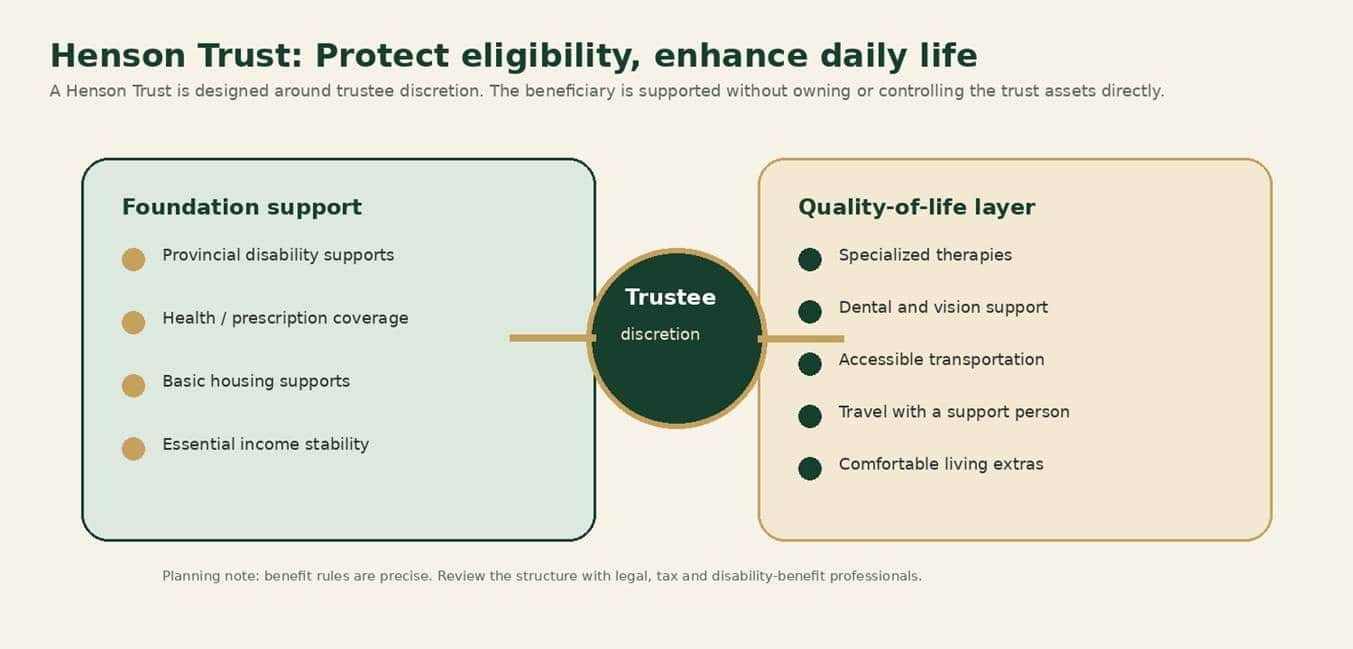
A Henson Trust is built around absolute trustee discretion. The beneficiary does not have the legal right to demand payments from the trust. Because the beneficiary does not control the assets directly, those assets may not be treated the same way as a direct inheritance for benefit eligibility purposes.
| Planning caution Benefit rules are provincial and precise. Henson Trust planning should always be coordinated with estate counsel, tax advisors, and professionals familiar with the relevant disability support program. |
Why families consider it
· Benefit preservation: the structure is designed to avoid replacing essential public supports with private money.
· Better quality of life: the trust can fund items that programs may not cover, such as therapies, dental work, transportation, electronics, companion travel, or comfort supports.
· Continuity: a named trustee can keep support flowing even if the parent or caregiver is no longer alive or able to manage the details.
| Client example: Nadia’s quality-of-life strategy Situation: Nadia wants to leave assets for her adult son, Liam, who relies on disability supports for housing and medications. She is worried that a direct inheritance could create more harm than help. Planning approach: Nadia includes a Henson Trust in her will and appoints a trusted family member and backup professional trustee to manage the funds. Result: Liam continues to have essential support in place, while the trust can improve his daily life with items and services that public programs may not cover. |
3. When the goal is reducing tax drag for a disabled beneficiary
Qualified Disability Trust
Many trusts pay tax at high flat rates on income retained inside the trust. For a trust that is meant to support a disabled beneficiary over many years, that tax drag can matter. A Qualified Disability Trust, or QDT, may help when the beneficiary and trust meet the required conditions.
What makes it different
A QDT is not a separate trust that replaces the underlying planning. It is generally a tax status/election for an eligible testamentary trust. When the rules are met, the trust may access graduated tax rates instead of being taxed at the highest marginal rate on retained income.
Where it may fit
· The beneficiary qualifies for the Disability Tax Credit.
· The trust is created by a will and meets the required testamentary trust conditions.
· The trustee and beneficiary make the appropriate annual tax election and coordinate filings properly.
| Plain-language takeaway The Henson Trust conversation is often about protecting benefits. The QDT conversation is often about reducing unnecessary tax erosion. In the right case, both conversations may need to happen together. |
| Client example: Protecting Liam’s trust from tax erosion Situation: Nadia’s trust for Liam is invested to support him for decades. If all investment income is taxed at the highest trust rate, less money remains available for his long-term care. Planning approach: Because Liam qualifies for the Disability Tax Credit, the trustee reviews whether the trust can file as a Qualified Disability Trust. Result: If eligible and filed properly, more of the trust income can remain available for Liam’s care instead of being lost to avoidable tax drag. |
4. When the goal is protection from mismanagement or outside risk
Spendthrift Trust
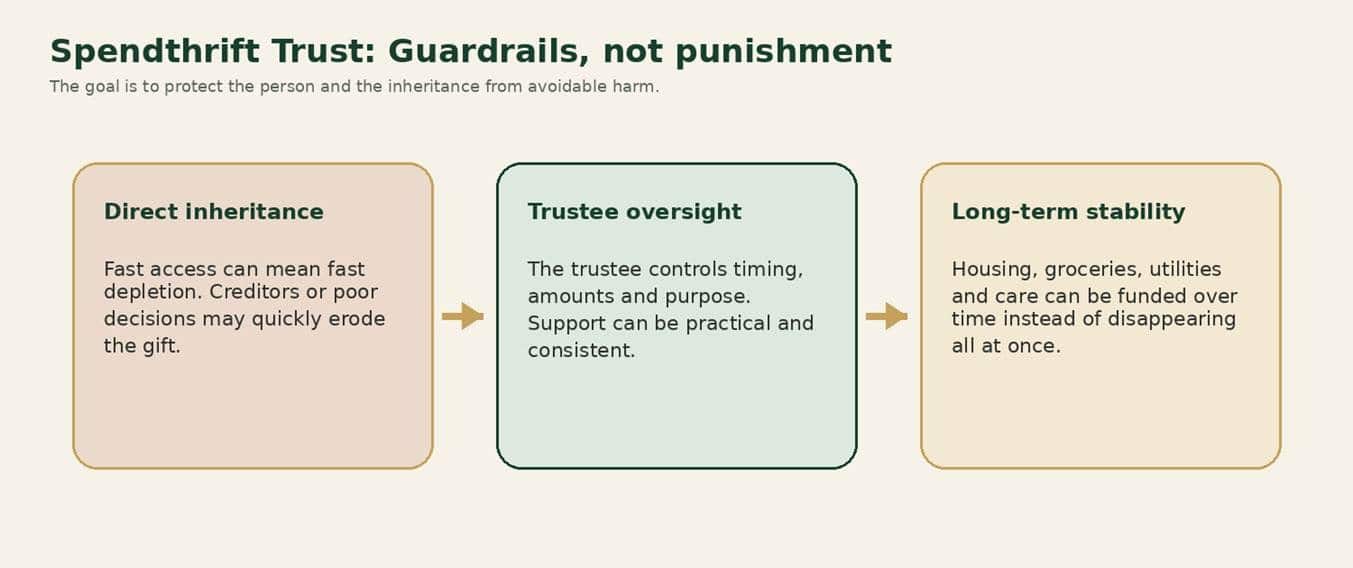
Some beneficiaries are deeply loved but not ready to manage a major inheritance. The concern may be addiction, gambling, significant debt, mental health challenges, manipulative relationships, or simply a long pattern of poor financial decisions. In these situations, planning is not about punishment. It is about protection.
How it works
A Spendthrift Trust limits the beneficiary’s ability to sell, pledge, assign, or quickly spend the inheritance. The trustee controls how and when funds are released and can pay certain expenses directly, such as rent, utilities, groceries, counselling, or treatment supports.
Why families consider it
· Prevents rapid depletion: the inheritance is not available to be spent all at once.
· Creates a stable floor: housing and basic needs can be supported consistently.
· Adds protection from pressure: the beneficiary is less exposed to creditors, scams, or people trying to access the funds.
| Client example: David and Claire’s support plan for Marcus Situation: David and Claire have an adult son, Marcus, who struggles with gambling and debt. They want him to be safe and housed, but they know a direct inheritance could disappear quickly. Planning approach: Their estate plan uses a Spendthrift Trust with clear instructions for the trustee to pay essential expenses directly and provide limited discretionary support. Result: Marcus does not receive a large lump sum, but he does receive what his parents most wanted for him: housing stability, food security, and a practical layer of protection. |
5. When the goal is flexibility across different children or heirs
Discretionary Family Trust
Fair does not always mean identical. One child may be independent and established. Another may still be in school. Another may need ongoing financial guardrails or disability-related support. A rigid estate plan can treat everyone the same on paper while creating very different real-life outcomes.
How it works
A Discretionary Family Trust gives the trustee authority to distribute income and capital based on the beneficiaries’ changing needs. The trust terms can provide guidance, but the trustee has room to respond to life as it unfolds.
Where it fits
· Families with children at very different ages or stages.
· Blended families where fairness requires careful judgment.
· Families who want an impartial decision-maker to balance education, housing, care, and long-term protection.
| Client example: The multi-stage family fund Situation: A couple has three children: one established adult, one university student, and one younger adult who has struggled with spending. Equal treatment sounds simple, but their actual needs are very different. Planning approach: The parents use a discretionary testamentary trust and give the trustee written guidance about education, housing, maturity, and responsible support. Result: The trustee can fund tuition, provide a home down-payment match where appropriate, and keep guardrails in place for the child who needs more structure. The result is not identical treatment, but thoughtful fairness. |
How the pieces can work together
In many real families, the answer is not one tool in isolation. The planning may combine a will-based trust, trustee discretion, insurance funding, disability-benefit review, and tax planning. The structure should be simple enough to administer, but strong enough to protect the people it was designed for.
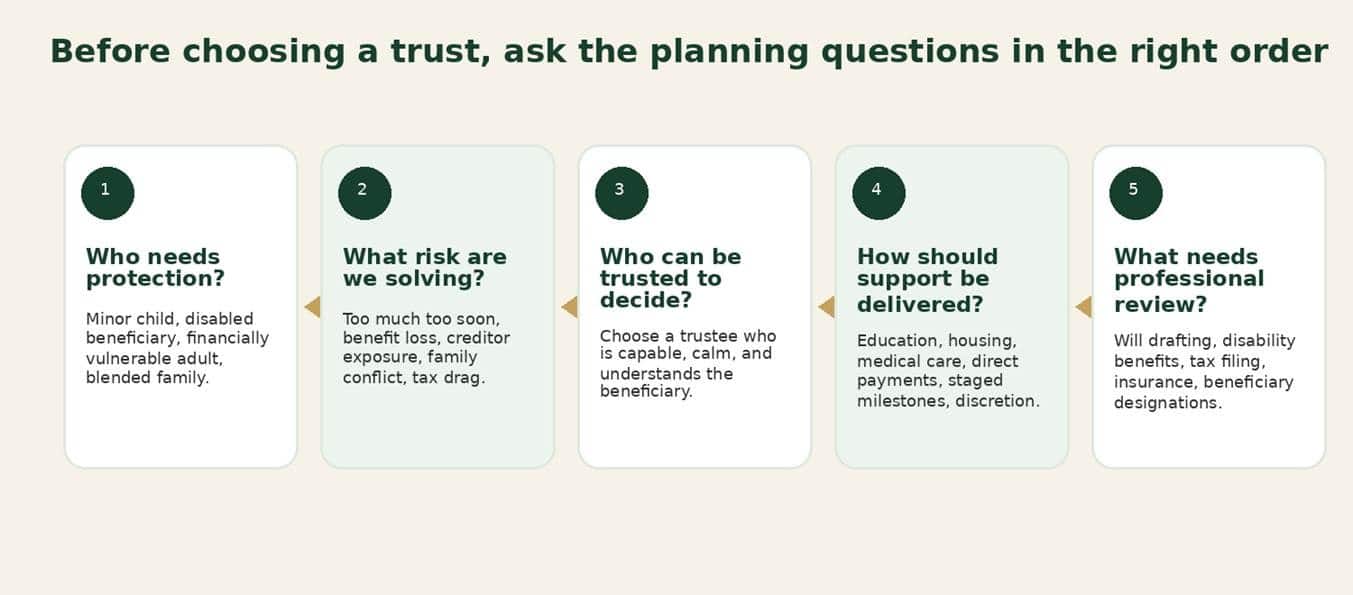
Infographic: strong trust planning starts with the beneficiary, the risk, and the trustee before moving into technical drafting.
Planning checklist: before you finalize the structure
| ✓ | Have you named the specific risk each beneficiary needs protection from? |
| ✓ | Have you chosen a trustee who is capable, calm, organized, and willing to serve? |
| ✓ | Have you named backup trustees in case your first choice cannot act? |
| ✓ | Have you given the trustee clear guidance without making the trust too rigid? |
| ✓ | Have you coordinated life insurance beneficiary designations with the trust plan? |
| ✓ | Have you reviewed disability benefits before leaving assets to a disabled beneficiary? |
| ✓ | Have you reviewed tax filing obligations for testamentary trusts and possible QDT status? |
| ✓ | Have you considered whether a professional or corporate trustee should be involved? |
| ✓ | Have you reviewed the plan with qualified legal, tax, and financial professionals? |
The ultimate act of protection
At the heart of this planning is a simple idea: some people need more than an inheritance. They need continuity, judgment, and support that does not disappear when life becomes complicated.
A trust can make sure that money is not simply transferred, but cared for. It can help a child grow into responsibility, protect a disabled loved one from losing essential supports, or give a financially vulnerable beneficiary a safe and steady foundation.
This is not about making estate planning more complicated than it needs to be. It is about making the plan thoughtful enough for the people it is meant to protect.
| Closing thought The most meaningful estate plans do not just pass on assets. They pass on stability, care, and the quiet reassurance that the people who matter most will not have to figure everything out alone. |
Important note
This article is for general educational purposes only and should not be treated as legal, tax, accounting, investment, or disability-benefit advice. Trust planning in Canada is technical, and rules can differ by province and by the beneficiary’s circumstances. Families should work with qualified estate lawyers, tax professionals, financial planners, and disability-benefit specialists before implementing any strategy.
— Sabiha
Planning With Ed

Ed Rempel has helped thousands of Canadians become financially secure. He is a fee-for-service financial planner, tax accountant, expert in many tax & investment strategies, and a popular and passionate blogger.
Ed has a unique understanding of how to be successful financially based on extensive real-life experience, having written nearly 1,000 comprehensive personal financial plans.
The “Planning with Ed” experience is about your life, not just money. Your Financial Plan is the GPS for your life.
Get your plan! Become financially secure and free to live the life you want.