

Retiring at an All-Time High: What History Actually Shows
I get this question a lot. Is a retirement plan safe if you retire when the markets are at an all-time high? Can you reasonably still expect good performance in the future?
The Conventional Wisdom About Retirement Risk
The conventional wisdom here is 3 things:
- The risk to your retirement is “sequence of returns risk” (SOR), meaning the risk of what happens if the first years are bad.
- The main risk is the first 5 years.
- You should protect your portfolio somehow by putting part of it into either cash or a fixed income investment like bonds.
All the questions I get about sequence of returns risk focus on 5 years. Why 5 years and not 3 or 10? Everyone is reading the same sources and studies. I can guess the logic is that markets give you a normal 10%/year return for 5 years and you only withdrew 4%/year, then you should be ahead of your goal. However, if you are worried about the first 5 years, there is an obvious question: “After 5 years, is the main risk done or is the next 5 years the main risk now?” If the next 5 years is always the main risk, then the risk is your entire retirement!
I have heard hundreds of variations of how much and which income investment should protect you, but the questions essentially always include fixed income as the answer to the risk of temporary market declines.
My Unconventional Wisdom
Here is my unconventional wisdom based on studies and actual experience:
- Markets are not necessarily riskier when they are at an all-time high. All-time highs happen all the time.
- Sequence of returns risk is not a thing for a 30-year retirement.
- You do not need any fixed income investments, unless that will help you stay invested.
- If you have any fixed income investments, you should assume that you will have less growth and less cash flow during your retirement.
- People who don’t think about sequence of returns risk usually have significantly more comfortable retirements.
Note that if you need fixed income to stay invested, then it is probably better for you to have some. Markets have reliably provided strong long-term returns, but only if you stay fully invested for the long term. Many people cannot stay fully invested after a large market decline.
My unconventional wisdom applies to people who want to optimize and maximize their retirement and have the risk tolerance to stay invested right through any market declines. Not nearly everyone can do this, but it is a highly valuable skill and is the way to reliably maximize your retirement. Remember, high risk tolerance is the ability to do nothing after a major market decline.
Are Markets Riskier at an All-Time High?
Why are markets not riskier at an all-time high? The markets typically rise in 3 of 4 years, so most years include an all-time high. They happen all the time – in about 60% of years. After a large market gain, the most likely next year based on history is another gain. If you become more defensive when the market is at an all-time high, you will be defensive most of the time!
Sequence of Returns Risk Over a 30-Year Retirement
How can I say sequence of returns risk is not a thing for a 30-year retirement? Looking at the stock markets for the last 95 years (the modern stock market), the worst 25-year period had a gain of 8%/year. That is the worst period. The worst 25-year period in the last 150 years had a gain of 5%/year.
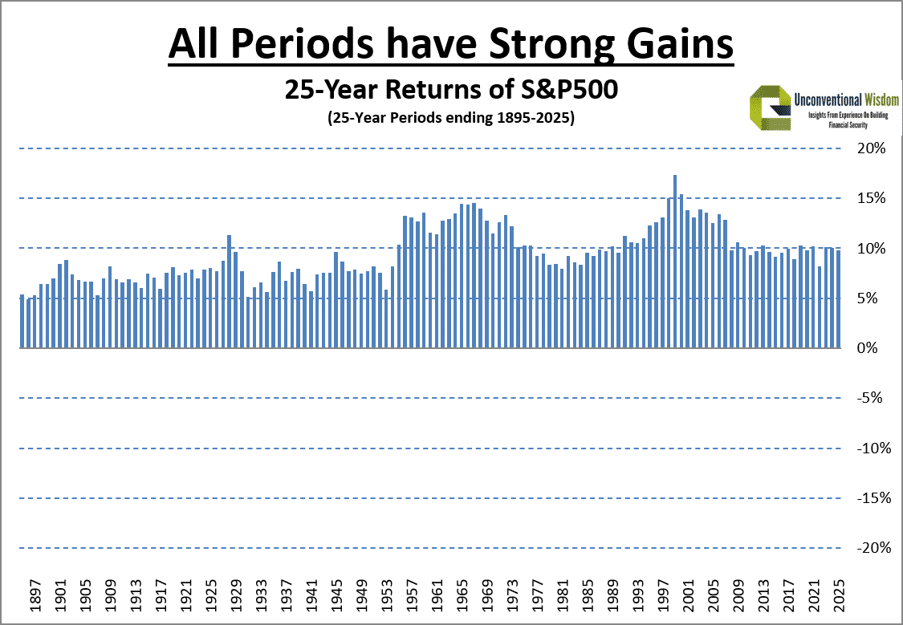
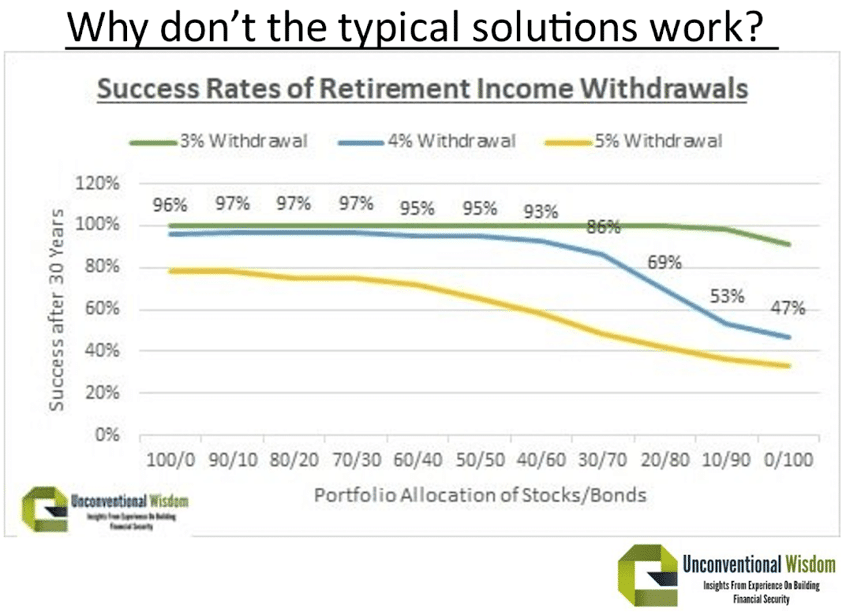
My point is that the stock market has reliably provided strong returns over the long term – even when the first years are bad. In fact, my study showed adding fixed income consistently increased your risk of running out of money during retirement. Fixed income makes a 30-year retirement MORE risky, not less risky. There is no guarantee that this will always be true, but it has been true in the last 150 years.
The 4% Rule and Fixed Income
The general recommended withdrawal guideline for your retirement is the “4% Rule”, which says you should withdraw 4% of your retirement investments the first year and then increase that by inflation every year – regardless of what the markets do. I studied this 4% Rule in detail for the last 150 years and found that a 100% equity portfolio with no fixed income has provided a reliable retirement 96% of the time with no management. If you manage your withdrawals effectively by taking less if you find yourself withdrawing more then 5% or 6% of your portfolio, then it has worked 100% of the time the last 150 years.
Fixed income successfully provided a 30-year retirement with the 4% Rule less than half the time. Fixed income usually fails over 30 years. This is because you need an income that rises with inflation – not a fixed income. Don’t assume that adding fixed income is safer over a 30-year retirement.
Bottom line: You do not need any fixed income investments, unless that will help you stay invested.
The Cost of Holding Cash or Fixed Income
What is wrong with holding a bit of cash or fixed income to use after a market crash? The problem is that you hold that low-return investment for your entire retirement. That means you almost definitely will have lower returns, and therefore less cash flow during your retirement.
For example, you put just 10% of your investments into fixed income. If that 10% averages 6%/year lower return than the stock market, then your long-term return of your portfolio is .6% lower – such as 7.4%/year instead of 8%/year. With compounding over 30 years, that is 15% less growth! You may or may not be able to use the cash after a market decline and then replenish it when the markets are higher (because market timing is hard), but you do lose the 15% of your return for 30 years. The lower returns you get for 30 years is why studies show holding cash or fixed income of any amount does not help you provide more for your retirement.
I studied holding cash holdings of a wide variety of sizes over the last 150 years and could not find even one example where it was helpful over a 30-year retirement. There was not a single time in the last 150 years when you would have run out of money with 100% in equities when you would not have if you had any amount of fixed income. Of course, the 100% equity portfolio always provided much more growth and cash flow during retirement.
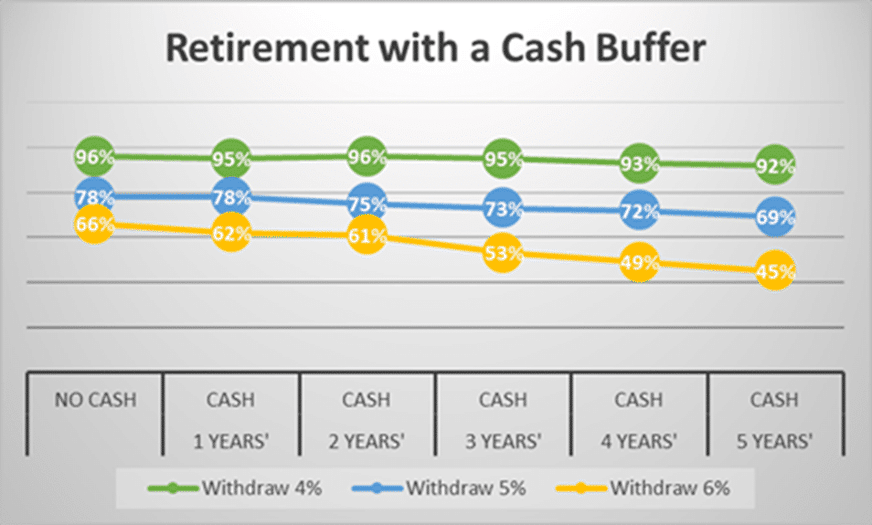
Bottom line: If you hold any cash or fixed income through your retirement, you should assume you will have less cash flow during your retirement.
Retiring at an All-Time High: The Bottom Line
The bottom line to questions about “Retiring when Markets are at an All-Time High” is that they are usually at an all-time high, so it does not necessarily mean anything. You can have the highest, reliable retirement if you ignore sequence of returns risk. Stay invested for long-term growth right through your retirement. Use your Financial Plan or a guideline like the 4% Rule to withdraw about 4% of your portfolio the first year and then just increase that by inflation every year to maintain the purchasing power of your retirement income. Monitor how much you withdraw each year and consider taking less if you find yourself withdrawing more than 5% or 6% of your portfolio in any year.
Note that when you have a professional retirement plan, your actual income each year is based on your desired lifestyle. The amount you withdraw is calculated more precisely and may vary quite a bit from the 4% Rule. Following your Financial Plan is usually the most effective and reliable advice. The 4% Rule is just a guideline.
We have extensive experience with this working with many retired clients for years, including some that retired just before 2008 (the worst crash since 1930s). Staying fully invested in equities (especially global and US growth equities) right through your retirement, following your Financial Plan, and monitoring your withdrawals has worked for us and our clients reliably. It is amazing how comfortable your retirement can be when your portfolio continues to give you strong growth all the way through your retirement!
Check out the Reviews page on my blog for stories like the story of P.H. from Brampton who said, “With Ed’s knowledge and vision, he has shown how his plan can generate $15-20,000 of additional income per year throughout our retirement years. And THAT, in short, is the difference between penny pinching “golden years” or the freedom to finance all the plans we had already made, but for which we didn’t really know if the money would be there or not. “
In short, our extensive experience is that you can have the most comfortable, reliable retirement by ignoring all the conventional wisdom. Just relax, stay focused on long-term growth, and enjoy your comfortable retirement.
Ed
Planning With Ed

Ed Rempel has helped thousands of Canadians become financially secure. He is a fee-for-service financial planner, tax accountant, expert in many tax & investment strategies, and a popular and passionate blogger.
Ed has a unique understanding of how to be successful financially based on extensive real-life experience, having written nearly 1,000 comprehensive personal financial plans.
The “Planning with Ed” experience is about your life, not just money. Your Financial Plan is the GPS for your life.
Get your plan! Become financially secure and free to live the life you want.