

National Post article: Could an RRSP/RRIF meltdown reduce Liam’s GIS clawback without triggering a big tax bill?
Liam thinks he is in a 19% tax bracket.
He isn’t.
He is effectively in a 50% tax bracket because he pays 0% income tax, but loses 50% of additional taxable income through the GIS clawback.
His situation is interesting because:
- His cash income, taxable income and income for GIS purposes are three very different numbers, which is part of why his situation is so complex.
- Most retirees simply take the minimum RRIF withdrawal. For Liam, that could be a poor strategy because he could lose 50% of those withdrawals through reduced GIS over the years.
- He is considering an RRSP Meltdown Strategy. The traditional version involves borrowing to invest, which could work exceptionally well for him, but is probably too aggressive and complex.
- Liam is thinking about withdrawing $30,000–$35,000/year from his RRSP, but the optimal amount is much higher — about $66,000/year. It means about 2/3 of his RRSP would be taxed about 21%, instead of the 50% clawback.
- It’s unconventional, but after about four years of eliminating his RRSP, he could receive roughly $10,000/year in GIS for the rest of his life.
- The $66,000/year RRSP meltdown also works beautifully with his plan to buy a new car in four years.
- He only has somewhat more money than he needs for his lifestyle for the rest of his life, so he probably should not give much to his nieces and nephews. It is more important to stay financially independent and never have to ask family for money.
In my latest article for the National Post, I look at why withdrawing more from an RRSP now can sometimes leave you better off later.
CLICK THE LINK BELOW TO READ THE ARTICLE BY MARY TERESA BITTI:
Could an RRSP/RRIF meltdown reduce Liam’s GIS clawbak without triggering a big tax bill?
Liam*, 67, is retired, single, and focused on managing his finances as effectively and efficiently as possible.
He is considering a Registered Retirement Savings Plan/Registered Retirement Income Fund meltdown, a tax strategy that involves drawing down his retirement savings before required to increase his income and smooth out lifetime tax.
He is also looking into a reverse mortgage as a living inheritance for his nieces and nephews or to free up funds to expand his modest lifestyle.
Liam lives in Ontario where he owns a home valued between $650,000 and $700,000. His monthly income is about $3,000 from part-time work ($500), Canada Pension Plan benefits ($510), Old Age Security 65 ($740), and Guaranteed Income Supplement payments ($1,000), and dividends ($250 automatically deposited to a Tax-Free Savings Account). His monthly expenses are $2,200, including saving $50,000 over the next four years for a new vehicle and $850 in payments on a $78,000 mortgage.
“I could pay off the mortgage, but I prefer leaving that money in my TFSA where it can grow,” he said. He may downsize down the road if the house becomes too much or to boost his investments.
Liam’s portfolio includes nearly $240,000 in RRSPs and about $120,000 in a TFSA invested in a mix of growth and conservative bank-managed mutual funds. He has $30,000 in contribution room in his TFSA.
While Liam thinks withdrawing the RRIF minimum and tapping into his TFSA as needed should be able to cover his expenses, he wonders if there is a strategy that could create more financial flexibility without impacting government benefits and reduce lifetime taxes.
For example, in 2030, after he has converted his RRSP, which estimates should be worth about $300,000 at the end of 2029, to a RRIF, does it make sense to start to “meltdown” the account? Specifically, he wonders if, in addition to CPP and OAS, he should apply his marginal tax rate of 19.05 per cent to systematically withdraw between $30,000 to $35,000 a year from his RRIF and contribute any funds he doesn’t immediately need to his TFSA and to pay off any potential tax liability.
If so, when?
“Should I wait until later in the year (November/December) to calculate and execute this extra ‘meltdown withdrawal’?” he asked.
“Is there a better way to manage cash flow and tax-plan in my 70s and 80s?
Financial Plan
Liam’s case is typical of many low-income seniors who think their situation is simple and low tax, but it’s actually complicated and high tax. He has a good opportunity, but it is unconventional.
Liam needs $220,000 to support his lifestyle of $36,000/year after tax for the rest of his life, which is okay because he has $360,000. He has enough money.
The reason he needs this much when he is only withdrawing $3,000/year from his investments (from his TFSA) is because he will stop working at some point, he will be forced to start withdrawing from his RRSP, and he will lose a chunk of his GIS. How much GIS he loses depends on what he does.
Tax Planning
he wonders if there is a strategy that could create more financial flexibility without impacting government benefits and reduce lifetime taxes.
Liam thinks he is in a low 19% tax bracket, but he is actually in a high 50% tax bracket, which applies to many low-income seniors. He does not actually pay income tax, because his taxable income is less than his basic and age tax credits. However, his GIS is clawed back by 50% of his adjusted taxable income.
Liam gets $36,000/year in cash income, but only $21,000 of it is taxable and $6,620 reduces his GIS. His GIS is reduced by 50% of his income, but there are specific rules for which income is clawed back and which is not. Here are the details:
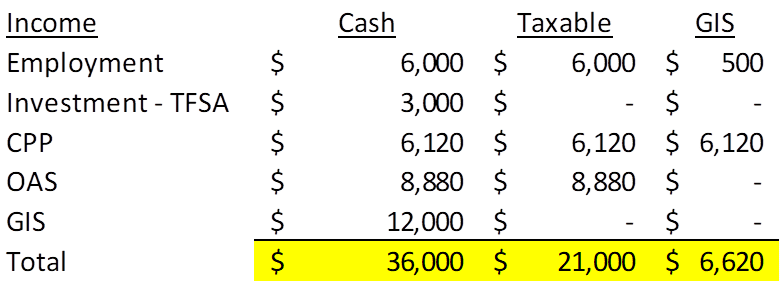
His employment income is taxable, but the first $5,000 does not count to reduce his GIS and only 50% of the next $10,000 counts. So only $500 of his $6,000 employment income reduces GIS by $250.
He thinks he gets a “dividend”, but it is really a combination of interest and some return of his own money from a mortgage fund, but it is not taxable because it is a withdrawal from his TFSA.
CPP is taxable and reduces his GIS by $3,060. OAS is taxable, but GIS is not, and neither reduces GIS.
The basic tax credit that everyone gets plus the age credit for being over 65 total to about $25,660, which more than offsets all his taxable income, so he pays no income tax. He does not pay 19%. He pays 0% income tax.
However, every additional dollar of taxable income he earns will reduce his GIS with the 50% clawback. Whenever he withdraws from his RRSP, he will lose 50% of the withdrawal in GIS. He is essentially in a 50% tax bracket because he loses 50% of any taxable income to the government.
RRSP/RRIF Meltdown Strategy
The actual RRIF Meltdown Strategy involves borrowing to invest and using your RRIF to pay the tax-deductible interest. Liam has not mentioned this and he probably does not have the risk tolerance for it, but it would work exceptionally well for him if he took out a reverse mortgage and invested the proceeds.
Liam would likely not qualify for any mortgage other than a reverse mortgage. The bank would likely lend him up to $250,000-$300,000. The interest would be about $10,000/year, which is roughly equal to his minimum RRIF. It could mean that he would get close to the maximum GIS all his life and have a simple minimum RRSF withdrawal, but it is a complex strategy to borrow to invest, withdraw a sustainable amount and invest tax-efficiently. This is probably not the right strategy for Liam because he invests conservatively and has no experience borrowing to invest.
…does it make sense to start to “meltdown” the account? Specifically, he wonders if, in addition to CPP and OAS, he should apply his marginal tax rate of 19.05 per cent to systematically withdraw between $30,000 to $35,000 a year from his RRIF and contribute any funds he doesn’t immediately need to his TFSA
Most retirees do the simple approach and just take the minimum RRIF. This will be somewhat of a disaster for Liam because he will lose 50% of all of his RRIF to reduced GIS over the years. For example, the minimum RRIF for him would be about $13,000/year, which would reduce his GIS by $6,500 with the 50% clawback. His GIS would drop from $12,000/year to $5,500/year.
Liam is thinking about a “meltdown” by withdrawing $30,000 or $35,000 per year from his RRSP to melt it down and invest in his TFSA, so that eventually it will be gone and he won’t have his GIS clawed back. Since he gets $12,000/year of GIS, the 50% clawback on the first $24,000/year he withdraws will eliminate his GIS. Withdrawing $30-35,000 would mean only a bit is does not affect his clawback. The $5-11,000 above the clawback would be taxed at 19%.
He has the right idea, but the optimal amount is withdrawing $66,000/year from his RRSP, which is much higher. It is unconventional to withdraw that much! This works because it would bring his taxable income up to $94,000 which would be taxed at various tax rates of 33% or less. Any larger withdrawal would be taxed at 44% which is almost as much as the GIS clawback of 50%.
This RRSP Meltdown Strategy would eliminate his RRSP in about 3.6 years. He would lose his GIS completely for 4 years and pay about $14,500/year income tax. It means about 2/3 of his RRSP would be taxed about 21%, instead of the 50% clawback. After the 4 years, he should get about $10,000/year GIS for the rest of his life.
The bank would withhold about $20,000 of tax and he should get a refund for the $5,500 difference. He should maximize his TFSA every year and invest the rest in a non-registered account that is very tax efficient. Over the 4 years, he should accumulate about $90,000 for his non-registered account and maximize his TFSA every year.
He will lose 50% of any taxable income from this non-registered account for the rest of his life. With tax-efficient investing, he should only have $1,000-3,000/year of taxable income. Tax-efficient investing will be very important for Liam, since he will effectively be in a 50% tax bracket – like the very high-income earners!
If so, when? “Should I wait until later in the year (November/December) to calculate and execute this extra ‘meltdown withdrawal’?” he asked.
He should do this RRSP Meltdown Strategy starting this year. The longer his RRSP grows, the more tax & GIS he will lose when he withdraws it.
Ideally, he should wait until near the end of the year and then estimate his taxable income for the year. The optimal RRSP withdrawal is the amount that will bring his taxable income up to $94,000.
Mortgage, Car Purchase and Estate
“I could pay off the mortgage, but I prefer leaving that money in my TFSA where it can grow,” he said. He may downsize down the road if the house becomes too much or to boost his investments.
This is good thinking. His investments today are about 54% equities and 46% fixed income, so he should expect a long-term average return of about 5.25%. He can renew his mortgage at 3.7%, so it is better for him to keep the investments and the mortgage.
…saving $50,000 over the next four years for a new vehicle.
Liam is trying to save $50,000 over 4 years, but does not really have the cash flow to do this. The RRSP Meltdown Strategy should give him about $90,000 in addition to maximizing his TFSA, which can allow him to buy his car in 4 years. It’s a nice coincidence that he wants to buy the car in 4 years and the optimal RRSP Meltdown is over 4 years.
He is also looking into a reverse mortgage as a living inheritance for his nieces and nephews or to free up funds to expand his modest lifestyle.
Liam would likely not qualify for any mortgage other than a reverse mortgage. He has about $140,000 more than he needs to support his lifestyle for the rest of his life, but he should keep a comfortable margin of safety above this.
It is probably not advisable for him to give much to his nieces and nephews. He should make sure first that he will be financially independent and have enough for himself, and never need financial help from his family.
Ed
Planning With Ed

Ed Rempel has helped thousands of Canadians become financially secure. He is a fee-for-service financial planner, tax accountant, expert in many tax & investment strategies, and a popular and passionate blogger.
Ed has a unique understanding of how to be successful financially based on extensive real-life experience, having written nearly 1,000 comprehensive personal financial plans.
The “Planning with Ed” experience is about your life, not just money. Your Financial Plan is the GPS for your life.
Get your plan! Become financially secure and free to live the life you want.