

Budgeting With a Full-Time Income Without Feeling Restricted
A practical guide to managing your first full-time income with clarity, consistency, and room to enjoy your life.
The Moment Your Income Starts Feeling Real
There is a moment that happens a few months after you start earning a full-time income.
First, everything feels new – your paycheques, your routines, your sense of independence. But then something shifts. You are paying your bills, buying groceries, going out, and still asking yourself: where did all my money go?
It is usually not because you are irresponsible. It is because no one ever taught you how to manage a full-time income in a way that feels supportive instead of suffocating.
So, this is not about a restrictive, colour-coded, track-every-coffee budget. It is about a system that helps you breathe easier, enjoy your life, and still move forward.
| ReframeBudgeting is not about controlling every dollar. It is about creating clarity, so money does not control you. |
Why Most Budgets Fail
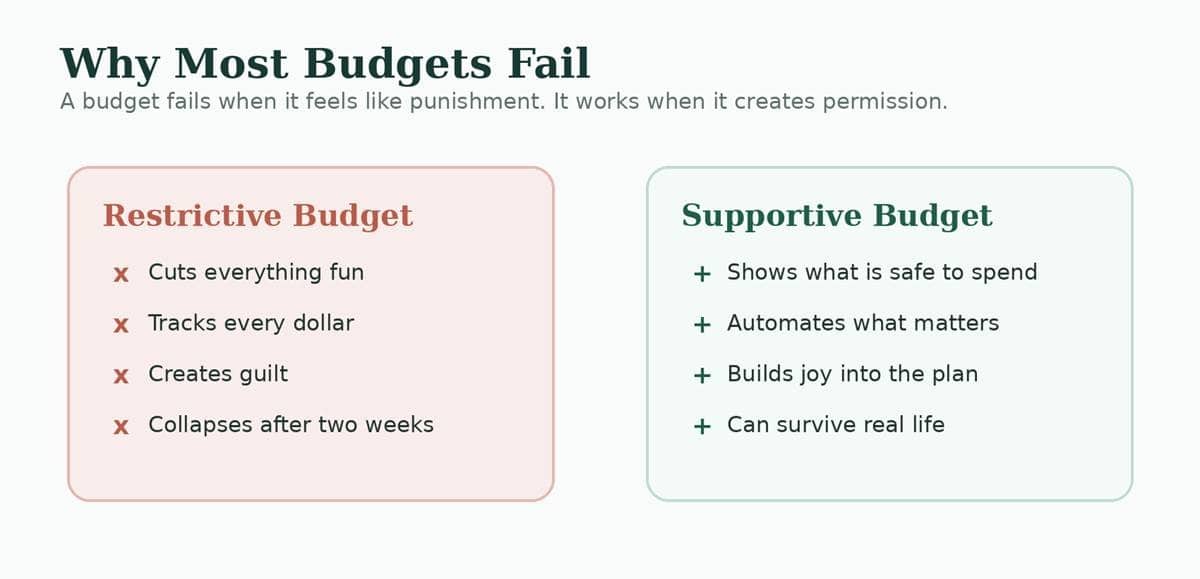
A supportive budget gives permission and clarity. A restrictive budget usually collapses.
Most people hear the word budget and immediately think about cutting everything fun, tracking every dollar, and feeling guilty about spending. No wonder people avoid it.
But a good budget is not about restriction. It is about clarity. It tells you what is safe to spend, what needs to be protected, and what can be enjoyed without anxiety.
| Core ideaA budget is not a cage. It is a map. It shows you what is safe to spend so you can enjoy your money without anxiety. |
The Three-Bucket Budget
Instead of a complicated spreadsheet, think of your money in three buckets.
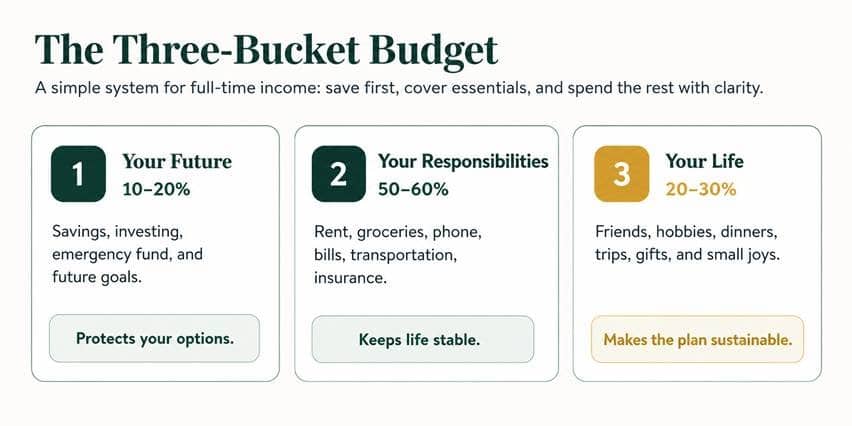
The target ranges are flexible. The goal is consistency, not perfection.
| Bucket | Target Range | Purpose |
| Your Future | 10-20% | Savings, investing, emergency fund, future goals, and long-term freedom. |
| Your Responsibilities | 50-60% | Rent, groceries, phone, bills, transportation, insurance, debt payments, and must-pay expenses. |
| Your Life | 20-30% | Fun money, hobbies, dinners out, weekend trips, gifts, clothes, and small joys. |
| Planning noteIf your rent or cost of living is high, these ranges may not fit perfectly at first. Start with the structure, then adjust the percentages to reflect real life. |
Two People, Two Budgets, Two Very Different Experiences
Let us revisit Aisha and Jason from the first-paycheque conversation.
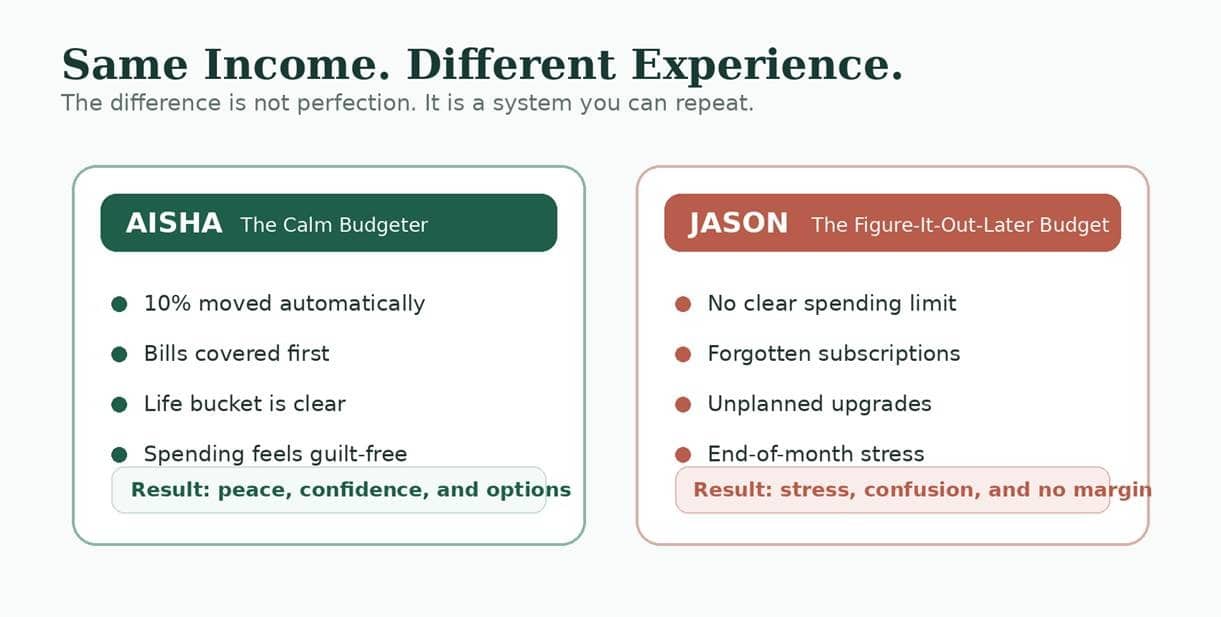
Aisha and Jason earn similar incomes. The difference is the system around their money.
Aisha – The Calm Budgeter
Aisha did not create a perfect spreadsheet. She did not track every purchase. She simply divided her money into three buckets and automated the first two.
· 10% to savings
· 55% to essentials
· 35% to living her life
She knew her bills were covered. She knew her savings were growing. She knew exactly how much she could spend guilt-free. She was not magically good with money – she was consistent.
Jason – The Figure-It-Out-Later Budget
Jason avoided budgeting because he did not want to feel restricted. He wanted freedom. But without a plan, his money slipped through the cracks.
· A few extra dinners out
· A subscription he forgot about
· A weekend trip he did not plan for
· A new gadget he convinced himself he deserved
By the end of the month, Jason was not sure where his money went – only that it went fast. He did not feel free. He felt stressed because he did not know what was safe to spend.
| The lessonFreedom does not come from ignoring your money. It comes from knowing what is safe to spend. |
A Real Full-Time Income Budget Example
Let us say your monthly take-home pay is $3,800. Here is one simple, healthy budget framework.
| Category | Monthly Amount | What it covers |
| Your Future | $380 | Savings or investing moved automatically on payday. |
| Rent / Housing | $1,700 | The biggest fixed cost. Roommates, location, or family support can change the math. |
| Utilities + Internet | $200 | Keeping the lights on and the internet working. |
| Phone | $100 | A realistic Canadian phone-line estimate. |
| Groceries | $450 | Food basics and meal-prep baseline. |
| Transportation | $250 | Transit, gas, parking, or commuting costs. |
| Insurance / Misc. | $170 | Insurance, subscriptions, gym, cloud storage, or other recurring costs. |
| Your Life | ~$550 | Fun, hobbies, gifts, entertainment, travel savings, and small joys. |
| Key ideaThis is not restrictive. You are saving, paying your bills, and giving yourself permission to enjoy the rest. |
The Secret to Budgeting Without Feeling Restricted
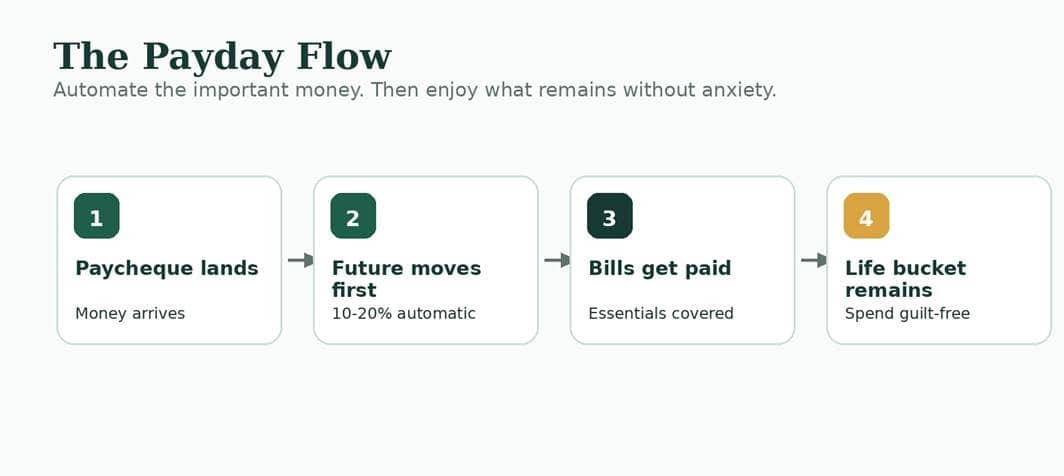
The system works because the important money moves before you have to make another decision.
Here is the part that changes everything: you do not need to track every dollar. You just need to automate the important ones.
When your paycheque lands:
· Your savings move automatically.
· Your bills get paid.
· Whatever remains is yours to enjoy.
That means no guilt, no spreadsheet anxiety, and no constant second-guessing. Just clarity.
| Simple operating ruleAutomate the money that protects you. Then give yourself permission to enjoy the money that remains. |
Add Sinking Funds So Life Does Not Surprise You
One enhancement that makes this system much stronger is adding small sinking funds inside your Life or Future bucket. A sinking fund is money set aside for an expense you know is coming, even if it is not monthly.
| Sinking Fund | Example Amount | Why it helps |
| Gifts | $25-$50/month | Birthdays, holidays, weddings, and special occasions. |
| Travel | $50-$150/month | Weekend trips, flights, hotels, or vacation spending. |
| Annual costs | $25-$100/month | Subscriptions, license renewals, memberships, or insurance surprises. |
When the Numbers Do Not Fit
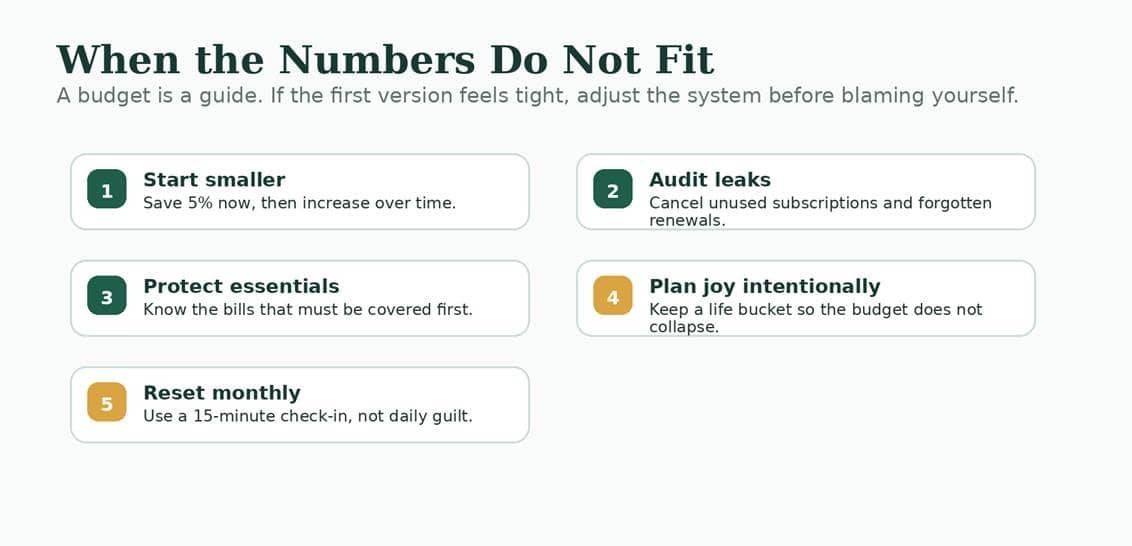
A budget is a guide. When life is expensive, adjust the plan instead of abandoning it.
Some months, the three-bucket budget will not fit perfectly. Rent may be too high. Groceries may jump. A car repair may hit. That does not mean you failed. It means the system needs a reset.
Use this order of operations
· Start with a smaller savings rate if 10% is not realistic yet – even 3% to 5% builds the habit.
· Review recurring expenses before cutting the things that genuinely bring you joy.
· Separate true essentials from lifestyle upgrades that became automatic.
· Keep a Life bucket, even if it is small, so the budget does not feel like punishment.
· Revisit the numbers monthly instead of judging yourself daily.
| Reality checkThe goal is not a perfect budget. The goal is to have a repeatable system that can survive real life. |
Why This Works Emotionally, Not Just Financially
Budgeting is not really about controlling your money. It is about creating a life where money does not control you.
· Permission to enjoy your life.
· Confidence that you are moving forward.
· Protection from unexpected expenses.
· You can feel a sense of stability.
Your Monthly Money Check-In
You do not need a complicated tracking system. A 15-minute monthly check-in is enough to keep the system alive.
| Step | Action | What to do |
| 1 | Look at what came in. | Confirm your total take-home income for the month. |
| 2 | Check your three buckets. | Did Future, Responsibilities, and Life stay roughly on track? |
| 3 | Spot one leak. | Find one subscription, fee, or habit that no longer fits. |
| 4 | Plan one joy item. | Choose one thing you can enjoy on purpose this month. |
| 5 | Adjust next month. | Make one small improvement, not a full lifestyle overhaul. |
Final Thought
Here is the thing no one tells you when you start earning a full-time income: you are not just learning how to manage money. You are learning how to manage your life.
You are learning how to take care of yourself, build stability, create a future that feels safe, and still enjoy the life you are working so hard to build.
Budgeting is not about restriction. It is about giving yourself room to breathe. It is about knowing that you can enjoy today and still protect tomorrow.
You do not need perfection. You need consistency. Keep saving your first percentage, keep honouring your responsibilities, and keep giving yourself permission to enjoy the life you are building.
Your Payday Checklist
| Step | Action |
| 1 | Move 10-20% to your Future bucket automatically. |
| 2 | Confirm rent, bills, and essentials are covered. |
| 3 | Send small amounts to sinking funds for future expenses. |
| 4 | Give yourself a clear Life bucket for guilt-free spending. |
| 5 | Do one 15-minute monthly check-in. |
| 6 | Adjust the system when life changes – do not abandon it. |
Disclaimer
| Educational content onlyThis article is for general educational purposes only and should not be considered personalized financial, investment, tax, legal, credit, or debt advice. Budget percentages and strategies should be reviewed based on your income, goals, province, debt obligations, risk tolerance, and personal circumstances. |
— Sabiha
Meet Sabiha Mukadam

Sabiha Mukadam is a Senior Planner with Ed Rempel and Sage Collaborative Financial Planning, where she supports Full-Service clients in achieving their plans by reviewing financial strategies and guiding thoughtful decisions over time.
She and Ed have worked together for eight years, sharing a philosophy of long-term thinking, practical strategies, and real-life decisions people can follow. Through Advice from the Sage Owl and Youth Corner, Sabiha helps people build clarity, confidence, and a stronger understanding of the behavioural side of financial planning.