

Secure Your Future Together: The Power of Trust Planning for Couples
Beyond the Will: How Canadian Couples Can Use Trusts to Protect Each Other
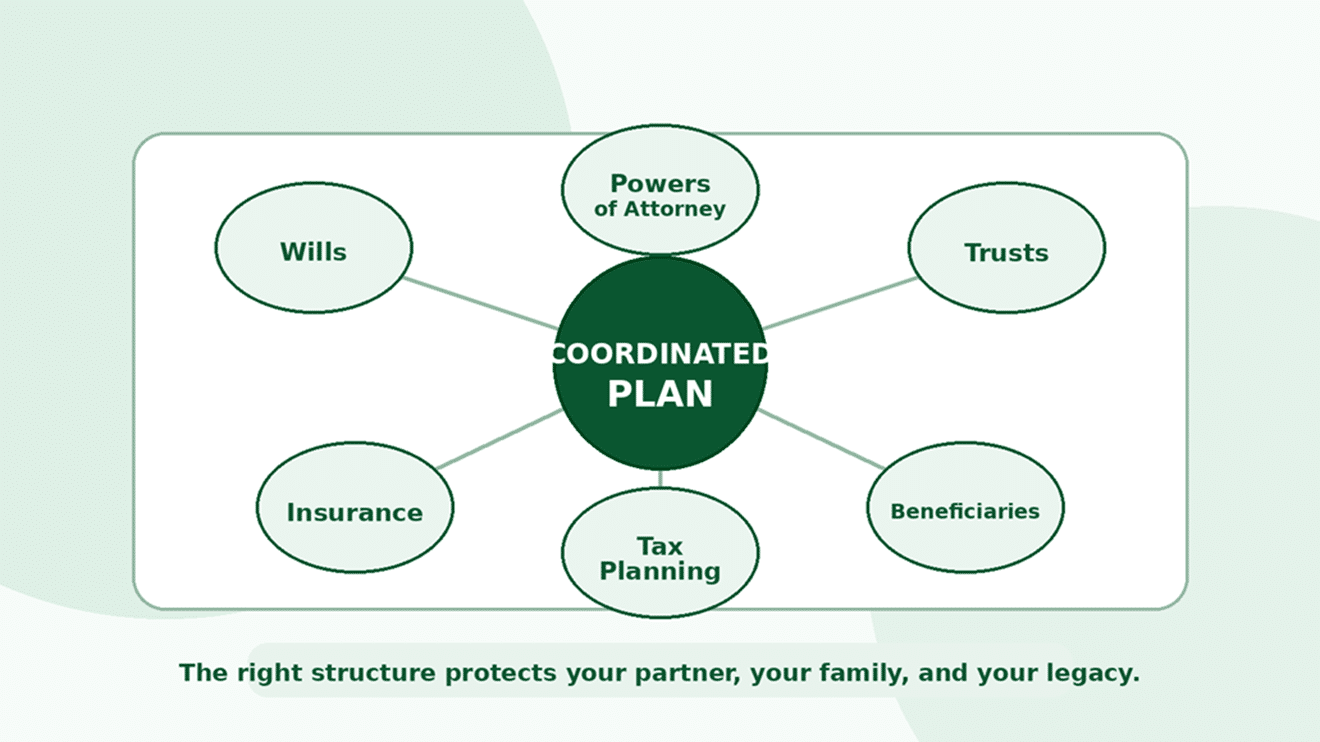
A guide to achieve continuity, clarity, tax efficiency, and family harmony.
Beyond the Will: How Canadian Couples Can Use Trusts to Protect Each Other
Most Canadian couples believe their estate plan is complete once they have wills, powers of attorney, and beneficiary designations in place.
Those documents matter, but they do not always solve the questions that create real stress later:
- What happens if one spouse loses capacity?
- Will the survivor have immediate access to funds?
- Will probate delay the family?
- Could a blended family create conflict?
- Will taxes force the sale of important assets?
This is where trust planning becomes powerful.
A trust is not simply a legal structure. Used properly, it is a coordination tool—one that can bring investments, real estate, family structure, business interests, and long-term intentions into alignment.
For Canadian couples, the goal is not complexity. It is continuity, clarity, tax efficiency, and family harmony.
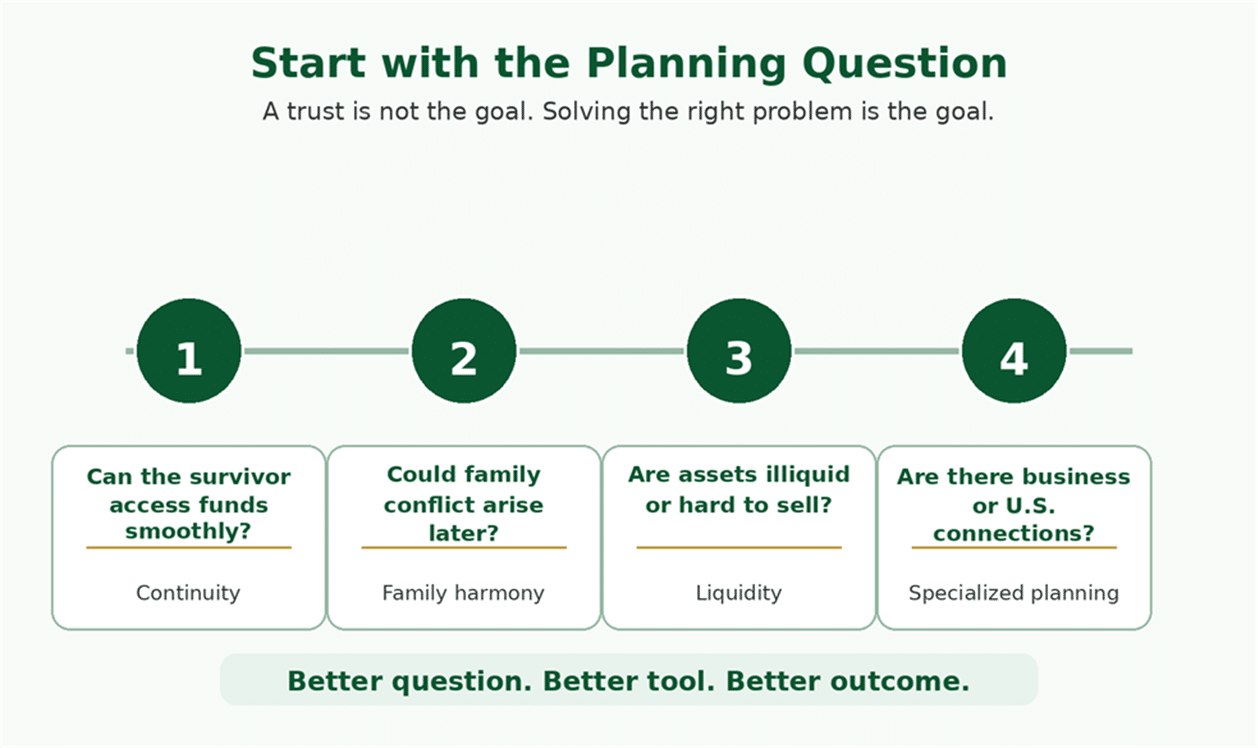
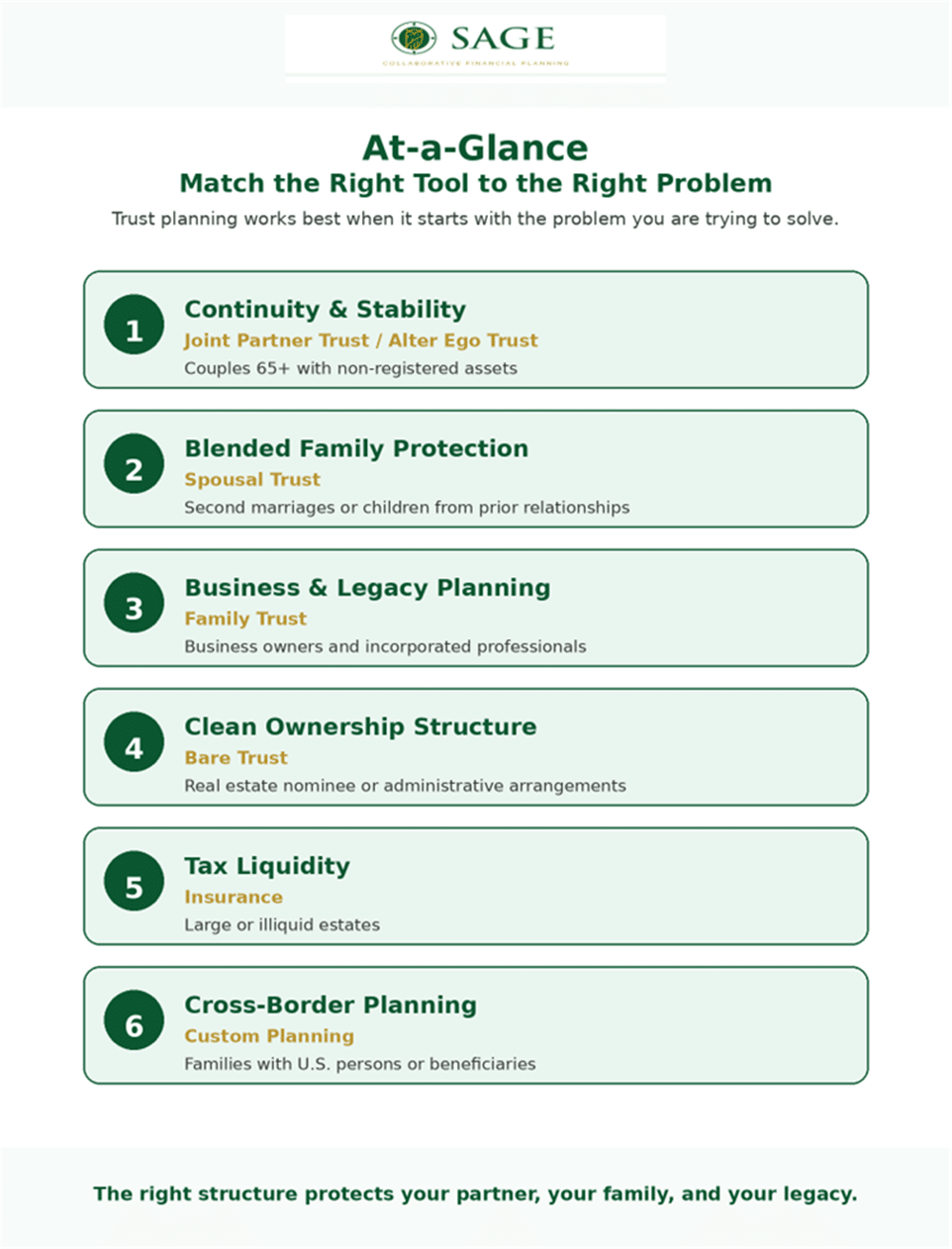
At-a-Glance: Matching the Right Tool to the Right Problem
The best trust strategy starts with a clear planning question. Different structures solve different problems, and the right answer depends on the couple’s assets, ages, family dynamics, tax exposure, and long-term goals.
| Planning note: The examples below are simplified for education. Trust planning is highly fact-specific and should be reviewed with qualified tax and legal professionals before implementation. |
1. When the Goal Is Lifetime Continuity: Joint Partner Trusts
A Joint Partner Trust (JPT) can be one of the most effective tools for couples—when structured correctly.
For couples where the person creating and transferring assets into the trust—the settlor—is age 65 or older, a Joint Partner Trust may allow qualifying assets to move into the trust on a tax-deferred basis, while both spouses retain access to the income during their lifetimes.
Why couples consider it
- Continuity: The trust can continue if one spouse becomes incapacitated or dies.
- Access: Both spouses can receive income during their lifetimes.
- Estate efficiency: Assets properly held in the trust may reduce probate exposure.
- Privacy: Assets passing through the trust are generally more private than assets that pass through a probated estate.
| Planning note: It is not automatically required that both spouses be age 65. What matters is who owns the assets, who settles the trust, and whether the rollover rules and trust terms are satisfied. |
| Real-Life Scenario: Robert & Elena The situation: Robert is 71 and holds a significant non-registered investment portfolio in his name. His wife, Elena, is 62. Robert is concerned about Elena’s financial security if his health declines and wants to reduce administrative delays later. The solution: Robert works with his legal and tax advisors to establish a Joint Partner Trust and transfer qualifying assets into it on a tax-deferred basis. The outcome: When Robert later suffers a stroke, the trust structure and successor trustee provisions help keep asset management and income payments organized. The plan is designed to support Elena without relying solely on court-supervised estate administration or a last-minute scramble. |
2. When One Spouse Needs Their Own Structure: Alter Ego Trusts
An Alter Ego Trust is similar in tax treatment but structurally different. It is designed for one individual age 65 or older.
During that individual’s lifetime, the settlor must be entitled to all income, and no one else can receive or use the trust’s income or capital while the settlor is alive.
Where it fits
- One spouse owns most of the assets.
- There is a desire for incapacity planning and continuity.
- A joint structure is not yet possible or not appropriate.
| Planning note: Because only the settlor can benefit during their lifetime, an Alter Ego Trust is not a full couple-based solution. It can, however, serve as a personal structure alongside other estate-planning tools. |
| Real-Life Scenario: Eleanor & David The situation: Eleanor is 68 and inherited a valuable commercial property from her family. She is married to David, but this specific property has always been kept separate. Eleanor wants a smooth management plan if she ever loses capacity, but she is not ready to blend this asset into a joint structure. The solution: Eleanor transfers the property into an Alter Ego Trust after obtaining professional legal and tax advice. The outcome: Eleanor remains the lifetime beneficiary. If she loses capacity, her designated trustee can manage tenants, collect rent, and support Eleanor’s care. David is not forced into complex property management, and Eleanor’s personal planning intentions remain organized. |
3. When the Goal Is Family Harmony: Spousal Trusts
A Spousal Trust is typically created through a will and comes into effect after death. It is one of the most important tools for blended-family planning.
What it is designed to do
- Support the surviving spouse during their lifetime.
- Preserve the remaining capital for specific beneficiaries, often children from a prior relationship.
Without a trust, assets left outright to a spouse may later be redirected unintentionally, affected by remarriage, or exposed to conflicting family interests. A Spousal Trust helps align two priorities: care for the surviving spouse and protection of the original inheritance plan.
| Real-Life Scenario: Mark, Sarah & the Blended Family The situation: Mark is in a second marriage with Sarah and has two adult children from his first marriage. He wants Sarah to be financially secure if he dies first, but he also wants his children to ultimately receive the inheritance he intended for them. The solution: Mark’s will creates a testamentary Spousal Trust. The trust terms provide support for Sarah during her lifetime and direct the remaining capital to Mark’s children after Sarah’s death. The outcome: Sarah receives support, and Mark’s inheritance plan remains clearer for his children. The structure does not eliminate every possible disagreement, but it can greatly reduce ambiguity and future family conflict. |
4. When the Goal Is Long-Term Legacy or Business Planning: Family Trusts
Family trusts are among the most flexible tools in Canadian planning, but they are also among the most complex.
Where they help
- Succession planning: Shifting future growth to the next generation.
- Estate freezes: Locking in current value while transferring future upside.
- Tax planning: Potential access to the Lifetime Capital Gains Exemption (LCGE), where available and properly structured.
| Planning note: Family trusts are not automatic asset-protection shields. Their effectiveness depends on proper structuring, timing, trustee decisions, compliance, and the family’s broader legal and tax context. |
The 21-year rule
Most trusts are deemed to dispose of their assets at fair market value every 21 years. That means the plan should include a long-term strategy for distributing, reorganizing, or otherwise managing trust assets before the deemed disposition date.
| Real-Life Scenario: The Patel Family Business The situation: Amit owns a growing Canadian manufacturing company. He wants to lock in the current value of his shares, allow future growth to accrue for the next generation, and maintain appropriate control while he remains active in the business. The solution: Amit completes an estate freeze with professional advisors. He exchanges his common shares for fixed-value preferred shares, and a newly formed Family Trust subscribes for new common shares representing future growth. The outcome: If the company grows and the structure remains compliant, future growth may benefit the family trust beneficiaries. On a later sale, the family may be able to access available tax planning opportunities, including the LCGE where the rules are met. |
5. When the Goal Is Clean Ownership: Bare Trusts
A Bare Trust is not really a tax strategy. It is an administrative arrangement. The trustee holds legal title, but has no discretion and acts only on instructions from the beneficial owner.
Key points
- There are no automatic tax advantages.
- Income and gains are generally reported by the beneficial owner.
- Bare trusts are commonly used in real estate nominee or administrative ownership arrangements.
Updated reporting reality
- Bare trusts are not required to file T3 returns for the 2024 and 2025 taxation years, unless the CRA requests it.
- Certain bare trusts may become reportable again for taxation years ending in 2026 and later years, depending on enacted rules and CRA guidance.
| Real-Life Scenario: Chloe & Her Parents The situation: Chloe is buying her first condo and needs her parents to co-sign the mortgage. The lender requires the parents to appear on title, but everyone agrees Chloe is the true beneficial owner: she pays the mortgage, the property taxes, and keeps the equity. The solution: They document the arrangement with a Bare Trust agreement showing the parents hold legal title as nominees and Chloe remains the beneficial owner. The outcome: The agreement helps clarify ownership for future legal, tax, and family discussions. It does not create a tax benefit by itself, but it can help avoid confusion about who actually owns the property. |
6. When the Goal Is Liquidity: Insurance Used Carefully
One of the largest risks in Canadian estate planning is the final tax bill. At death, certain assets may be treated as if they were sold, including investment portfolios, rental properties, cottages, and private company shares.
This can create a significant tax liability at a difficult time.
Where insurance fits
Insurance does not eliminate tax. Its role is to provide liquidity—cash available when tax is due.
When it may make sense
- The estate is large and illiquid, such as land, a cottage, or a private business.
- Assets cannot easily be sold, or the family wants to keep them.
- The projected tax exposure is clear enough to justify premiums and policy design.
| Real-Life Scenario: The Laurent Family Cottage The situation: Jean-Pierre and Monique own a cherished family cottage that has grown substantially in value. Their children love the property, but they may not have enough cash to pay the tax triggered when the second spouse dies. The solution: The couple reviews a Joint Second-to-Die life insurance policy with their advisors. The policy is sized to help fund the expected tax liability and related estate costs. The outcome: When the second spouse passes away, the insurance proceeds can provide cash to help settle taxes. This may allow the family to keep the cottage instead of being forced to sell it quickly or at the wrong time. |
Cross-Border Warning: U.S. Connections
| Planning note: If you, your spouse, your children, or your beneficiaries are U.S. citizens, green card holders, or otherwise U.S.-connected, standard Canadian trust planning can create significant U.S. tax reporting, penalty, and passive foreign investment company (PFIC) issues. Cross-border situations require specialized advice before implementing any trust structure. |
What a Coordinated Plan Looks Like
For many couples, no single tool is enough. A well-designed approach may combine several planning elements so the family’s legal documents, investment accounts, tax strategy, and liquidity planning all work together.
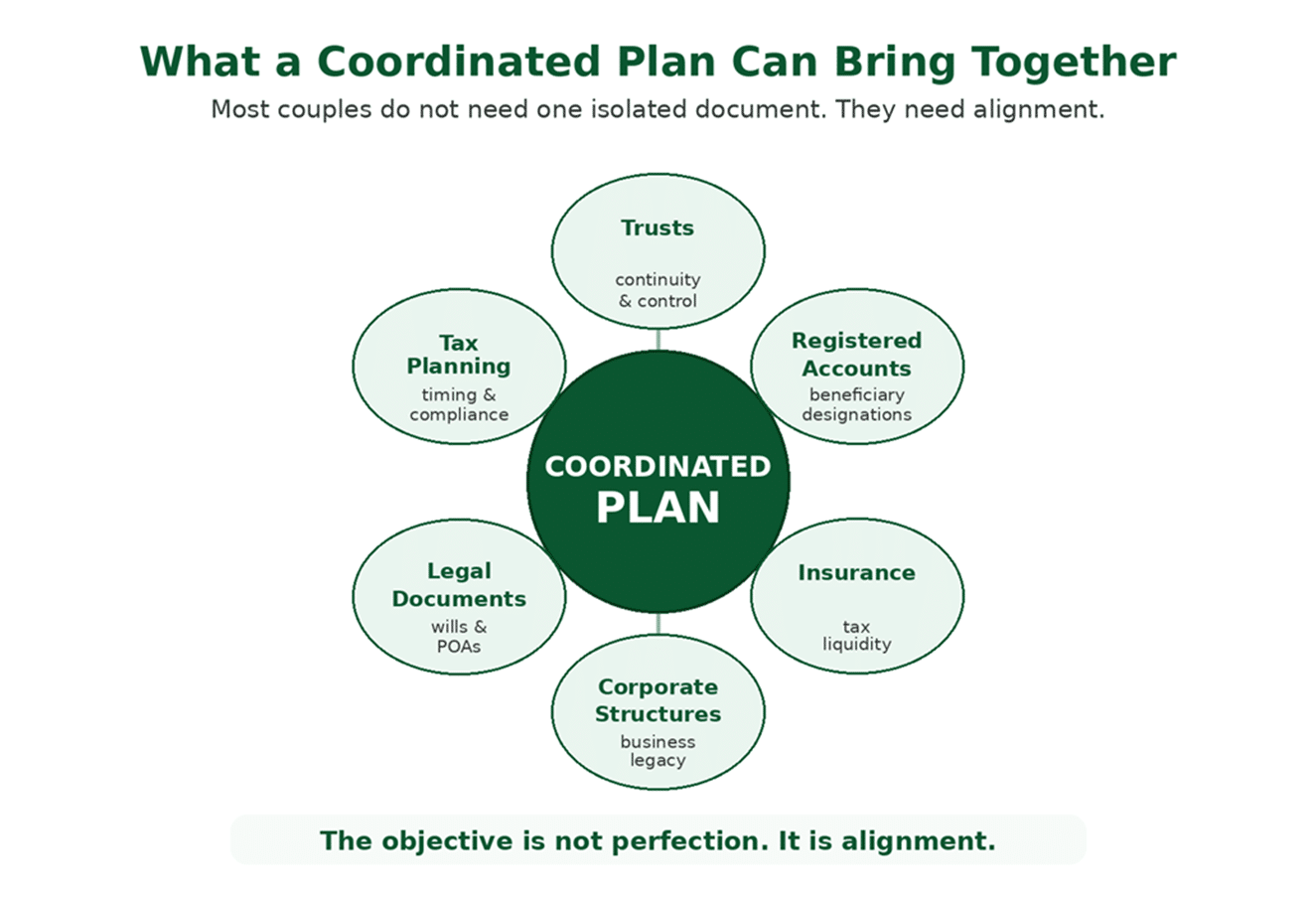
The objective is not perfection. It is alignment.
Final Thoughts
Trust planning is not really about documents. It is about protecting the life two people built together.
Done well, it gives a surviving spouse continuity instead of confusion, gives children clarity instead of conflict, and provides a family with structure, privacy, and peace of mind.
A well-designed plan does not make life more complicated. It makes the future more secure.
The Ultimate Act of Protection
At the end of the day, this level of planning is not about making life more complicated. It is about creating stability, protecting what you have built from unnecessary tax exposure, and creating peace of mind.
When we strip away the legal terminology and CRA guidelines, trust planning is rarely about the money itself. It is about what that money represents: a lifetime of shared sacrifices and the quiet promises you made to each other.
It is an act of love to make sure that if the unexpected happens, your partner does not have to navigate financial chaos while mourning a loss. It is also a gift to your children to leave them a legacy of family harmony rather than avoidable administrative confusion.
True wealth is not just what you gather. It is the security you cultivate for the people who matter most.
Before implementation, confirm
- Who owns each asset and whether the asset should be moved, designated, insured, or left alone.
- Who will act as trustee, alternate trustee, executor, attorney, and decision-maker if capacity changes.
- Whether the intended rollover, probate, liquidity, and tax outcomes are actually available in the facts.
- Whether registered accounts, beneficiary designations, insurance ownership, corporate structures, and wills all align.
- Whether any spouse, child, beneficiary, or trustee has U.S. or other cross-border connections.
| Disclaimer This article is for general educational purposes only and should not be treated as tax, legal, accounting, insurance, or investment advice. Canadian trust laws and tax compliance requirements are precise, and each plan must be tailored to the couple’s balance sheet, ages, family structure, residency, and objectives. Always review your situation with qualified Canadian tax, legal, accounting, insurance, and financial professionals before implementation. |
— Sabiha
Meet Sabiha Mukadam
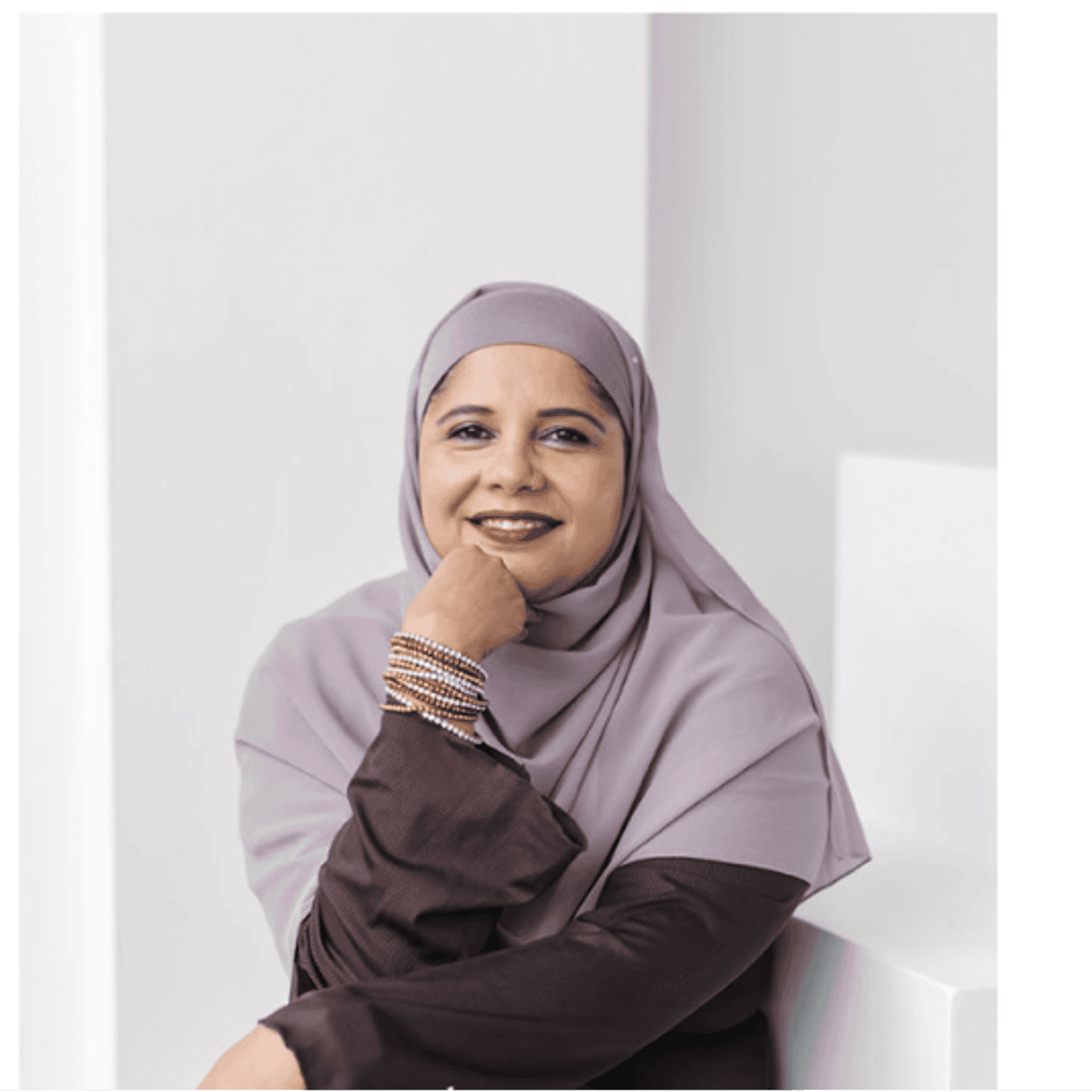
Sabiha Mukadam is a Senior Planner with Ed Rempel and Sage Collaborative Financial Planning, where she supports Full-Service clients in achieving their plans by reviewing financial strategies and guiding thoughtful decisions over time.
She and Ed have worked together for eight years, sharing a philosophy of long-term thinking, practical strategies, and real-life decisions people can follow. Through Advice from the Sage Owl and Youth Corner, Sabiha helps people build clarity, confidence, and a stronger understanding of the behavioural side of financial planning.