

Don’t Let Today’s Headlines Wreck Your Retirement
Gas prices are up from about $1.30/litre to $1.75/litre across Canada this year.
There is conflict in Iran. Markets are reacting to geopolitical uncertainty once again.
So what should investors actually do during times like this?
Should you move more conservative?
Or is reacting emotionally what hurts investors most?
In my latest video, podcast episode and blog post you’ll learn:
- If you go conservative, when do you buy back in?
- Does politics affect the markets much?
- When will a year not be an “uncertain time”?
- Does market timing work? What do studies say?
- What is the “Go Kart Strategy” of investing?
- The one way to time the market effectively.
- The good news and bad news of planning for retirement.
- What is the one thing most investors get wrong?
- Why you need to keep your foot on the gas to get the long-term market returns.
- What is Ed’s personal strategy?
If you go conservative, when do you buy back in?
- Going more conservative now based on news events is trying to time the market.
- If you sell because of some event, then you can only be ahead if you buy in at a lower point. What is your plan to buy in at a lower point – when things look worse?
- Investors tend to sell when the trend is bad and buy back in when the trend is good, but that is usually when the market is at least 10-20% higher.
- You have to guess right twice – when you sell and when you buy back in.
Does politics affect the markets much?
- Numerous studies and long-term historical analyses from firms like Capital Group, T. Rowe Price, CFRA Research, and academic papers consistently show that politics has only minor and temporary effects on the stock market. Short-term volatility rises around elections due to uncertainty, but long-term returns are driven far more by economic fundamentals (corporate earnings, interest rates, growth) than by politics.
- Markets have delivered strong positive returns across every type of political environment.
- News is also increasingly unreliable. News media have found they get more viewers by telling one-sided stories and exaggerating to create fear than they do by having unbiased news.
- A Gallup poll released on October 2, 2025, found that only 28% of Americans say they have a “great deal” or “fair amount” of trust in the mass media (newspapers, television, and radio) “to report the news fully, accurately, and fairly.”
- Investing based on politics or news is not an effective way to invest.
When will a year not be an “uncertain time”?
- One of my pet peeves is the expression in many news stories – “We are in uncertain times.”
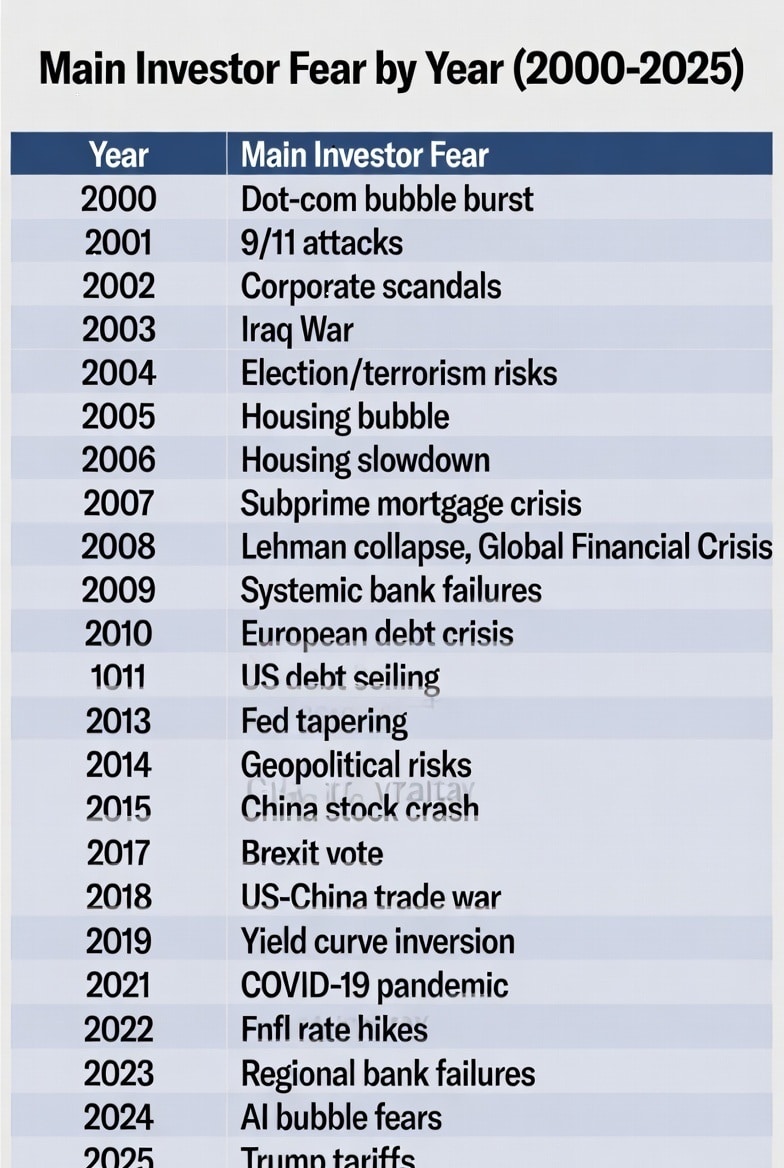
- When are times NOT uncertain?? Every year will always be an uncertain time!
- In 2026, we have gas prices and a war. Here are the issues from every past year this century:
Does market timing work? What do studies say?
- Studies across academia, investment firms (Vanguard, Morningstar, JPMorgan), and behavioral research (DALBAR) consistently show that market timing—trying to predict and act on short-term market moves—rarely works and typically reduces long-term returns compared to a simple buy-and-hold strategy.
- The core reasons are behavioral biases (buying high/selling low), the difficulty of being consistently right twice (on exit and re-entry), and transaction costs/taxes.
- You need unrealistically high accuracy: Nobel laureate William Sharpe’s landmark 1975 study (“Likely Gains from Market Timing”) found that a market timer must be correct ~74% of the time (right direction and on bull vs. bear periods) just to match the market after costs—far higher than random chance (50%).
- Individual investors “guess right” on market direction only about half the time (per DALBAR’s Guess Right Ratio), but the dollar impact of bad guesses far outweighs good ones.
- DALBAR’s Quantitative Analysis of Investor Behavior (QAIB) reports (tracking actual investor cash flows since 1994): Average equity investors lag the S&P 500 by 1–5%+ per year over 10–30-year periods due to poor timing. Example: With rolling 20-year periods, investors earned ~5.5% annualized vs. S&P 500 ~9.9%.
- For example, March, 2009 was the bottom of the Great Financial Crisis after a decline of about 45%. That month also broke a record with $20-30 billion in net redemptions of stocks. Investors sold massively at the bottom – the worst possible time!
- Morningstar “Mind the Gap” studies (latest 2025): Over 10 years, the average dollar invested in U.S. funds or ETFs earned ~1.2%/year less than the funds themselves (e.g., 7% investor return vs. 8.2% total return). This “behavior gap” equals ~15% of the potential return lost to timing.
- Bottom line: Buy-and-hold investors usually outperform those that try to time the market – by a lot!
- The saying is true: “Time in the market beats timing the market.”
What is the “Go Kart Strategy” of investing?
- I recently went Go Karting on a family cruise. Lots of fun with nephews, nieces & their kids.
- How do you get the best lap time with Go Karts? Keep your foot on the gas at full speed the entire time. Works everywhere except the sharpest curves.
- What should you do before the sharp curves? I used to think I should slow down by coasting before the curve and then cut the corner as close as possible. However, it took a couple seconds to get back to full speed after the curve.
- Then I found a faster way. Keep my foot fully on the gas the entire time, but pump the brake just briefly before the curve so I slow down but the engine stays revved to the max. Take the curve wider to get around the curve without skidding. Then hit the speed boost as soon as I start coming out of the curve.
- The secret is to focus on maximizing speed coming out of the curve, not on slowing down before the curve. Keeping the engine revved high and hitting the speed burst can mean one second after the curve I’m going faster than before the curve.
- Investing is similar. Investors tend to focus on how much to slow down before or during an event, instead of focusing on how to maximize the growth coming out of it.
- I call investing this way the “Go Kart Strategy”. Keep your foot fully on the gas the entire time and focus on maximizing the growth coming out of any market downturn.
The one way to time the market effectively.
- Trying to guess a high point in market is very difficult because most years are up. Large gain years are mostly followed by another gain. Gains are very common. About 75% of years are up.
- The one reliable market timing method is that large declines in the broad markets have always recovered. Large losses are rare. There have been only 4 years in the last 90 that the S&P500 was down more than 20%. Large losses have been only 5% of the time.
- Our “Market Timing Rule of Thumb”: Whenever the market is down 20+%, look for creative ways to find more money to invest.
- This is the one method I have found to work reliably. Getting this one right alone can mean you outperform the markets.
The good news and bad news of planning for retirement
- From writing thousands of Financial Plans, we see the good news and the bad news.
- Bad news: It takes more money to retire comfortably than you think.
- Good news: You can get there more easily than you think.
- For example, if you want to retire on $100,000/year, let’s say the government pensions will give you $20,000, so you need $80,000/year from your investments.
- To estimate how much you need, the “4% Rule” is a good estimate. I found in my detailed study about it that the amount you can reliably withdraw from your investments and increase by inflation for 30+ years is:
o Equity investments 4%/year
o Balanced investments 3.5%/year
o Fixed income 2.5%/year
- Withdrawing 4%/year to give you $80,000/year plus inflation means you need $2 million in investments to retire, if you are high in equities.
- With more conservative investments, you need more than $2 million.
- $2 million is probably more than you thought. That is not a lavish retirement, but you need to be a multi-millionaire to afford it!
- The good news is that you can get to $2 million by investing only $1,500/month for 30 years. That is $18,000/year, which is about your RRSP room if you earn $100,000/year.
- In other words, in most cases, just maximizing your RRSP and possibly TFSA for 30 years is often enough to retire with the lifestyle you want.
- That is probably easier than you thought.
- But you need to average the long-term return of the markets.
What is the one thing most investors get wrong?
- To have the future life you want, you need to get the rate of return in your Financial Plan as a long-term average. If that is based on an equity return, you need to be fully in equities on average through your life – not just most of the time.
- You need to keep your foot on the gas to get the long-term returns of the markets.
- Your Financial Plan is based on the long-term average return. If you are not fully invested for long-term growth all or nearly all the time, you are likely to fall short.
- The one thing most investors get wrong is that they want to get the full return of equities, so they buy index ETFs, but they buy several ETFs including some with lower expected returns, which means they don’t end up with the full return of equities. Or they are not confident in the long-term return of equities, so they add fixed income or gold or something defensive, which drags down their returns.
- For example, if you invest in equities for 30 years but switch to fixed income or gold every 5th year because of some event, you are highly likely to get lower returns. Or you hold 20% fixed income or gold or other defensive investment all the time. Your long-term average return with either of these methods is expected to be about 7%/year, instead of 8%/year for the market conservatively.
- Your retirement portfolio and retirement income end up 17% lower for life because you were not fully in equities for growth the entire time.
What is Ed’s personal strategy?
- Personally, I use my Go Kart Strategy.
- I have been 100% invested for growth for all of the last 35 years. I have owned no fixed income or defensive investments at any time – and I am quite sure I never will.
- I am standing on the gas pedal all the time.
- Plus, whenever the market is down 20% or more, I look for a creative way to take advantage of it. Do my annual investment sooner, or find extra cash to invest, or increase my leverage.
- If I can get more money into the market after a decline, then my personal return will be higher than the return of the investments themselves. Easy way to outperform!
Ed
Planning With Ed

Ed Rempel has helped thousands of Canadians become financially secure. He is a fee-for-service financial planner, tax accountant, expert in many tax & investment strategies, and a popular and passionate blogger.
Ed has a unique understanding of how to be successful financially based on extensive real-life experience, having written nearly 1,000 comprehensive personal financial plans.
The “Planning with Ed” experience is about your life, not just money. Your Financial Plan is the GPS for your life.
Get your plan! Become financially secure and free to live the life you want.
Hi Ed,
I recently listened to your discussion regarding remaining 100% invested in equities throughout retirement, and I found your “Go Kart Strategy” perspective very compelling.
I was curious to get your thoughts on a slightly modified approach for retirees who are no longer earning employment income.
For example, suppose a retiree has approximately a $3 million portfolio and maintains a relatively small allocation (perhaps 7–8%) in short-term bonds, with the remainder invested in broad equity index ETFs.
The idea would not necessarily be to reduce volatility materially or to market-time, but rather to create a modest liquidity buffer that could potentially be used during major market drawdowns (for example, used for 20%+ declines). During those periods, the retiree could temporarily draw from the short-term bond allocation and portfolio distributions instead of selling equities at depressed prices.
Even if the bond allocation did not fully cover an extended downturn, it could still reduce the amount of equities sold during the worst parts of the decline and potentially help the retiree remain fully invested emotionally and behaviorally.
I also recognize that, mathematically, a 100% equity portfolio should outperform over the long term under ideal conditions. However, real life is not always mathematically perfect, particularly during retirement when there is no ongoing employment income. In that context, I wonder whether a relatively small allocation to short-term bonds may have some practical value despite the modest long-term drag on returns.
For example, would the long-term outcome difference between a retiree remaining 100% invested in equities versus maintaining a 7–10% short-term bond allocation actually be materially significant in practice? Especially if that small bond allocation helps the retiree stay disciplined and avoid selling equities during severe market downturns.
To me, this seems less about market timing and more about maintaining optionality and staying the course during difficult periods.
In some ways, this also seems conceptually similar to the liquidity reserves maintained by institutions or even aspects of Warren Buffett’s philosophy regarding cash reserves and staying invested during periods of market stress.
I would genuinely appreciate your thoughts.
Thank you again for your excellent content.