

Your First Real Paycheque: A Smart Money System for Young Professionals
The Habit That Builds Wealth Not the Amount
A -friendly guide to using your first corporate paycheque with confidence, clarity, and a system that protects your future self.
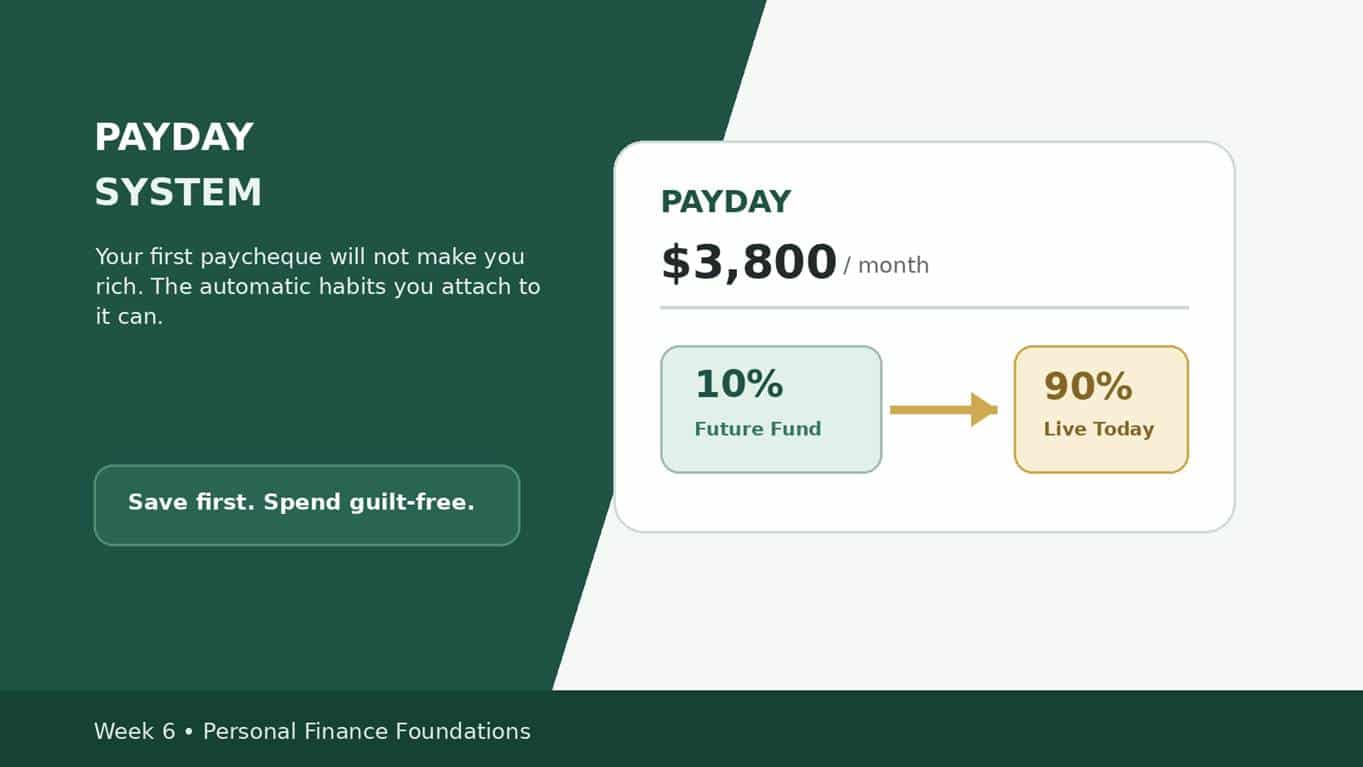
The first paycheque is exciting. The real opportunity is what you automate before lifestyle creep takes over.
Your First Paycheque: What Actually Matters
There is a moment you will never forget. You open your banking app, the screen loads, and there it is: your first real corporate paycheque.
For a second, you feel completely unstoppable. You worked for this. You survived the interviews. You earned this. You are finally stepping into the driver’s seat of your own life.
Then the real-world math hits: rent, groceries, phone bill, Wi-Fi, transportation, maybe a student loan payment. Suddenly, the number that felt big starts to feel smaller.
| The truth no one tells you: Your first pay cheque won’t make you rich. But the automatic habits you attach to it can change your financial trajectory. |
The 10% Rule: A Small Act of Self-Respect
Before you stress over complicated spreadsheets, restrictive budgets, or tracking every single coffee, start with one simple move: save 10% of every paycheque from day one.
- Not when you make more money.
- Not when life finally settles down.
- Not when you finally feel ready.
- Right now.
This is not only about the math. It is about the psychological message you send yourself: “My future matters just as much as my current bills.”
A 10% cut is small enough that you won’t even notice it’s gone, but meaningful enough to create real momentum over time. If 10% is too much at first, start with 5% or even 2% and increase it with each raise. The most important part is starting the habit.
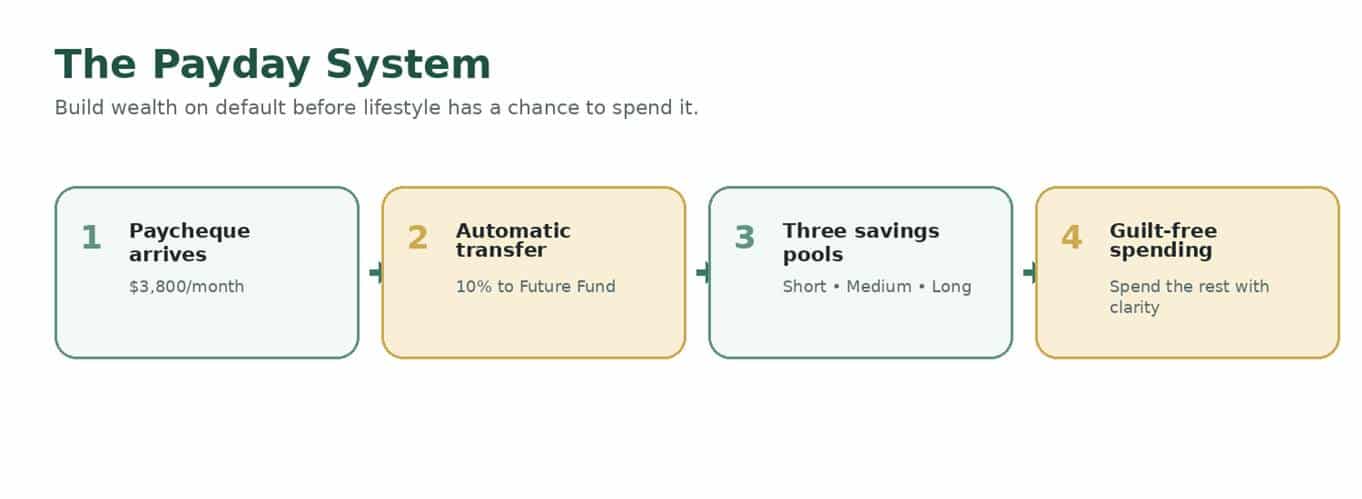
Automating the first 10% turns saving from a monthly decision into a default setting.
Two Paths: Same Income, Different Futures
Let’s look at two people who started at the same starting line.
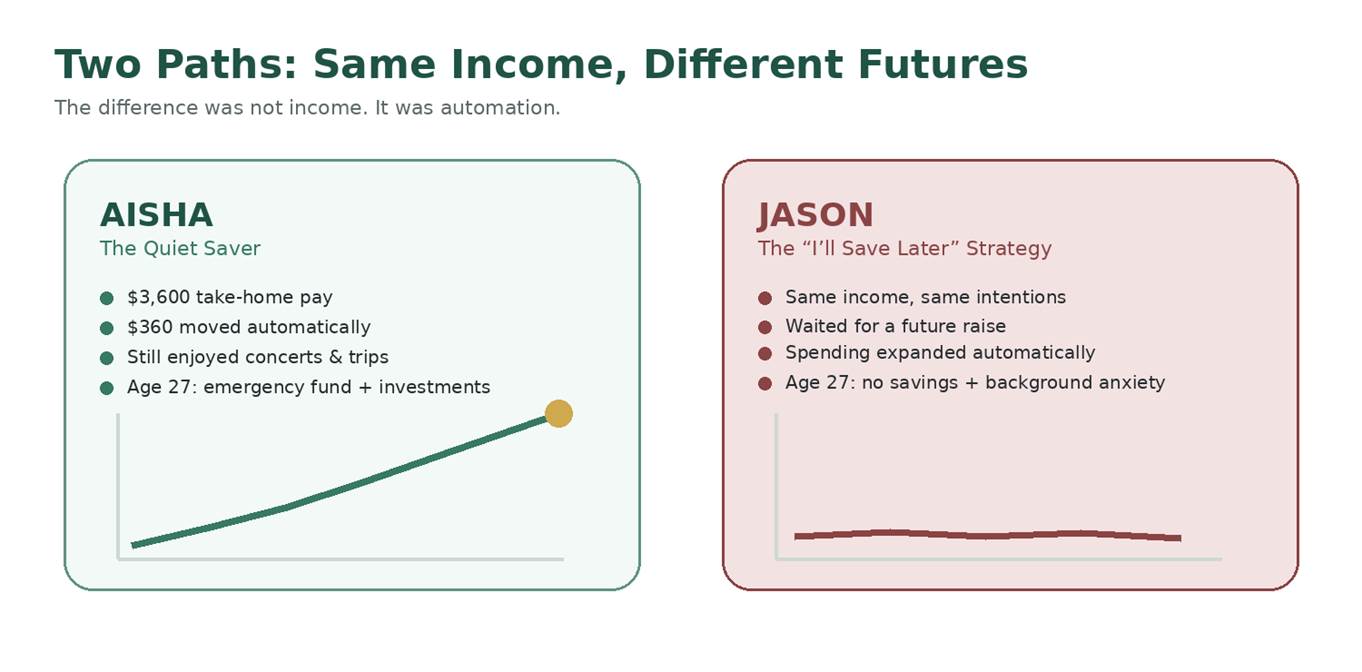
Profile 1: Aisha – The Quiet Saver
- The setup: Aisha gets her first full-time job at 22. Her take-home pay is $3,600 per month.
- The move: She sets up an automatic transfer so $360 moves to a separate savings or investment account the morning her pay hits.
- The lifestyle: She still goes to concerts, travels on long weekends, and orders takeout when it fits her spending plan.
- The result at 27: She has an emergency fund, a growing investment account, and the confidence that she can handle a curveball.
Profile 2: Jason – The “I’ll Save Later” Strategy
- The setup: Jason has the same job, same company, and same $3,600 per month take-home pay.
- The move: He genuinely wants to save, but every month life happens: a weekend trip, a phone upgrade, a nicer apartment, and a few more subscriptions.
- The mindset: He tells himself he will start investing when he gets the next promotion.
- The result at 27: He has no savings, a credit card balance that never quite hits zero, and a background anxiety that he is falling behind.
| The Reality Check: Jason was not reckless. He just fell into the trap of lifestyle creep, where spending grows to absorb every increase in income before that money has a chance to work for him. |
The Real Paycheque Breakdown
Here is an illustrative example for someone earning roughly $70,000 per year and taking home about $3,800 per month after income tax and payroll deductions. Actual take-home pay will vary by province, benefits, pension contributions, and personal tax credits.
| Budget Category | Monthly Amount | What it actually means |
| 10% Future Fund | $380 | Moves automatically on payday. Non-negotiable. |
| Rent / Housing | $1,700 | Often the biggest hurdle. Roommates can change the math. |
| Utilities & Wi-Fi | $200 | Keeping the lights on and the internet fast. |
| Phone Plan | $100 | A realistic Canadian phone-line estimate. |
| Groceries | $450 | Meal-prepping baseline versus constant premium takeout. |
| Transit / Commuting | $250 | Transit pass, gas, insurance, parking, or hybrid commuting costs. |
| Insurance & Subscriptions | $170 | Gym, cloud storage, streaming, insurance, apps, and memberships. |
| Guilt-Free Spending Cash | $550 | Dinners, clothes, events, gifts, and fun – yours to spend with clarity. |
The point is not that every person should use these exact numbers. The point is the order: pay your future self first, then make the remaining money fit your real life.
Where to Put Your 10%: The Three Pools Strategy
Do not leave your 10% sitting in the same chequing account where you spend from. If it sits there, it is too easy to accidentally spend it.
Instead, divide your savings into three pools based on when you will need the money. The timeline matters because short-term money should be kept safer, while long-term money may have more room to grow.
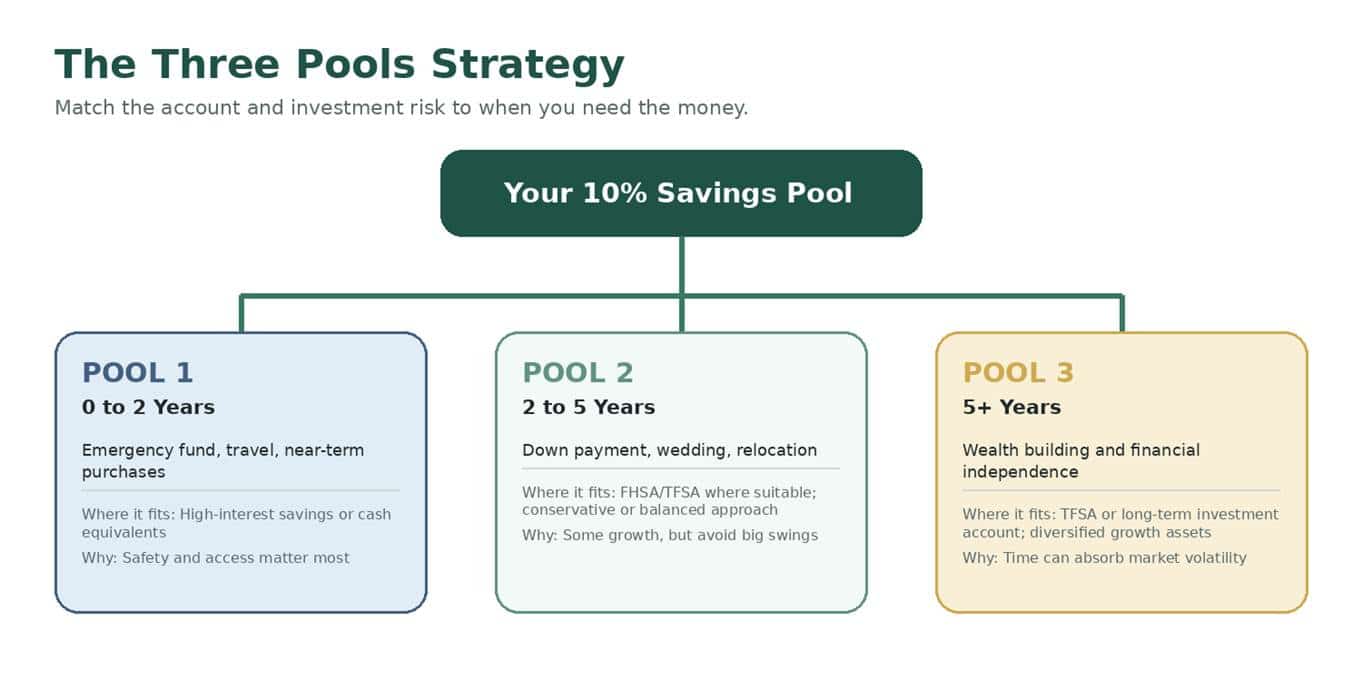
Pool 1: Short-Term Goals – 0 to 2 Years
- Purpose: Emergency fund, sudden travel, moving costs, or near-term purchases.
- Where it fits: High-interest savings or cash-equivalent options.
- Why: You cannot risk the stock market dropping right before you need the money.
Pool 2: Medium-Term Goals – 2 to 5 Years
- Purpose: A down payment, wedding, relocation, or major life transition.
- Where it fits: FHSA if eligible, TFSA where appropriate, and a more conservative or balanced approach.
- Why: You may want growth, but you still need a smoother ride than a full equity portfolio.
Pool 3: Long-Term Goals – 5+ Years
- Purpose: Financial independence, long-term investing, and serious wealth building.
- Where it fits: TFSA, employer retirement plan, RRSP where suitable, or long-term investment account.
- Why: If you do not need the money soon, you may be able to ride out market ups and downs and benefit from compounding.
| Planning Tip If your employer offers retirement matching, review it early. A matching program can be one of the highest-impact benefits available to a new employee. This does not replace advice, but it is worth understanding before you leave free compensation on the table. |
Two Mental Frameworks to Protect Your Cash
1. The 24-Hour Rule for Impulse Buying
To protect your lifestyle cash from quick-tap payments, social media ads, and emotional spending, use the 24-hour rule. See something you love online? Add it to your cart, close the tab, and walk away for 24 hours.
If you still want it tomorrow and it fits your guilt-free spending cash, buy it without shame. You may be surprised how many impulse purchases lose their appeal once the dopamine spike fades.
2. How to Handle a Raise
What happens when you kill it at work and your monthly take-home increases by $300, you have a choice. You can let lifestyle creep absorb the entire raise, or you can split the difference.
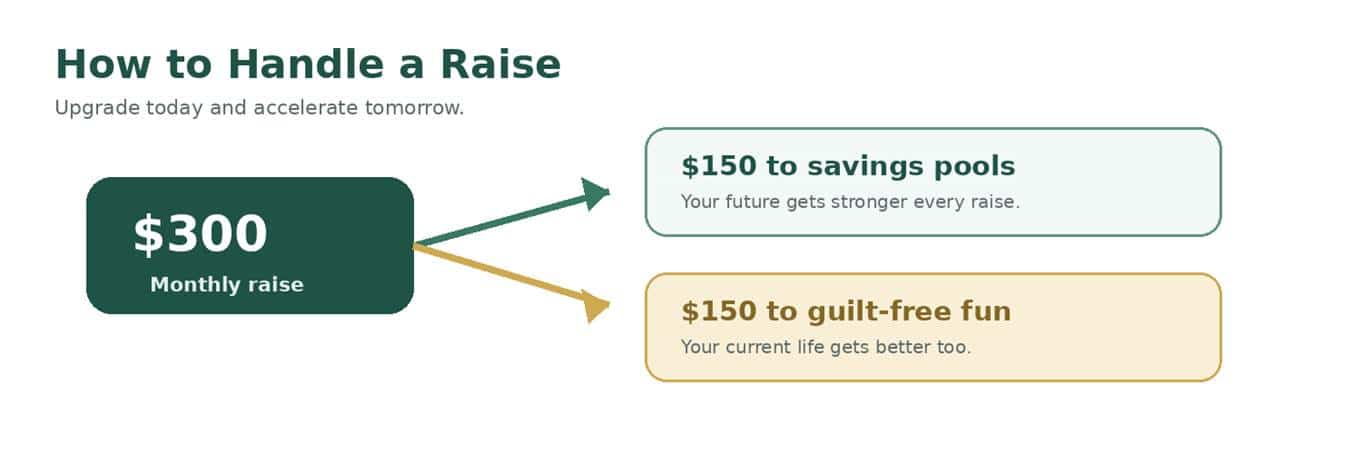
By splitting every raise, you upgrade your current lifestyle and accelerate your future at the same time.
What Actually Matters vs. What Is Hype
| Focus heavily on this | Ignore this entirely |
| Starting immediately: time and compounding matter more than the starting amount. | Overcomplicated paid budgeting apps you will not actually use. |
| Automation: if you must manually move the money every month, you will eventually skip a month. | Massive colour-coded spreadsheets you will abandon in two weeks. |
| Intentional upgrades: nice things are fine when they are chosen on purpose. | Feeling guilty over a small purchase that brings genuine joy. |
| Consistency: repeatable systems beat perfect motivation. | Waiting for the perfect high-paying time to start. |
Your Next Move
Your first real paycheque is not going to buy a house or fund a permanent beach vacation tomorrow. But the psychological muscle you build right now can determine whether you feel financially stressed five years from now or completely in control.
| Your 5-step payday checklist 1. Pick the percentage you can start with – ideally 10%, but any automatic amount counts. 2. Set the transfer to happen on payday before you spend. 3. Split your savings into short-, medium-, and long-term pools. 4. Keep your spending cash guilt-free and intentional. 5. Increase your savings when your income rises. |
You do not need a massive executive salary to build a massive future. You need to protect the first slice of every paycheque, divide it cleanly by timeline, automate the transfers, and let time do the heavy lifting.
Be like Aisha. Give your future self respect, put your wealth on default, and spend the rest completely guilt-free. You earned it.
What’s Next
In the next breakdown, we are replacing old-school budget rules with a cash-flow framework that works for real life. No restriction, no guilt – just a system that lets you spend on the things you love while still getting ahead.
| Let’s hear it In the comment box below let us know What did you spend your very first real paycheque on? Be honest. |
Disclaimer
This article is for general educational purposes only and should not be treated as investment, tax, legal, or personalized financial advice. Investment choices, registered account eligibility, savings rates, and cash-flow priorities depend on your income, province, debt, benefits, goals, and risk tolerance. Speak with a qualified professional before making major financial decisions.
— Sabiha
Planning With Ed

Ed Rempel has helped thousands of Canadians become financially secure. He is a fee-for-service financial planner, tax accountant, expert in many tax & investment strategies, and a popular and passionate blogger.
Ed has a unique understanding of how to be successful financially based on extensive real-life experience, having written nearly 1,000 comprehensive personal financial plans.
The “Planning with Ed” experience is about your life, not just money. Your Financial Plan is the GPS for your life.
Get your plan! Become financially secure and free to live the life you want.