

EntrepreneursBreak article: Ed Rempel on Why Free Markets and the Stock Market Build True Wealth
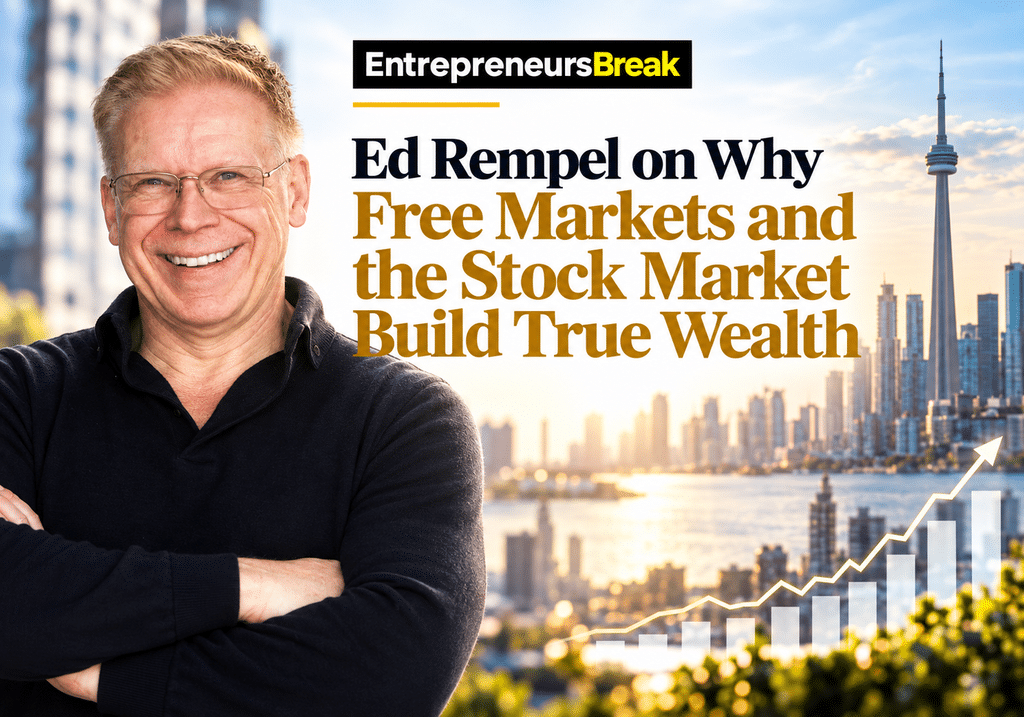
I was recently featured in EntrepreneursBreak discussing why I believe free markets and the stock market have been such powerful drivers of prosperity and long-term wealth.
In the article, I look at:
- Why economic freedom matters for rising living standards
- Some of the biggest myths about capitalism and inequality
- What history tells us about the Great Depression and industrialization
- Why owning businesses and equities has been one of the most effective ways to build wealth
One thing I’ve seen repeatedly after looking at the complete finances of thousands of Canadians: people who build significant wealth usually own productive assets — businesses and stock market investments.
CLICK THE LINK BELOW TO READ THE FULL FEATURE HERE:
Ed Rempel on Why Free Markets and the Stock Market Build True Wealth
For decades, popular narratives have painted free markets and equity investing as engines of inequality and instability. Critics frequently suggest that strict government regulation and heavy intervention are necessary guardians of public prosperity. Toronto-based financial planner and tax accountant Ed Rempel argues that history tells a completely different story.
In a recent analysis of market history, Rempel discusses how economic freedom and open capital markets are the primary drivers of rising global living standards. Far from concentrating wealth among a select few, open markets create the conditions necessary for innovation, higher real wages, and long-term portfolio growth. Most people participate in this growth by owning stocks in their retirement accounts and pensions.
“When people can freely start businesses, invest, trade, hire, and compete without excessive government barriers or favouritism, capital flows to the best ideas, companies create real value, and investors are rewarded with compounding wealth,” says Rempel.
One major obstacle to learning the value of economic freedom is the persistence of economic myths. Modern commentary links societal hardship to free-market mechanisms. Hard data show that past economic surges greatly benefited ordinary citizens.
Critics say the Industrial Revolution and the “robber barons” hurt the working class. History says the opposite. Real wages after inflation more than doubled in Britain between 1840 and 1900. Life expectancy rates climbed during this time. Workers voluntarily left agrarian life for factory towns because industrialization offered better earnings and more economic stability.
Similarly, economic drops are routinely blamed on unchecked capitalism. The Great Depression is regularly framed as a crisis caused by market greed that required massive government help to be fixed. Economic data demonstrates that policy missteps prolonged unemployment and worsened financial pain. Central bank contractions of the money supply and government restrictive trade tariffs and wage rigidities (the New Deal making it far harder to hire employees) turned a normal market downturn into 10 years of very high unemployment and severe hardship.
Rempel points out that when public policy distorts natural market mechanics, systemic problems follow. “From my own experience seeing the full finances of thousands of people, the people with money are usually the ones who invested in stock market equity investments or in their own businesses,” he says.
The link between economic freedom and everyday prosperity extends into modern market dynamics. Concerns around manufacturing declines, income gaps, and corporate dominance often ignore the basic mechanics of productivity and trade. In manufacturing, high output levels are maintained with changing workforce needs. Manufacturing in the US is not “hollowed out”. It is actually at an all-time high. Studies show that most factory job losses over the last 10 years were driven by advances in technology and automation, not international trade. Productivity reduces the cost of everyday goods, giving people of all incomes more purchasing power.
Traditional measurements of income inequality often impact modern living standards. Standard Centrus metrics frequently exclude non-cash government benefits, tax credits, and transfer programs, painting an incomplete picture of household finances. When adjusted for total government transfer benefits and family employment rates, the material gap between income brackets shrinks dramatically. Real inflation-adjusted consumption show the lifestyles of people in lower-income brackets has increased significantly throughout the past several decades. This has helped expand access to quality housing, vehicles, appliances, healthcare, and technology.
When governments try to manage outcomes through excessive price controls, targeted subsidies, or retaliatory trade barriers, the resulting market distortions often harm the consumers and workers those policies were meant to protect. Free enterprise thrives when capital flows naturally to efficient ideas rather than to politically favoured entities.
The stock market is an accessible way for individual investors to engage in free enterprise. Equities help individuals gain a share of innovative companies that build products, create jobs, and solve problems. When businesses operate in environments with low barriers to entry and healthy competition, capital is allocated efficiently toward the most productive ventures. This productivity generates corporate profits, which are then given to individual shareholders through capital appreciation and compounding returns.
Protecting open markets is not merely an abstract political preference. It is a practical prerequisite for long-term wealth. As investors look to secure their financial futures, supporting innovative businesses with equity investments is one of the most reliable strategies for building personal wealth alongside economic growth.
Ed
Planning With Ed

Ed Rempel has helped thousands of Canadians become financially secure. He is a fee-for-service financial planner, tax accountant, expert in many tax & investment strategies, and a popular and passionate blogger.
Ed has a unique understanding of how to be successful financially based on extensive real-life experience, having written nearly 1,000 comprehensive personal financial plans.
The “Planning with Ed” experience is about your life, not just money. Your Financial Plan is the GPS for your life.
Get your plan! Become financially secure and free to live the life you want.