

Why Economic Freedom and the Stock Market Make Us All Richer
As equity investors, we put our money into companies through the stock market because we believe in the power of innovation, competition, and long-term growth.
But for the stock market to deliver strong returns over time, we need economic freedom and free enterprise.
When people can freely start businesses, invest, trade, hire, and compete without excessive government barriers or favoritism, capital flows to the best ideas, companies create real value, and investors are rewarded with compounding wealth.
Without that freedom, markets become distorted, innovation slows, and returns suffer. That’s why defending economic freedom isn’t just good policy – it’s essential for anyone who owns stocks or wants a prosperous future.
Yet stubborn myths keep blaming free markets for problems and pushing more government control. These stories ignore the hard numbers. Here’s the truth about the seven biggest myths, backed by the clearest evidence.
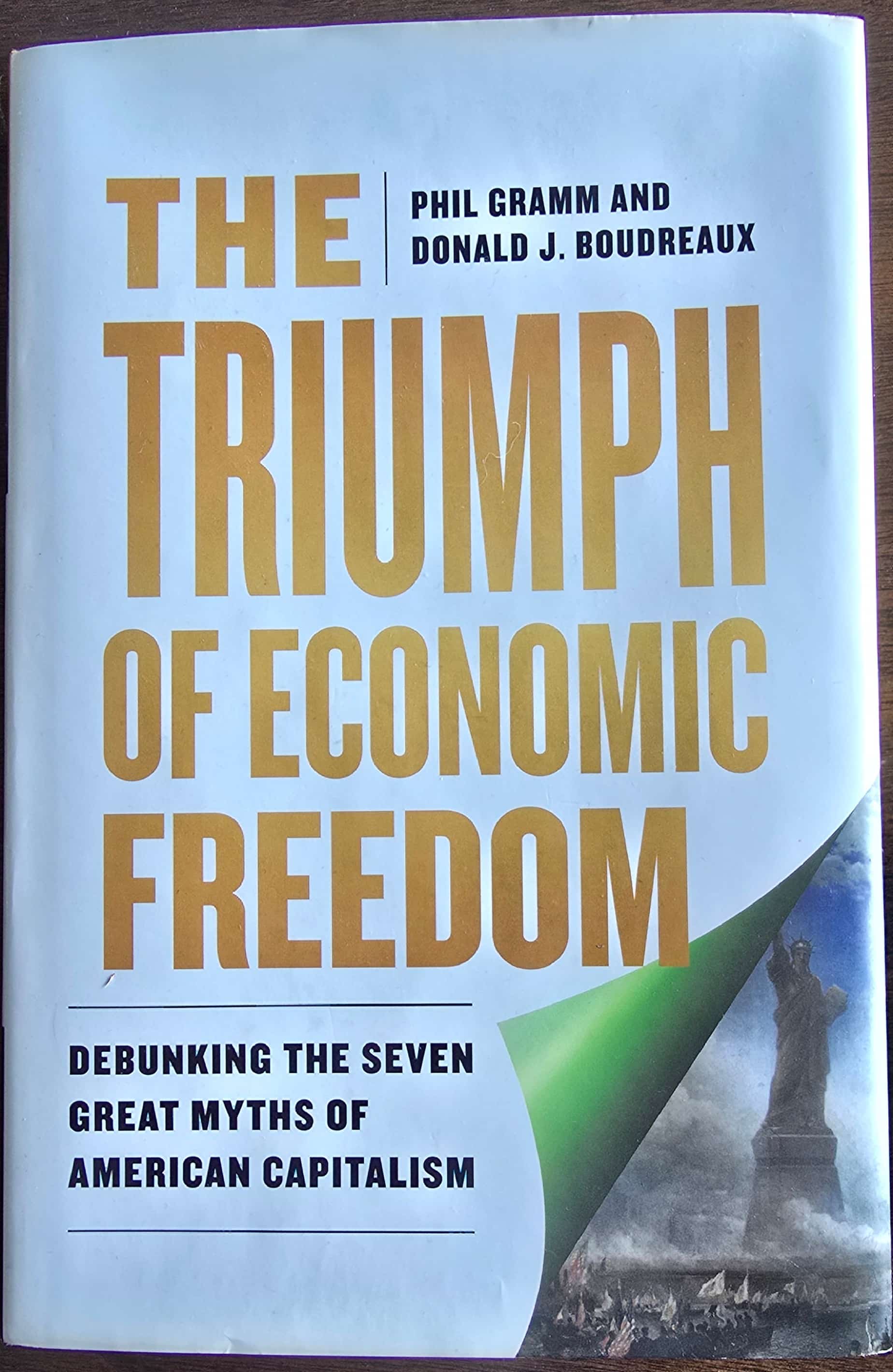
I constantly read books. “The Triumph of Economic Freedom” by Phil Gramm & Donald Boudreaux is a wonderful eyeopener! I believed a couple of these myths.
Read the book to see the evidence is clear.
You will learn:
- Why economic freedom and free enterprise are essential for strong, long-term stock market returns and widespread prosperity.
- How persistent myths blaming free markets for society’s problems distort history and policy.
- The real evidence showing how free markets – not government intervention – have driven the greatest gains in living standards in human history.
- Practical reasons why protecting open markets benefits investors, workers, and families alike.
Myth 1: The Industrial Revolution made workers poorer and more miserable.
People still picture dark factories and ruined lives in the 1800s. The facts say otherwise. Real wages (after inflation) for ordinary workers more than doubled in Britain between 1840 and 1900. Life expectancy jumped (men from about 40 to 48 years, women from 42 to 52). Literacy soared. People chose factory towns over farms because pay and opportunities were better. This was the start of the greatest rise in living standards in human history.
For nearly all of human history before the 1800s, living standards were essentially stagnant. The industrial revolution in the 1800s in Britain and the United States marked the most transformative and historically unprecedented improvement in living standards up to that point – and the foundation for all subsequent gains.
Myth 2: Robber-baron monopolies jacked up prices until antitrust laws saved consumers.
The story claims big oil and steel companies crushed rivals and gouged buyers until the government stepped in. Look at the actual prices. When Standard Oil began in 1870, kerosene cost 26 cents a gallon. By 1885 it had fallen to 8 cents, and by the 1890 Sherman Antitrust Act it was down to just over 7 cents. Steel-rail prices dropped 30% from 1870 to 1880 and then another 53% by 1890. Output in these industries grew faster than the rest of the economy, and prices fell faster than the overall price level. After the regulations hit, many rates (especially rail shipping) actually rose.
Antitrust laws were supposed to prevent monopolies from gouging consumers, but in reality, have mostly been used to protect weaker competitors and keep prices higher, not to deliver lower prices to consumers.
“Based on 90 years of hard evidence that reveals the overwhelming failure of this regulation, a bipartisan consensus was reached … in the 1970s and 1980s to bring that regulatory approach to an end.” It was finally repealed or reformed to focus only on clear harm to consumers.
Myth 3: A stock market crash caused the Great Depression & big government cured it.
Greedy markets crashed the economy; only heavy intervention fixed it. The evidence points the other way. A normal market downturn turned into a catastrophe by policy errors.
The Great Depression was prolonged into a decade of high unemployment primarily by government and central bank policies. The Federal Reserve allowed the money supply to shrink by about one-third between 1929 and 1933 while failing to act as a lender of last resort during bank panics and runs – causing thousands of bank failures and a severe credit crunch. Then, the Smoot-Hawley Tariff Act of 1930 raised tariffs sharply, triggering retaliatory trade barriers worldwide that crushed exports and international commerce. Finally, the New Deal’s interventions—such as wage controls (preventing wage cuts needed for adjustment), pro-union regulations that raised labor costs, and other price/wage rigidities – made it far more expensive and risky for companies to hire workers, discouraging job creation and slowing recovery for years. Unemployment remained extremely high – close to or above 20% for much of the 1930s.
These policy errors caused the longest and deepest depression in U.S. history.
Fed official Ben Bernanke later admitted the truth to Milton Friedman: “Regarding the Great Depression. You’re right, we did it. We’re very sorry. But thanks to you, we won’t do it again.” Tariffs, wage controls, and prolonged interventions created the pain and made it last a decade.
Free markets did not fail – policy errors did.
Myth 4: Free trade hollowed out American manufacturing.
Imports, especially from China, supposedly killed factory jobs and left the country weak. The numbers show manufacturing is still strong. U.S. industrial production capacity sits at all-time highs – well above levels from decades ago. Output has kept rising even as employment shifted. A careful study found that 88% of the manufacturing job losses from 2000 to 2010 came from productivity gains and better technology, not trade. We make more goods with fewer workers because machines and methods have improved.
Consumers enjoyed lower prices, and the country’s manufacturing industry – factories, machines, equipment, and infrastructure – grew dramatically.
Myth 5: Deregulation caused the 2008 financial crisis.
Wall Street ran wild without enough rules. Government policies fueled the fire. Easy money from the Federal Reserve, pressure on banks to make riskier home loans, and the special role of Fannie Mae and Freddie Mac created the housing bubble.
Government mandates on low-income lending rose steadily, requiring 30–40% of loans to be for low/moderate-income borrowers in the early 1990s. In the 2000s, this was pushed to 50–55%+, with tougher subgoals for very low-income borrowers. These quotas, especially via Fannie and Freddie, drove riskier subprime lending.
The crisis was not the result of free markets left alone; it was the result of distorted incentives created by public policy.
Myth 6: Income inequality is exploding under capitalism.
The rich race ahead while everyone else falls behind. Official figures hide the full picture. Census data claim the top 20% earn 16.7 times more than the bottom 20%. However, the official stats ignore 88% of the government programs for the poor. Once you count all government transfers (food stamps, Medicaid, housing aid, tax credits – most of which the Census ignores) and subtract taxes paid, that gap shrinks to about 4 times.
A significant factor in the income difference is that in the bottom 20% of households, only about .3-.5 people per household are working. In the top 20%, on average 2.0 people per household are working.
When poverty is measured properly – counting all government transfers that the official Census largely ignores – the deep or “intense” poverty rate (the kind involving real material hardship) falls to roughly 2–3% of the U.S. population.
The most visible and persistent cases of extreme hardship today, such as chronic homelessness and street poverty, are disproportionately driven by severe mental illness, drug addiction, and related issues (often co-occurring), not widespread material destitution or large traditional slums. Studies consistently show 30–70%+ of the chronically homeless population struggles with these problems, which create barriers to stability even when aid is available. This is very different from the mass urban poverty or shantytowns many people imagine from history or other countries.
Real income after inflation for the bottom fifth, including transfers, has risen roughly 300% since the 1960s, faster than the gains at the top. Consumption and material living standards for the bottom 20% are much closer to middle quintiles than official income numbers suggest.
Markets create wealth that is then shared through both wages and transfers.
Myth 7: Poverty remains stubbornly high because capitalism fails the poor.
Markets leave millions trapped with no way out. Adjusted numbers tell a different story. The official poverty rate hovers around 11–12% because the government refuses to count most of the $2.8 trillion in annual transfer payments as income. Include those benefits and the poverty rate falls to 2–3%. The remaining hard cases are mostly people struggling with addiction or severe mental illness whom the programs cannot easily reach.
Lower-income Americans today have far better housing, cars, appliances, and medical care than previous generations. Economic freedom reduces poverty by creating jobs and lowering the cost of everyday goods.
Free Enterprise Built Our High Living Standards
Every one of these myths collapses under the data. When people can freely invent, invest, trade, and compete, wages rise, prices fall, and ordinary lives improve. The stock market is one of the purest expressions of that system—it lets millions share in the gains.
Government overreach – through bad money policy, protectionism & tariffs, price-raising regulations, or distorted incentives – creates or worsens the very problems it claims to solve. Our comfortable modern lives exist because of economic freedom, not despite it. Protect that freedom, keep markets open, and living standards will keep climbing for the next generation.
Conclusion: Invest in the Future of Freedom
From my own experience seeing the full finances of thousands of people, the people with money are usually the ones that invested in stock market “equity” investments or in their own businesses.
By embracing economic freedom, we create the conditions for innovation, growth, and opportunity. As equity investors, we can all benefit by putting capital to work in the stock market – backing the companies that deliver better products, more jobs, and higher living standards – and participating in their growth. When free enterprise thrives, your portfolio and society both win. Protect that freedom, invest confidently, and help build a more prosperous world for everyone.
Ed
Planning With Ed

Ed Rempel has helped thousands of Canadians become financially secure. He is a fee-for-service financial planner, tax accountant, expert in many tax & investment strategies, and a popular and passionate blogger.
Ed has a unique understanding of how to be successful financially based on extensive real-life experience, having written nearly 1,000 comprehensive personal financial plans.
The “Planning with Ed” experience is about your life, not just money. Your Financial Plan is the GPS for your life.
Get your plan! Become financially secure and free to live the life you want.