

National Post article: Should a couple in their 40s buy or rent in Toronto to afford retirement?
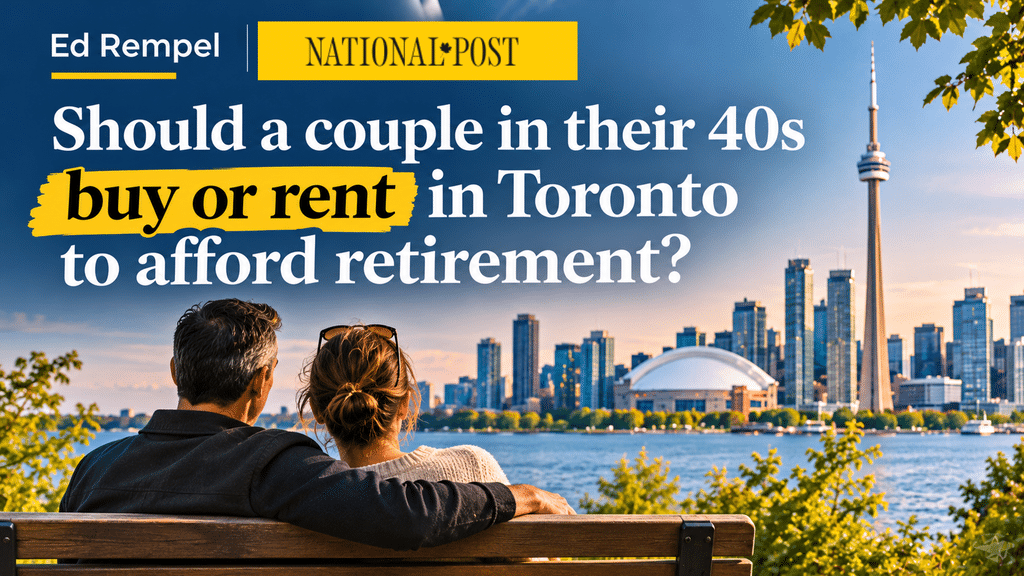
Should you buy a home, keep renting, or invest the difference?
A couple in their 40s recently moved from Calgary to the GTA. They own three rental properties in Calgary and are trying to decide which path will give them the most comfortable retirement.
In my latest National Post financial planning case study, I compare three scenarios:
🏠 Keep their Calgary properties and rent in the GTA.
🏠 Sell all three Calgary properties and buy a home in the GTA.
🏠 Sell one Calgary property and buy a home in the GTA.
The results may surprise you.
One scenario could leave them with a higher net worth, but less retirement income because so much of their wealth is tied up in their home.
I also explain:
- Why the size of your mortgage can dramatically affect a rental property’s return
- When it may make sense to sell real estate and invest in equities
- How Calgary and Toronto real estate have performed over time.
The key question isn’t just how much wealth you can build. It’s how much retirement income that wealth can provide.
CLICK THE LINK BELOW TO READ THE ARTICLE BY MARY TERESA BITTI:
Should a couple in their 40s buy or rent in Toronto to afford retirement?
Tony*, 45, and Rebecca, 43, are recent transplants to Ontario from Alberta. Parents to a preschooler, they moved for their careers and have been renting while they get a better feel for their new home in the Greater Toronto Area.
Rebecca wants to buy, preferring to pay down their own mortgage instead of a landlord’s. Tony wants to rent, given the GTA’s high real estate and home ownership carrying costs. Still, he sees Rebecca’s point. They agree that if they do buy, it will likely be a townhouse in the $700,000 to $800,000 range.
They plan to stay in Ontario at least until they retire, which they’d like to do when they each turn 60. Their target income in retirement is $100,000 before tax. The couple’s current combined income is $210,000 before tax.
If Tony retires in 15 years as planned, he will receive $3,400 a month before tax from a previous employer’s defined benefits pension plan. He will also receive an income stream from his current employer’s defined contribution pension plan, but he’s not sure how much it will be. Rebecca does not have an employer pension plan.
The couple own three self-sustaining rental properties in Calgary – a detached house (which was their primary residence until they moved), a semi-detached house and a two-bedroom condo all carrying mortgages that should be paid off right around when they retire. Combined, the properties have an estimated value of $1,865,000.
The couple are considering three scenarios:
- Keep all three rental properties and continue to rent in the GTA until they retire, anticipating monthly rental fees of about $3,000.
- Sell all of the properties in Calgary and buy a home in the GTA.
- Sell the condo, which hasn’t appreciated as much as the other properties, and buy in the GTA.
What are the pros and cons of each and which scenario will position them well for the future?
Tony and Rebecca have no desire to be landlords in Ontario and plan to open Tax Free Savings Accounts to start building an investment portfolio. They’re focused on growth and are looking into the broad range of Exchange Traded Funds. “I’d like guidance on what to consider, both in terms of ETFs and other investments,” said Tony.
The couple are also looking beyond retirement to ensure they are able to leave an estate for their young daughter. “Selling all of our properties means we lose a significant part of our retirement income. It would also reduce the inheritance we hope to leave our daughter, which would be of tremendous financial benefit to her.”
Financial Plan
Your goal is to retire in 15 years with about $100,000/year before tax in today’s dollars. Your pensions and government pensions, once you are getting all of them when you are age 67 and 65 should total about $152,000/year at that time.
Your desired lifestyle of $100,000/year today is $191,000/year at that time with 3% inflation. Therefore, your rentals will have to clear $40-50,000/year after expenses. You have not provided all the rental expenses, but assume you have the 2 homes in Calgary and both are paid off, they should clear about $80,000/year.
In short, you should have more than enough and may be able to retire with $130,000/year before tax, instead of your goal of $100,000/year.
However, are you sure that will be enough for you and that your figures are accurate?
You make $210,000/year together and are bringing home about $155,000/year now. Your desired lifestyle of $100,000/year is about $85,000/year after tax.
That would be a huge drop in your lifestyle to only a bit over half of your take-home pay today. That is a drop in after-tax lifestyle of about $70,000/year. If your rents get your retired income up to $130,000/year before tax, then your reduced lifestyle would still be close to $50,000/year from your lifestyle today.
With your high incomes now, you have not mentioned any savings or investments (other than the defined contribution pension plan transferred from an employer), which means you are probably spending all your take-home pay today.
You should verify your pension estimates. The defined benefit pension starting at age 60 probably will be reduced by the CPP offset at age 65. It’s not clear how you calculated $2,000/month from your defined contribution pension.
Best choice of your scenarios:
Here are the 3 scenarios we are considering:
· Scenario 1 – Rent in GTA until retirement
· Scenario 2 – Sell all of our properties in Calgary and buy in GTA
· Scenario 3 – Sell one property in Calgary and buy in GTA (likely the condo)
Scenario 1: Rent in GTA until retirement and invest the savings from the cost of owning. Rent in Milton for $3,000/month. Buying a home there for $750,000 with $100,000 down from selling the Calgary condo gives you a $650,000 mortgage. A 25-year mortgage would cost $3,600/month plus property taxes, utilities and maintenance of 1,000-1,500 puts your cost owning close to $5,000/month.
In short, owning that property would cost about $2,000/month more than renting the same property. If you invest that $2,000/month in a conservative balanced investment making 5%/year for 15 years, your investments should be about $530,000. If you invest in equities for more growth, your investments should be about $675,000.
Estimating your retirement income from these investments with the 4% Rule, you should get $21,000/year with balanced investments or $27,000/year with equity investments plus inflation for life.
Scenario 2: Sell all your properties in Calgary and buy in GTA for cash. You would lose the net rent in retirement that should be close to $80,000/year at that time.
Buying your home cash means you won’t have a mortgage here. If you invest the amount of the mortgage payment $3,600/month in conservative balanced investments, you should have $950,000.
If you invest for more growth in equity investments, you should have $1.2 million. With the 4% Rule, you should get $40,000/year with balanced investments or $50,000/year with equity investments plus inflation for life.
With these 2 options, keeping your 2 Calgary rentals appears the better option. Let’s rule out scenario 2.
Scenario 3: Sell the Calgary condo and buy a home in the GTA. Buying a home there for $750,000 with $100,000 down from selling the Calgary condo gives you a $650,000 mortgage. A 25-year mortgage would cost $3,600/month plus property taxes, utilities and maintenance of 1,000-1,500 puts your cost owning close to $5,000/month.
Real estate in the GTA has risen 5-6%/year for the last 30 years, but only just over 3%/year the last 10 years. Growth has slowed down. A $750,000 home today with 3% growth should be worth about $1.2 million in 15 years. The $650,000 mortgage would be down to about $350,000, so you should have equity of about $850,000.
Comparing scenario 1 and scenario 3:
In net worth, scenario 3 is probably better because the $850,000 estimated home equity is more than the $530,000 to $675,000 investments saved with scenario 1.
For retirement income, scenario 1 may be better because the investments can give you a lifetime income of 21,000-27,000/year rising by inflation. Scenario 3 gives you home equity, but no income unless you sell your home.
In short, if you stay in your Milton home in retirement, scenario 1 can give you a more comfortable retirement with income from the investments. But if you sell it and move back into your Calgary home, you will likely have more money to bring back with scenario 3.
Understanding the reasons:
Comparing growth rates does not give you the full story. Real estate growth has been 3-5%/year, mortgage interest is now about 4%, and investments long-term grow conservatively at $5-8%/year. You would think that having investments would be most effective and that paying down a mortgage is better than owing more real estate.
However, the determining factor is leverage. Your properties have large mortgages. Real estate growth is on the full value of the home, not your equity. For example, your home in Calgary should grow at 3-5%/year on the full value of $975,000 even though you only have $397,000 in equity. This means the $397,000 of your money in that home effectively grows at 7-12%/year from the 3-5%/year growth on $975,000.
The lesson: Real estate needs a large mortgage to be a good investment. A rental property with a large mortgage tends to be a good investment. A paid off rental property is usually a low-return and fully taxed investment.
This is why keeping your rentals in scenario 2 beats paying the proceeds down to avoid a mortgage in Milton.
Investments in equities tend to have far higher growth than real estate. For example, for the last 50 years, the Toronto stock market has had 7 times the growth of Toronto real estate. The global stock market has had 13 times the growth of Toronto real estate.
Then why did the investments in scenario 1 work out to less than buying the home in scenario 3? With buying a home, you buy the full value with a mortgage and the full value rises – even if it is slow. The investments in scenario 1 start with zero and are invested monthly. The higher growth rate does not work to your advantage until the amounts get bigger.
This is why scenarios with investments starting at zero and investing monthly tend to be less than keeping a property with a mortgage.
Best recommendations:
You probably have many other possible scenarios. Rather than trying to make up a bunch, here is the thinking behind what other scenarios may provide a more comfortable retirement for you.
1. Become comfortable with equity investments to get a more comfortable retirement. Equity investments have far higher long-term returns than real estate. Your focus has been almost entirely on rental properties. You don’t appear to have saved and invested. It is not clear that the investments in your defined contribution pension are being managed effectively. There would be other scenarios involving equity investments that should provide a more comfortable retirement for you.
Equity investments can save a ton of tax in retirement. You can sell a bit of your investments each month based on the 4% Rule and only pay a small amount of tax based on half the capital gain on the amount you sold. Meanwhile, rent income is fully taxable once the mortgage is low or paid off. This is why a stock market portfolio can give you a much more comfortable retirement after tax.
2. Calgary real estate growth has been almost as high as Toronto. The 30-year average growth rate in Calgary has been 5.1%/year and in Toronto 5.75%/year. The last 10 years, growth has slowed to just over 3%/year in both cities. You are right that condos in Calgary have had far lower growth. Toronto has been more volatile with larger growth and larger declines. For example, Toronto real estate is down about 25% from the peak in early 2022, while Calgary barely declined.
3. Rule of thumb with rental properties: When the mortgage is down to less than half the value of the property, you are usually better off selling the property to invest in equity investments.
For example, your home in Calgary is probably worth keeping, but the semi-detached home is probably better to sell. The property is worth $625,000 growing at the recent growth rate of 3%/year. If you sold, you should clear at least $350,000 that you could invest in equities for 8%/year or more long-term average growth (and less tax).
Ed
Planning With Ed

Ed Rempel has helped thousands of Canadians become financially secure. He is a fee-for-service financial planner, tax accountant, expert in many tax & investment strategies, and a popular and passionate blogger.
Ed has a unique understanding of how to be successful financially based on extensive real-life experience, having written nearly 1,000 comprehensive personal financial plans.
The “Planning with Ed” experience is about your life, not just money. Your Financial Plan is the GPS for your life.
Get your plan! Become financially secure and free to live the life you want.